Canada ends decade-long duties on Chinese photovoltaic products; expert sees positive signal
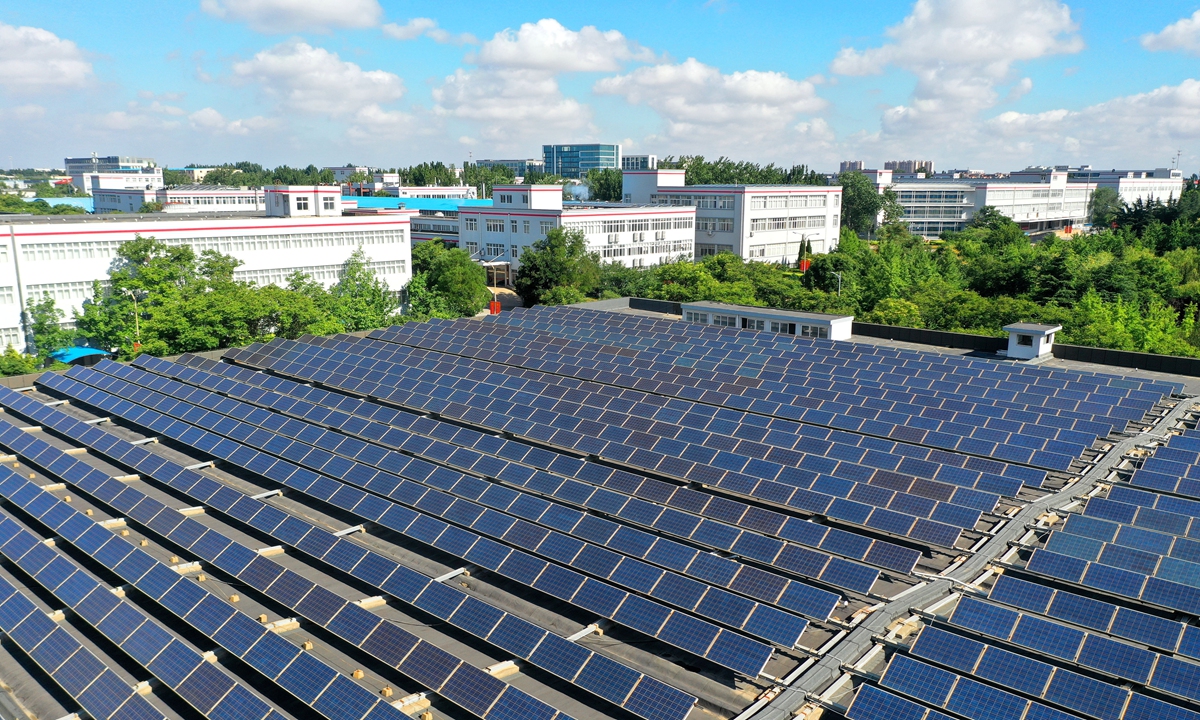
Solar rooftop photovoltaic power generation facilities are seen on a building in Qingdao, East China's Shandong Province, on June 23, 2026. Photo: VCG
Canada has terminated its second expiry review of anti-dumping and countervailing measures on certain photovoltaic (PV) modules and laminates from China, bringing to an end trade remedy measures that were in place for more than a decade, according to an official announcement by the Canadian International Trade Tribunal (CITT).A Chinese expert said that the move reflects a more pragmatic approach by Canada and could help reduce solar development costs while creating a more positive atmosphere for bilateral economic and trade cooperation.
The CITT announced on September 17 (local time) that it had terminated the expiry review of its order made on March 25, 2021, concerning the dumping and subsidizing of certain PV modules and laminates from China.
Accordingly, the tribunal rescinded the order concerning the products, and the Canada Border Services Agency will no longer impose anti-dumping and countervailing duties on them, according to the official announcement.
The latest expiry review was launched on February 2, 2026, to determine whether the expiry of the 2021 order was likely to lead to continued or resumed dumping or subsidizing of the products from China and result in injury to Canada's domestic industry.
According to the CITT, Canada launched anti-dumping and countervailing investigations into Chinese crystalline silicon PV modules and laminates in December 2014 and made affirmative final determinations in 2015. The measures remained in place following the first expiry review launched in 2020, before Canada initiated a second expiry review in February 2026.
Zhou Mi, a senior researcher at the Chinese Academy of International Trade and Economic Cooperation, told the Global Times on Monday that after the measures were in place for more than a decade, Canada's latest decision reflects a more pragmatic response to actual market demand.
Trade protection measures may provide room for domestic industries to develop, but after more than 10 years of such measures, Canada still faces substantial demand for PV products as it expands its clean-energy capacity, Zhou said.
Removing the additional duties will allow Canadian companies and other downstream users to import PV modules and related products from China at lower costs, helping reduce the cost of developing solar power projects, he noted.
"The decision is a sensible choice for Canada," Zhou said. Maintaining additional tariffs does not necessarily strengthen domestic industrial capacity, particularly when domestic supply cannot fully meet market demand, he added.
China has developed a competitive PV manufacturing and supply chain, and greater access to Chinese products could provide Canadian companies with more options while reducing costs associated with the country's renewable-energy development, according to Zhou.
Zhou said that the decision also carries positive implications for China-Canada economic and trade relations. The move shows that Canada is paying greater attention to market concerns and exploring a more pragmatic approach to economic and trade issues, he said.
"It is also a positive signal for the improvement of China-Canada economic and trade relations," Zhou said, adding that concrete moves to reduce unnecessary trade restrictions could help create better conditions for the two countries to discuss further easing trade and investment barriers and strengthening the resilience of bilateral economic ties.
China's exports of PV products, including wafers, cells and modules, reached about $17.18 billion in the first half of 2026, up 24.3 percent year-on-year, according to media reports that cited data from the China Photovoltaic Industry Association.
Wang Bohua, former secretary-general of the association, said in July that Europe remained one of the key markets for Chinese module exports, while demand from Africa had expanded notably. Indonesia became the largest export market for Chinese solar cells in the first half of the year, while India ranked as the largest market for Chinese silicon wafers.
RELATED ARTICLES