BUSINESS / CHINA NEOMAKE
Firms unveil large models, agents at WMC in Hefei as China pushes AI+manufacturing drive
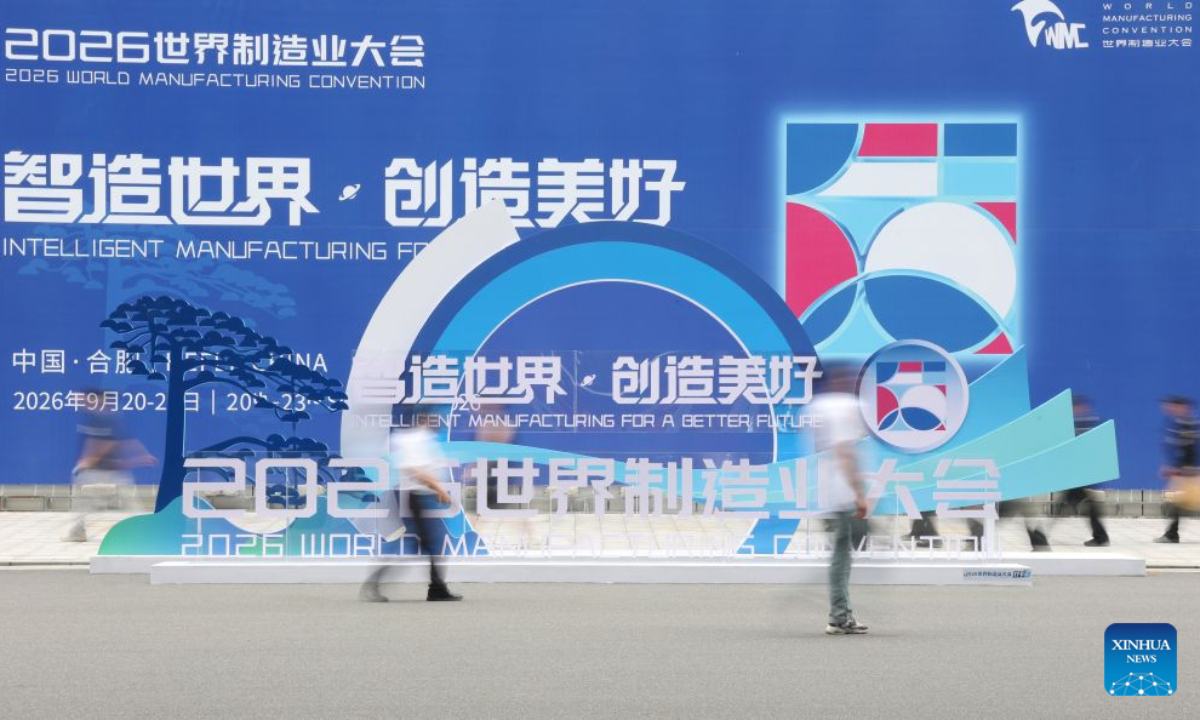
Visitors walk past the logo of the 2026 World Manufacturing Convention (WMC) in Hefei, east China's Anhui Province, Sept. 20, 2026. Themed "Intelligent Manufacturing For a Better Future," the 2026 WMC kicked off here on Sunday. (Xinhua/Chang Nengjia)
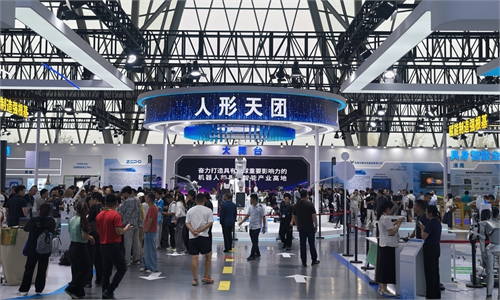
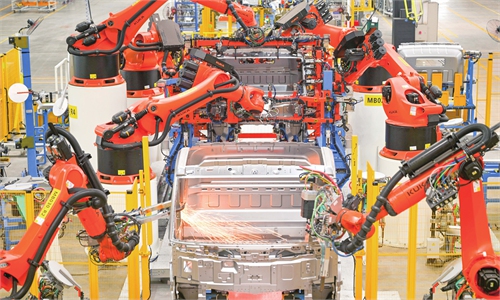
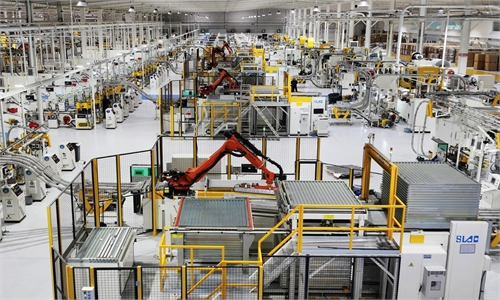
A slew of Chinese companies unveiled their latest industrial artificial intelligence (AI) products at the 2026 World Manufacturing Convention in Hefei, East China's Anhui Province, on Monday. The products are designed to handle real production work rather than just answer questions, as China accelerates its efforts to integrate AI into its vast manufacturing base.At an "AI+manufacturing" session hosted by the Anhui Provincial Department of Industry and Information Technology, the province released a list of nine provincial-level featured industrial large models and 26 featured industrial AI agents, covering the full chain from R&D and production to supply, sales and services.
The Anhui branch of the China Academy of Industrial Internet also released the province's first collection of typical AI+manufacturing application cases, featuring 50 cases spanning 13 industries, including nonferrous metals, automobiles, building materials and high-end equipment.
"Using AI to empower advanced manufacturing is a path we must take and a question we must answer," Pan Feng, an official at the department, told the Global Times on the sidelines of the event. He described the session as "a toolbox, and even more a refueling station" for manufacturers.
"At present, AI is better at 'talking' than 'doing.' But what will truly change China and the world must be the combination of AI with the real economy and real-world demand scenarios, that is, 'doing'," Pan Helin, deputy chairman of the AI System Construction Committee at China Society of Industrial Economics, told the Global Times on Monday.
Pan Helin stated that although enterprises' current exploration of "doing" is a long process, it will certainly be realized in the future. "Once it is achieved, the global competitiveness of China's manufacturing will be further enhanced, and the Chinese economy will gain a new pillar," he said.
From answering to doing
Anhui-headquartered automaker Chery, whose cumulative global sales have topped 20 million vehicles, including more than 6 million exported, presented Chery GPT, an enterprise-level AI platform built on its manufacturing-specific model AutoMind, the Global Times learned at the session.
The platform now covers more than 150 scenarios across R&D, production, supply, sales and services. Employees have created over 5,000 "digital employees" on it, and it completes more than 14,000 real work tasks a day, Luo Rui, head of Chery NEXAI Research Institute, said during the session. "We used to measure AI by how many times it was asked. Now we count how much work it has actually done," he said.
AI's rise is also driving up demand for electricity. Xu Jiajia, president of Ling Yang Industrial Internet Co, backed by iFlytek, noted that many now see energy as the ultimate bottleneck for AI. He cited forecasts that computing centers could consume one-fifth to one-quarter of total US electricity within five years, adding that computing centers in China are also major power consumers.
The company launched version 3.5 of its industrial large model, which turns scattered vertical capabilities into agents capable of autonomous planning and execution. Its time-series foundation model has pushed average electricity-price forecasting accuracy above 85 percent, Xu said.
At the booth of Hefei-headquartered Zetatech, marketing manager Zhang Yu told the Global Times that its Zhexue large model targets yield improvement in semiconductors, photovoltaics and display panels. A chip passes through some 1,500 process steps, each generating an amount of data too vast for manual analysis.
Engineers can now ask in plain language how temperature in a given period has affected a batch's yield. The model can also flag when a tool's yield slips from 99.5 percent to 99.2 percent, prompting maintenance before a line stoppage that can cost millions of yuan.
"Hefei has natural soil for this," Zhang said, noting that many of its benchmark clients are local, such as the chipmaker CXMT and display manufacturer BOE.
These encouraging local level use cases did not emerge in a vacuum. Anhui's strong manufacturing base over recent years has laid solid groundwork for such AI transformation.
During the 14th Five-Year Plan period (2021-25), the operating revenue of Anhui's major industrial enterprises rose from 3.8 trillion yuan to 5.9 trillion yuan, lifting the province from 12th to fifth nationwide, Pan Feng said.
National push
Anhui's efforts mirror a nationwide drive. The Ministry of Industry and Information Technology, the Cyberspace Administration of China and six other departments jointly issued implementation opinions on a special action for "AI+manufacturing," calling for the deep application of three to five general-purpose large models in manufacturing, 1,000 high-level industrial agents, 100 high-quality industrial datasets and 500 typical application scenarios by 2027.
The national special action has cleared obstacles across the entire chain of AI implementation through top-level design and systematically lowered the threshold for enterprises to apply AI, Wang Peng, an associate research fellow at the Beijing Academy of Social Sciences, told the Global Times on Monday.
"China leads the world in AI large model algorithm capabilities, and its huge population and industrial scale correspond to a vast amount of data, meaning China can obtain sufficient data resources," Pan Helin said. Combined with massive investment in the computing power network during the 15th Five-Year Plan period (2026-30), China has significant scale advantages in algorithms, data and computing power, he noted.
The momentum is already showing up in the data. In the first half of 2026, the value-added output of Anhui's major industrial enterprises grew 12.4 percent year-on-year, while that of high-tech manufacturing surged 44.6 percent, according to official figures.
With lightweight models that can be deployed directly on factory equipment breaking the high-cost barrier to AI adoption, AI applications will spread rapidly from leading companies to the vast number of small and medium-sized enterprises (SMEs), and the industry will bid farewell to the single-point pilot stage and enter a period of large-scale adoption, Wang said.
"This transformation will fully unleash productivity gains, drive China's manufacturing sector to shift from factor-driven to innovation-driven growth, and accelerate the leap from 'Made in China' to 'Intelligently Made in China,'" Wang said, adding that it will inject core momentum of new quality productive forces into China's drive to become a manufacturing powerhouse.
RELATED ARTICLES