Beijing to host robotics competition in October, testing real-world capabilities of robots
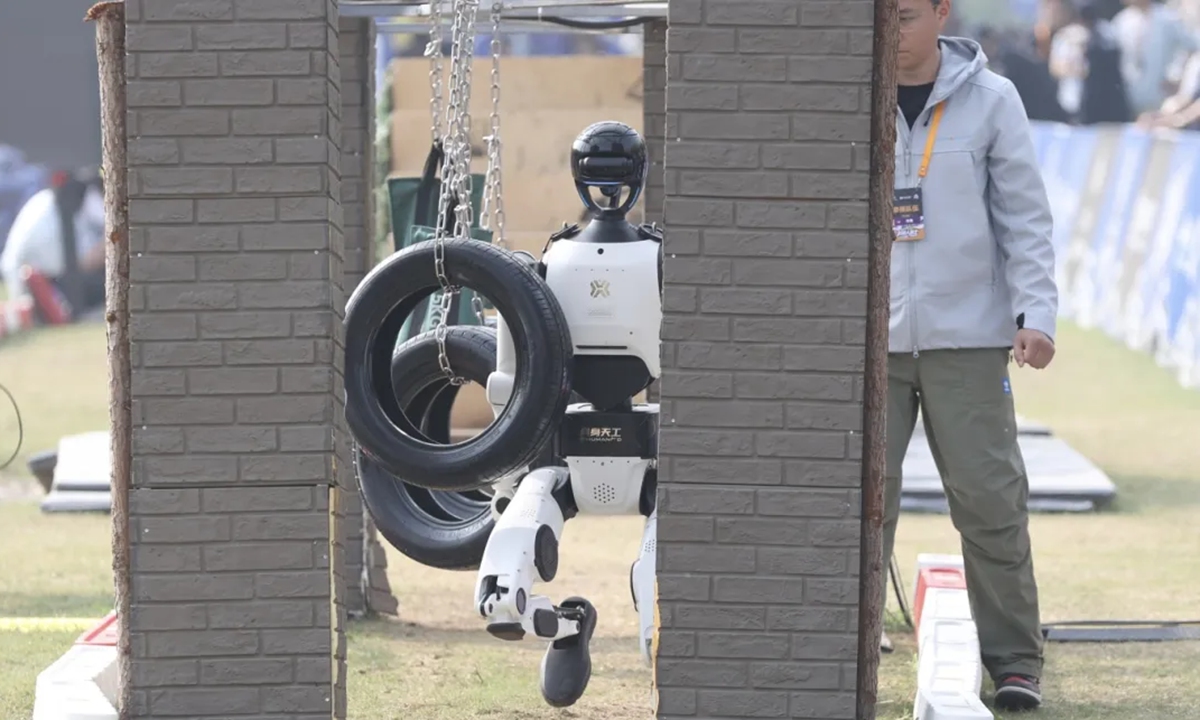
A humanoid robot navigates an obstacle course during the Robot Warrior Challenge in Beijing E-Town in April 2026. Photo: Beijing E-Town's official WeChat account
Beijing will host the 2026 Robot Warrior Challenge Fall Competition on October 17-18, putting humanoid and quadruped robots through simulated disaster rescue and other high-risk tasks in a push to accelerate the development and real-world deployment of robotics technology, according to Beijing E-Town, a major robotics hub in the city.
The competition will feature 14 obstacle challenges covering emergency rescue, industrial inspection and urban management, according to a post seen on Beijing E-Town's WeChat account.
By simulating earthquakes, floods, fires and other hazardous conditions, the event aims to test how robots perform in demanding environments and help translate technological advances into real-world applications. Tasks will include crossing broken bridges, climbing steep slopes and navigating rubble.
The event is recruiting teams from universities, research institutes and technology companies across China, with 24 teams having registered so far. Participants will compete in six categories based on two control modes - remote operation and autonomous navigation - and three robot types: humanoid, quadruped and wheeled quadruped.
Five challenges will be open to all robot types, while others will test specialized capabilities. Humanoid robots will tackle tasks such as opening doors, handling explosive hazards, shutting off valves and extinguishing fires. Quadruped and wheeled quadruped robots will be tested on utility tunnel inspections, power restoration, water-related emergencies and deliveries across obstacles.
To help teams prepare, organizers have opened online and offline training facilities. The BotWorld platform offers 14 simulated task environments covering terrain navigation and interactive operations, allowing teams to access training materials and practice individual challenges virtually, according to Beijing E-Town.
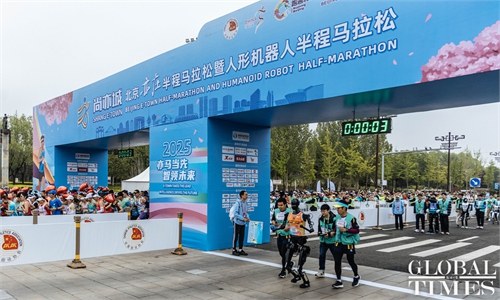
The October event builds on the Robot Warrior Challenge held in April alongside Beijing E-Town's humanoid robot half-marathon. That competition attracted 36 teams from 19 participating organizations, including leading robotics companies and universities. The fall edition will feature several upgrades, with more realistic scenarios, more refined competition rules and a more comprehensive training system.
The event is part of Beijing E-Town's broader efforts to develop its robotics industry through its RoboFuture competition series, which includes contests focused on smart hotels and elderly care, robot debates and fully autonomous 3-on-3 robot football.
The growing focus on real-world application reflects a shift in China's robotics industry toward deployment. In June, the Ministry of Industry and Information Technology and the country's state assets regulator launched a nationwide initiative to test humanoid robots and embodied AI systems in real-world settings, targeting more than 100 high-value application scenarios on a scale of 10,000 units by the end of 2026.
Global Times
RELATED ARTICLES