OPINION / GLOBAL MINDS
‘We need to rediscover the merits of engagement’: Chas Freeman
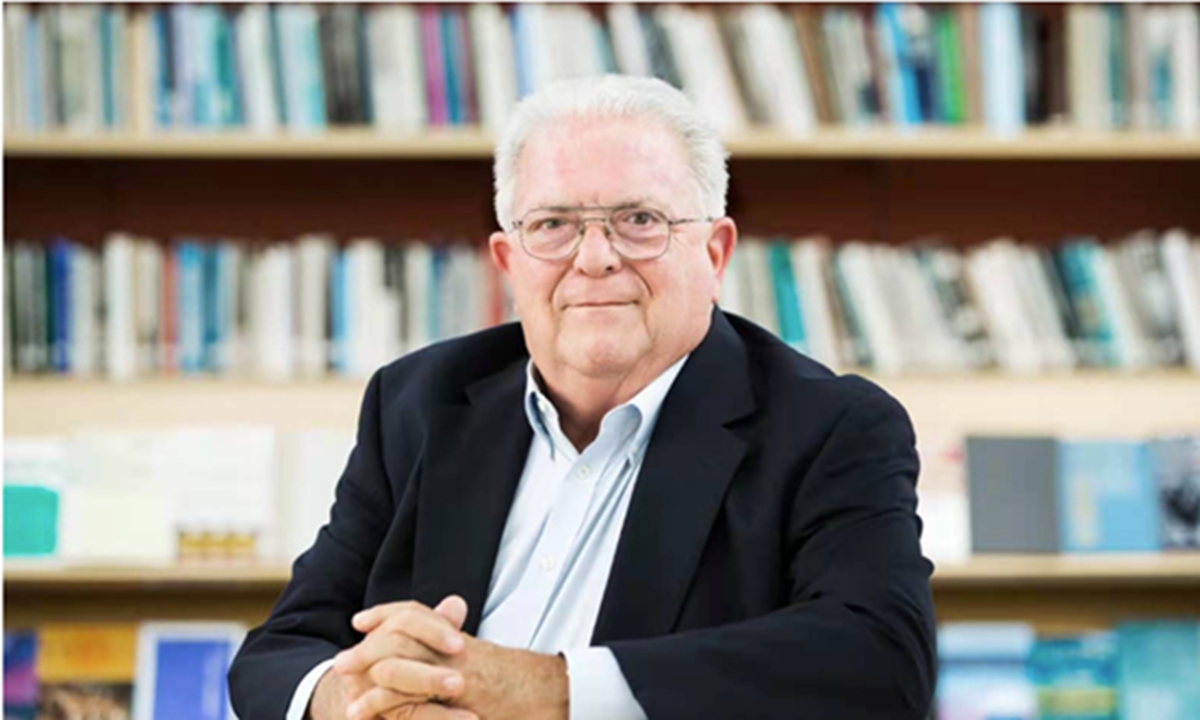
Chas W. Freeman Jr Photo: Courtesy of Freeman
Editor's Note:
Chinese President Xi Jinping is paying a state visit to the US from Wednesday to Friday at the invitation of the US President Donald Trump. Fifty-four years after he sat at the table as former US president Richard Nixon's principal interpreter in Beijing, Chas W. Freeman Jr (Freeman), a former senior US diplomat, shared his insights with Global Times (GT) reporter Li Aixin on this ongoing visit. The man who had participated in opening bilateral ties now says that China and the US need to relearn what the Shanghai Communiqué had already stated: different ideologies, different systems, yet the capacity to cooperate for mutual advantage remains.
GT: It has been 11 years since the Chinese head of state paid a state visit to the US. How should we weigh this visit?
Freeman: I would regard it as an exercise in the maintenance of a relationship, an effort to slow the deterioration of that relationship, and, in a time of great international turmoil, to try to prevent the US-China relationship from contributing to the turmoil, to see it as a stable factor in that.
If you lose contact and cease to have dialogue, you can easily become mutually suspicious, which can easily turn into enmity. This is something we should seek to avoid. We need to rediscover the merits of engagement and be pragmatic rather than ideological in our interactions.
GT: Given the tensions and fluctuations in the ties, could you elaborate on the merits of engagement and common ground between the two sides?
Freeman: Both of our countries have gone through multiple revolutions. When our country became independent, China was about one-third of the global economy. We had been barred from trading with China by the British when we were a British colony. Then one of the first things we did was try to engage with China.
We have had a complicated relationship, but at the beginning of the 20th century, the US adopted the so-called Open Door policy, which was intended to align the US with those in China seeking to modernize the country on an eclectic basis. And we have been very helpful to China in its recovery of wealth and power.
Now the US, like China, needs a peaceful international environment in which to deal with many domestic problems. So the two countries can indeed coexist and cooperate. We will compete in some ways, but it is actually constructive if it is an effort to excel - if you are trying to outdo your competitor by becoming more competitive yourself and performing better. That is good for everyone.
We should adopt that standard for our relationship: Stop trying to hurt each other or retard each other's development, and start concentrating - I particularly speak of my own country - on reacquiring a competitive stance and performing better in order to compete with the other side.
The two countries, in many ways - if you think of issues of importance to the planet as a whole: climate change, nuclear nonproliferation, the management of the global economy, and so forth - do have common interests. And China needs to rebuild support from the American business community. That is something China is quite capable of doing, and I hope it will do it.
GT: You mentioned stopping hurting each other. Does the mainstream American public think that China is hurting the US?
Freeman: I think that's kind of a misjudgment. I don't agree with the thesis that China is trying to hurt Americans. In my view, China is largely on the defensive, and the US has been on the offensive. China does not encircle the US, and I don't think it intends to. Economically, we are interdependent to the benefit of both countries. The challenge from China is that China is effectively pursuing scientific and economic advances that are disturbing to Americans, because for 150 years, we have been the predominant society - the preeminent society on the planet. This is psychologically difficult.
GT: What do you expect from this summit, and from China-US relations over the longer term?
Freeman: I'd like to see some concrete achievements in terms of agreements on cooperation. The BRICS meeting just took place in New Delhi. It produced a long list of potential cooperative arrangements between its members. I'd like to see the US and China begin to do that again.
I'd like to see the Board of Trade and Board of Investment that were announced during President Trump's visit to Beijing in March this year be carried forward.
Because trade is, as you say in Chinese, "hu tong you wu." This is exchanging what you don't have for what you have and need. And we both have requirements that lead us to interdependence. We need to manage this better than we have done.
It is important to restore an incentive for the two sides to cooperate on a practical level.
There are a lot of foolish people, at least I can speak in my own country, who are opposed to what I would regard as common-sense relationships with a China that is emerging as a leader in global science and technology and is increasingly innovative.
I would like to see more emphasis on putting Chinese progress to work in ways that also benefit my own country.
GT: You were the principal American interpreter on former president Richard Nixon's 1972 trip to China, and one of the career diplomats who took part in the opening of the relationship. Looking back, what legacy from that era is still worth carrying forward today?
Freeman: When we managed to open a relationship between China and the US, despite grave, difficult differences in ideology, sociology, socioeconomic systems, and so forth, it is advantageous to the two sides to cooperate on those things we agree about - that is, the common interests we have.
And I think the most pregnant phrase in the Shanghai Communiqué, which was issued on February 28, 1972, in Shanghai at the end of the Nixon trip, was the statement that the US and China have different ideologies and different socioeconomic systems, and yet we can cooperate to mutual advantage. That's what we need to rediscover as the principle for our relationship going forward.
The world is moving toward what I have called a multi-nodal system rather than a multipolar one. I know "multipolar" is the common term. But a pole is the end of a line - the extreme of a line that joins two parties. We had a bipolar world order between Moscow and Washington for much of the latter part of the 20th century. I do not think that is what we have now. What we have, I think, is many relationships in a network between nodes - jiedian in Chinese - meaning three-dimensional, perhaps four-dimensional, connectors. You can have a very strong economic relationship with a country and yet a poor political relationship. You can even have a hostile military relationship and still have a strong cultural relationship.
Things can evolve over time. This is a new world in which there are no blocs of countries. Each country is out for its own interests, is part of a network of relationships, and changes as its interests evolve. This is an environment in which qiutong cunyi - seeking common ground while reserving differences for later resolution - is entirely appropriate.
GT: What would you most want to say to young diplomats today from both countries?
Freeman: The future generation of Chinese diplomats who may not, like this generation, have gone to the Johns Hopkins School of Advanced International Studies or other American universities - and who may have felt, in the current atmosphere in the US, somewhat unsure of their security.
So I would like to suggest that the two countries consider how to ensure that the future generation of diplomats on both sides, and other government officials, have firsthand experience in each other's countries.
I want to make another suggestion. Thailand has sent many students to the US, like China, and they have an umbrella organization called the American University Alumni Association. If your son or daughter wants to go to Cornell, they will produce alumni from Cornell who can advise you and support your application. If you are a company and you want to find someone who has a degree in biochemistry from the US, they have a database that can introduce you to potential candidates.
I think this is actually a very good way of both cementing the educational and academic relationships - alumni looking after fellow alumni.
These are suggestions about how to enable future generations to be better informed, more objective in their understanding of each other, less emotional and more intellectually alive and so forth.
RELATED ARTICLES