Trump’s visit ‘may help set the groundwork for both sides to identify areas of common interest’

Illustration: Xia Qing/GT
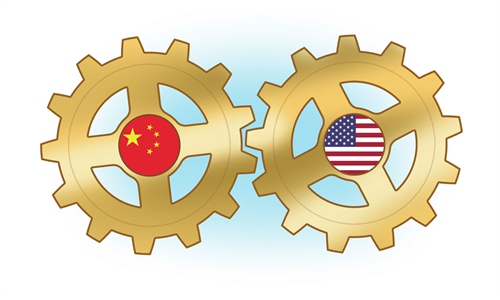
Editor's Note:US President Donald Trump's ongoing state visit to China from Wednesday to Friday has drawn significant international attention. In an interview with Global Times (GT) reporter Su Yaxuan, Sourabh Gupta (Gupta), a senior fellow at the Washington-based Institute for China-America Studies, noted that what China and the US are doing now is groping toward finding a new intermediate strategic equilibrium based on which they can engage each other. "The visit may help set the groundwork for both sides to identify areas of common interest," Gupta said.
GT: What is your interpretation of the significance of this visit in light of your long-term research on China-US relations?
Gupta: I think it is a very significant visit.
From a broader perspective, what the two sides are doing now is, in a sense, groping toward finding a new intermediate strategic equilibrium based on which they can engage each other.
From a narrower standpoint, the visit may help set the groundwork for both sides to identify areas of common interest, where they can cooperate as well as manage the competitive aspects of the relationship.
GT: According to US media reports, the Trump administration has invited CEOs from major American companies to accompany the visit. This has been widely seen as a signal of Washington's intention to promote economic and trade cooperation. What is your assessment of this visit accompanied by a high-level business delegation?
Gupta: Economic interdependence has been the ballast of ties between the US and China during those 40 years when the relationship flourished. Even in recent years, it is the business relationship that has fundamentally remained the most important ballast for the relationship. In that context, the fact that important Fortune 500 leaders are accompanying the president is meaningful.
However, I think the administration should have been sending out invitations earlier and bringing a larger cohort of CEOs. I don't think the cohort is broad enough or large enough.
That said, I would also add a note of caution here: The ballast that we did have is no longer as stable as it used to be. There are certain limits in terms of trade, technology and investment relations, which the US has been emphasizing. There is an element of selective decoupling - indeed, a significant one - that many American leaders and members of Congress support.
GT: What trajectory do you foresee for China-US economic relations following this visit?
Gupta: As for the situation following this visit, this relationship has been very much leader-driven. The leaders have acted as the steering wheel of the relationship.
In the short term, I am cautiously optimistic. In the long term, it is harder to say. Elements of competition are already embedded in this relationship and have been for nearly a decade.
The important point is not that the relationship can be completely turned around and suddenly flourish, but that it can be managed. There could be a period of strategic easing, during which both sides identify areas of common interest and build interconnections.
GT: Another topic that has received a lot of attention from US media is artificial intelligence (AI). The Wall Street Journal and The New York Times have both published articles on this subject recently. In your view, what concrete steps, particularly from the US side, would be necessary for the two countries to achieve substantive progress in AI governance?
Gupta: When they [the media] talk about AI governance, I think they are referring to coordination on policy elements related to AI.
AI is obviously a tool for much good, but it can also be used by bad actors to cause severe damage.
As we have seen with the release of certain AI models, there is potential for extreme cyber warfare or even biological threats. So, I think the purpose of discussions is to begin creating a framework to prevent these tools and technologies from falling into the hands of ill-intentioned third parties, including non-state actors. That is the fundamental goal.
China would likely prefer a broader discussion that includes reciprocal exchanges, including technology cooperation. Much of today's AI talent is Chinese, and ecosystems in the US and China are still interconnected.
The US appears to prefer limiting technology exchange and focusing mainly on security-related policy discussions. We will have to see how that plays out, but it is an important starting point for both sides.
I do not support the view that "China's AI development is a threat." I think it would be beneficial for the world if both the US and China develop their AI ecosystems and if those ecosystems remain interconnected. That is where the greatest technological potential lies. Treating scientific development as a zero-sum game is, in my view, both troubling and counterproductive. I would prefer to see cooperation and continued commercial exchange in this field.
GT: In recent years, there has been a noticeable decline in American academic exchanges, business presence and research collaboration in China, alongside a shrinking pool of experts with in-depth knowledge of China. Is the US gradually losing its ability to accurately understand China? To what extent could this "knowledge gap" affect US policy judgment and decision-making toward China?
Gupta: It certainly will, absolutely. We have to remember that the bilateral relationship has been fundamentally a people-to-people relationship. That created the foundation for mutual understanding. But the fact is, if you start cutting off that relationship, it will hurt you.
The prevailing mentality seems to be that if we are to compete with - and even defeat - China, we must first cut ourselves off from it. But in doing so, you may weaken your own position. The way to compete with China may well be to understand it better.
People-to-people exchanges are the most important foundation. It helps leaders make better decisions.
There is a view that China is inherently aggressive, expansionist and intent on becoming the world's number one power. However, I would argue that China's primary goal is national modernization, a process extending to 2050 and beyond. A key pathway to achieving that goal is maintaining a stable - and ideally productive - relationship with the US, not seeking to defeat it. Excessive competition would actually undermine China's own development goals.
These misunderstandings can lead policymakers down the wrong path - creating unnecessary strain, distorting engagement strategies, and ultimately harming US interests.
GT: Looking ahead, which area do you think needs to be changed most?
Gupta: I think the most important area will continue to remain the trade and investment ties. It has been the balance, and it will continue to be the balance because China itself is such a dominant actor in that space, and is moving up the value chain, at such a fast pace. China cannot be decoupled. China cannot be cut out of supply chains. Therefore, I am confident that China will be very much part of the Western world in terms of industrial supply chains with the Europeans and the Japanese and others.
RELATED ARTICLES