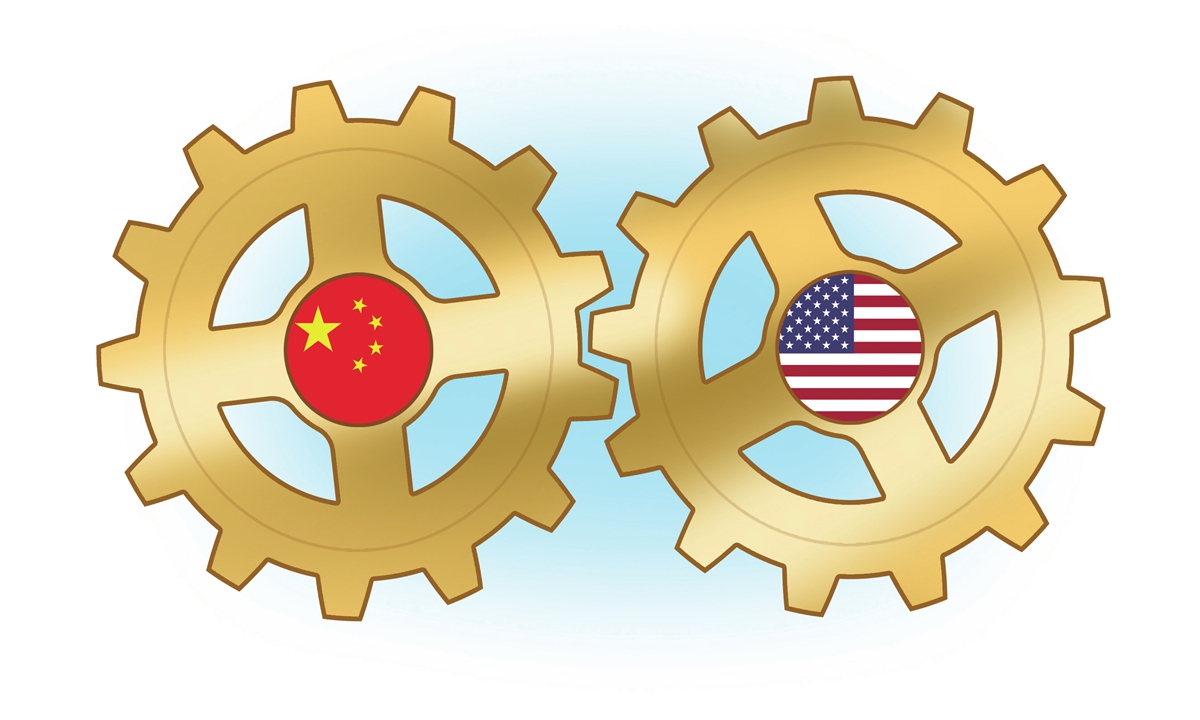
Illustration: Liu Rui/GT
US President Donald Trump will pay a state visit to China from Wednesday to Friday. It will be the first visit to China by a US president in almost nine years.Global media, especially in the US, have been speculating about the visit for quite some time. There are many pressing issues on the agenda.
The visit coincides with the fragile US-Iran ceasefire, and both sides are also expected to agree to forums to facilitate mutual trade and investment.
Chinese Vice Premier He Lifeng traveled to South Korea for trade talks with US Treasury Secretary Scott Bessent on Tuesday and Wednesday, marking the final round of negotiations before Trump's visit.
Another big item on the agenda is the Taiwan question. Prior to Trump's visit, US Secretary of State Marco Rubio said that the US and China both see maintaining stability in the Taiwan Straits as in their interests. The Chinese side is expected to stress China's red lines and the one-China principle that constitutes the political foundation of China-US relations.
Indeed, agreements will be agreements, and disagreements will be disagreements. But it would be good if the two countries can agree on disagreements and find a way forward.
As a lifelong China specialist, I hope that working groups from both sides have prepared some modest steps toward advancing this relationship - the world's most important bilateral relationship. Still, the fact that the leaders of these two major powers can sit down and talk sends a positive signal to the world.
If we look back at history, in the late 1970s, the US and China came together - scholarly contacts, cultural exchange, and diplomatic relations, followed by surging investment and trade.
Over the past few years, from trade wars to technology wars, and from the Taiwan Straits to the South China Sea, China-US relations have experienced considerable turbulence. I believe that from this turbulence we've learned how interconnected we have become and how costly it would be to tear that fabric apart.
There is no doubt that the era of pure cooperation and engagement is over, but outright decoupling is neither possible nor desirable.
The US and China can compete fiercely in some areas while cooperating in others. Thousands of US companies still rely on Chinese manufacturing, just as Chinese exporters depend on US consumer demand. Critical supply chains - from semiconductors to pharmaceuticals - cannot be rerouted overnight without enormous cost.
Moreover, global challenges simply cannot be solved without some form of China-US coordination. Climate change, pandemic preparedness, artificial intelligence governance and nuclear nonproliferation all require at least minimal cooperation between Beijing and Washington.
Thus, the way forward is not a binary choice between engagement and decoupling, but a more nuanced reality: managed competition.
This new normal may be more difficult and less predictable than the previous era, but it is also more honest - an acknowledgment that two great powers with deeply intertwined yet diverging interests must learn to compete without catastrophe.
Here is my list of major, practical actions that would benefit both countries, starting from the grassroots level.
The US should welcome Chinese visitors and provide visas readily, rather than requiring extensive scrutiny and long delays, and we should increase the flow of US students to China.
Our government should provide funding in support of this initiative, instead of issuing dire warnings against it. We need to rebuild the institutional links between the two countries, among academic institutions, business associations and cultural exchange organizations.
On China's side, a useful action would be to welcome American journalists, so that the US media can accurately portray China as it really is, rather than the caricature we currently see on Fox News and elsewhere.
All this will require a steady series of trust-building actions by each government.
Small gestures carry great weight. A journey of a thousand miles begins with a single step. That ancient wisdom applies as much to diplomacy as to any other human endeavor.
Neither Beijing nor Washington should expect a grand bargain that resets everything overnight. Instead, they should look for the next small step. The question is whether both capitals have the patience and courage to keep walking.
The author is a professor of economics at the University of Virginia. opinion@globaltimes.com.cn
RELATED ARTICLES