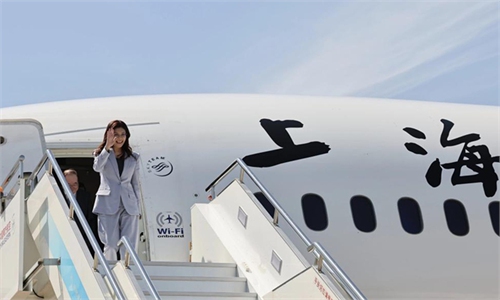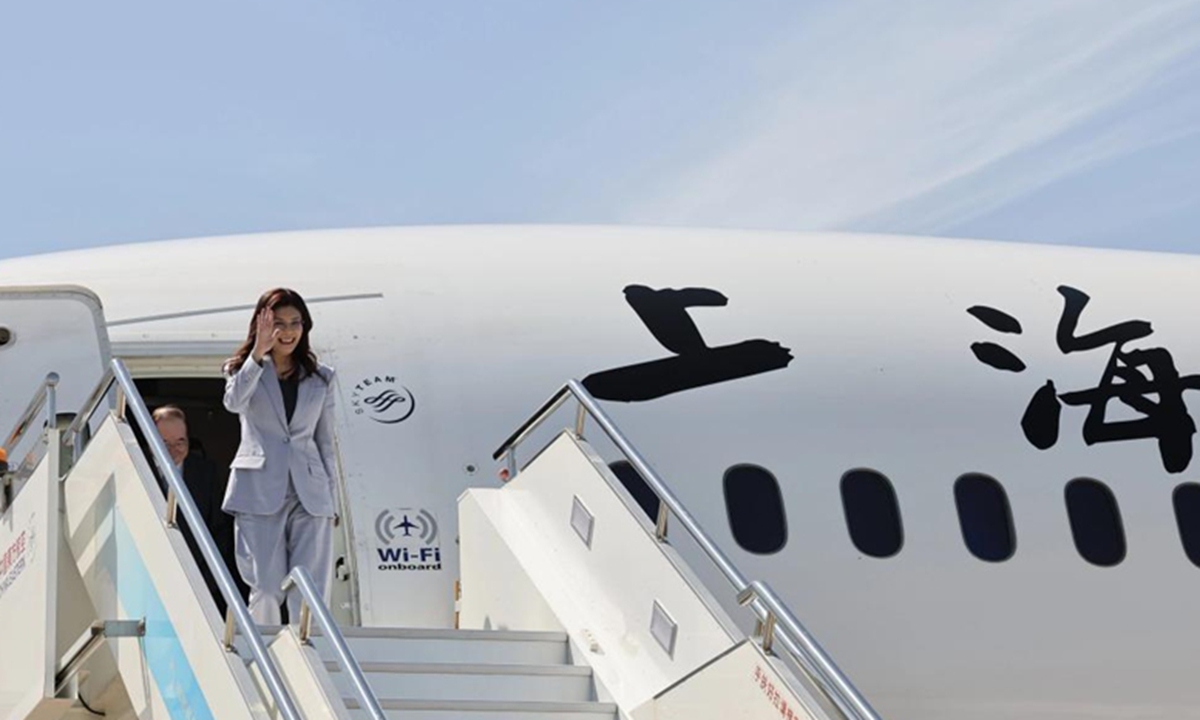
A delegation of the Chinese Kuomintang (KMT) party, led by its chairwoman Cheng Li-wun for a mainland visit, arrives at Shanghai Hongqiao International Airport, in Shanghai, east China, April 7, 2026. The delegation arrived here on Tuesday for a mainland visit that will run through Sunday. Photo: Xinhua
Cheng Li-wun marks the first Chinese Kuomintang (KMT) chairperson to have led a delegation to the Chinese mainland in the past decade. Cheng's visit to the Chinese mainland, themed on "2026 Journey of Peace," holds important historical and political significance.Xi Jinping, general secretary of the Communist Party of China (CPC) Central Committee, met with Cheng on Friday. Xi expressed the willingness to work with all political parties in Taiwan, including the KMT, as well as groups and people from all sectors, to strengthen exchanges and dialogue, promote peace across the Taiwan Straits, improve the well-being of the people and advance national rejuvenation, on the basis of the common political foundation of adhering to the 1992 Consensus and opposing "Taiwan independence." He also called for fostering the well-being of the people through exchanges and integration.
In fact, over the past decades, the Chinese mainland has established related institutions and organizations across provinces, regions and major cities to safeguard the interests of Taiwan compatriots. We, Taiwan compatriots, have witnessed and personally benefited from these efforts. On Sunday, a package of 10 policies and measures to boost exchanges and cooperation across the Taiwan Straits was unveiled. We should be grateful for the goodwill our motherland has shown to us.
At present, the Democratic Progressive Party (DPP) authorities have accelerated their push for "de-Sinicization" on the island while expanding arms purchases and advocating for "preventing reunification by force." The residents of Taiwan have suffered under these policies and have developed a growing and urgent longing for a peaceful and stable living environment, as well as a secure economic future. Cheng's visit reflects the genuine sentiments within Taiwan society.
For a long time, the DPP authorities have maintained tight control over the media. Under a propaganda policy of "demonization" of the mainland, they have systematically blocked out the mainland's gestures of goodwill toward the Taiwan region, distorted the collective history of cross-Straits relations and concealed the truth regarding the mainland's rapid economic development. Cheng's visit helps convey the mainland's achievements and willingness to engage. It serves to guide the people on the island toward a more comprehensive understanding of historical truths and the realities of cross-Straits relations. By awakening the social conscience in Taiwan, this visit contributes to efforts to curb separatism, resist external interference and return cross-Straits relations to a path of peaceful development.
Cheng's visit signals the resumption of institutionalized exchanges between the CPC and the KMT on the basis of the 1992 Consensus after a decade. The KMT is not only the longest ruling political party in the island's history and currently the largest opposition party there, but it is also a party deeply connected with the shared historical memories and national mission of the motherland. Cheng's itinerary to pay homage to the Sun Yat-sen Mausoleum in Nanjing during the visit was intended to awaken shared historical memories between both sides of the Straits.
During the visit, Cheng and the delegation also witnessed firsthand the prosperity and dynamism of Shanghai, which far exceeded their expectations. The consensus Cheng reached with Xin Changxing, secretary of the CPC Jiangsu Provincial Committee, on participating in the 15th Five-Year Plan will help create new opportunities for Taiwan's industries and businesses, bring them into a new economic era of Chinese modernization, inject new economic momentum into Taiwan, and seize the historic opportunity to improve the well-being of people on the island.
The people on both sides of the Taiwan Straits belong to the Chinese nation. We firmly believe that the interests and well-being of our Taiwan compatriots are closely linked to the great rejuvenation of the Chinese nation. This year marks the start of the 15th Five-Year Plan, and we hope that our Taiwan compatriots will actively participate in it, share in the development opportunities and achievements, and work together to strengthen the economy of the Chinese nation.
The most significant positive takeaway from this visit for the future of cross-Straits relations is that, as long as any exchange or communication is conducive to peace across the Straits, the mainland will offer its full support. We should cherish the historic opportunity for peaceful development provided by the mainland. Looking ahead, it is hoped that under Cheng's leadership, the KMT will take concrete steps after returning to Taiwan to advance cross-Straits relations. By strengthening political mutual trust and maintaining constructive interaction, both sides can ensure that the future development of cross-Straits relations remains firmly in the hands of the Chinese people, working together to realize the shared goal of national reunification and rejuvenation.
The author is honorary chairman of the Reunification Alliance Party in Taiwan. opinion@globaltimes.com.cn
RELATED ARTICLES