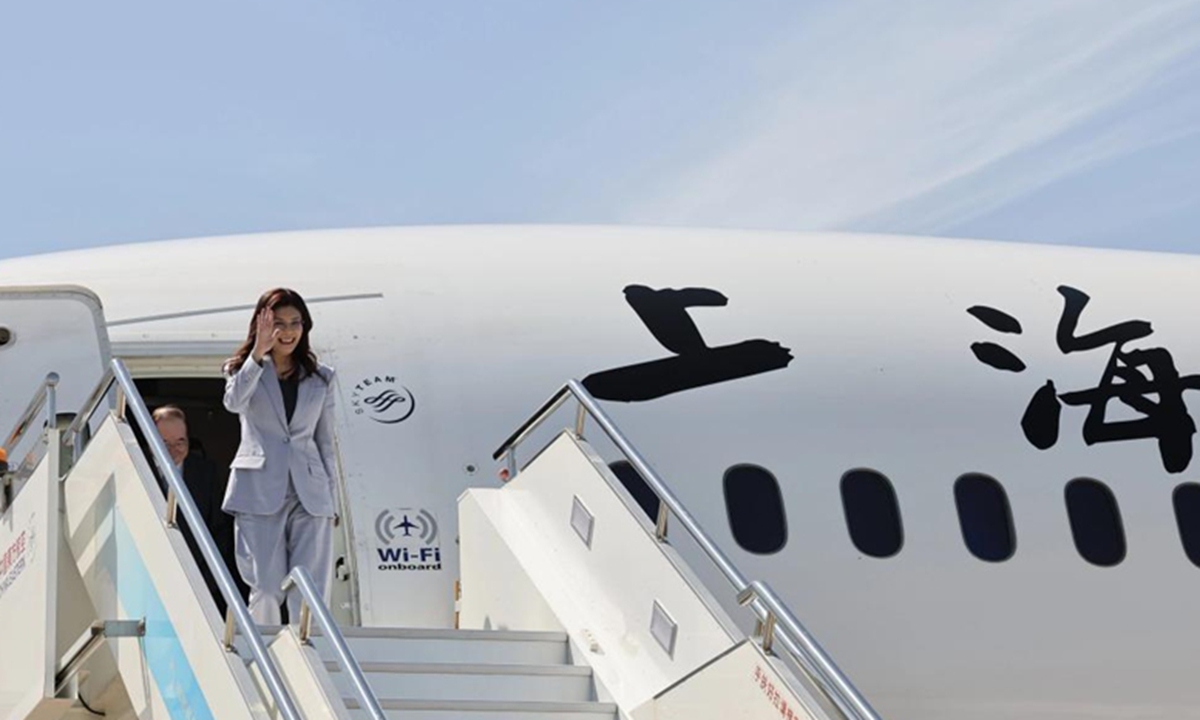
A delegation of the Chinese Kuomintang (KMT) party, led by its chairwoman Cheng Li-wun for a mainland visit, arrives at Shanghai Hongqiao International Airport, in Shanghai, east China, April 7, 2026. The delegation arrived here on Tuesday for a mainland visit that will run through Sunday. Photo: Xinhua
Cheng Li-wun, chairperson of the Chinese Kuomintang (KMT) party, is leading a delegation to visit the Chinese mainland from Tuesday to Sunday. This marks the resumption of institutionalized exchanges between the KMT and the Communist Party of China (CPC) after a decade.
In 2005, when cross-Straits relations suffered setbacks due to Chen Shui-bian's "Taiwan independence" provocations, then KMT chairman Lien Chan, at the invitation of the CPC Central Committee, led a delegation to the mainland, opening the path for institutionalized exchanges between the two parties.
Thereafter, the two sides held annual high-level party forums to discuss ways to safeguard peace across the Taiwan Straits and promote the well-being of people on both sides, playing an irreplaceable role in advancing cross-Straits relations at the time.
After 2016, due to changes in both internal and external circumstances and various constraints, exchanges between the two parties were suspended for a full decade.
After having been elected KMT chairperson in October 2025, Cheng demonstrated a keen understanding of public opinion on the island and the evolving dynamics of cross-Straits relations, and actively worked to restore institutionalized exchanges between the two parties.
In February 2026, think tanks affiliated with the CPC and the KMT held a forum in which five aspects of common opinions were proposed, receiving a warm welcome from compatriots on both sides of the Straits.
Cheng's visit to the mainland strongly responds to the mainstream public opinion in Taiwan calling for peace, development, exchanges and cooperation.
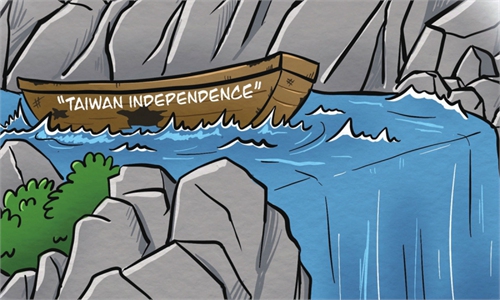
Since the Democratic Progressive Party came to power in 2016, it has refused to recognize the 1992 Consensus and has engaged in various forms of "Taiwan independence" separatist activities, pushing cross-Straits peace into turbulent and even perilous waters.
After Lai Ching-te took office in 2024, he has gone further by openly promoting the "two states" rhetoric and introducing restrictive policies on cross-Straits people-to-people exchanges, which have drawn widespread criticism on the island of Taiwan. The cross-Straits policies of the Lai authorities have caused significant damage to both peace in the Taiwan Straits and the island's economy and society.
As Cheng is the chairperson of the largest opposition party on the island, her visit to the mainland can create a demonstration effect for cross-Straits people-to-people exchanges, encouraging more Taiwan residents to overcome fears stemming from the Lai authorities' repression and to participate more actively in cross-Straits interactions.
The core value of this visit lies in opening up a new possibility: Political forces on the island, even under pressure, can still independently choose to engage in dialogue with the mainland, and that such dialogues can serve as a de facto stabilizer for cross-Straits relations. This communication channel helps prevent the two sides from sliding into dangerous situations due to major misjudgments.
The ultimate resolution of cross-Straits questions requires time and patience. In the absence of short-term political breakthroughs, it is crucial to maintain and expand various non-official and semi-civil communication networks. This not only serves as an effective check on "Taiwan independence" adventurism, but also represents a pragmatic step toward safeguarding peace across the Taiwan Straits and advancing national rejuvenation through concrete actions.
The current international landscape is unsettled. Conflicts such as the Russia-Ukraine conflict and tensions involving the US, Israel and Iran continue to challenge humanity's pursuit of peace and development, and have affected global energy, financial and food systems.
Amid frequent global conflicts, Cheng's visit to the mainland demonstrates, through concrete actions, that dialogue rather than confrontation, and exchange rather than isolation, remains a viable path for addressing complex historical issues. It carries real significance for preventing the Taiwan Straits from becoming another flashpoint and for maintaining the stability of global supply chains and energy security.
Therefore, amid a volatile international environment and mounting pressure on cross-Straits peace, Cheng's ongoing visit is not only a dialogue based on the shared political foundation of the 1992 Consensus and opposition to "Taiwan independence," but also a collective call from compatriots on both sides for peace over war and for development through cooperation. It opens a window for cross-Straits relations to move from confrontation and deadlock toward dialogue and cooperation.
The author is director of the Politics and Economic Research Office of the Institute of Taiwan Studies at the Chinese Academy of Social Sciences. opinion@globaltimes.com.cn
RELATED ARTICLES