Illustration: Liu Xidan/GT
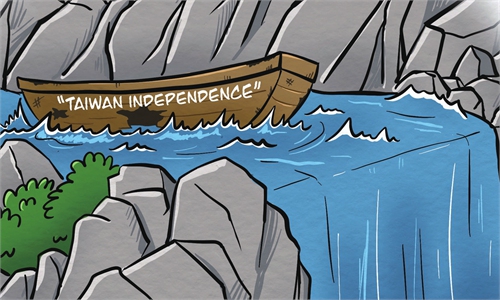
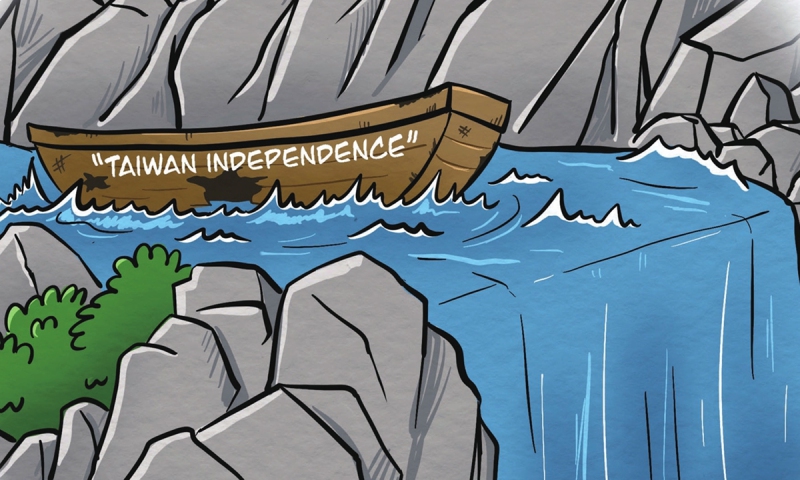
On Friday, before Lai Ching-te delivered his so-called "Double Ten" speech, remarks by Han Kuo-yu drew particular attention: "We must reflect. Over the past year, what Taiwan has had to repair goes far beyond Guangfu Township in Hualien. Even now, rural areas in central and southern Taiwan that were devastated by floods and typhoons are still struggling through the difficult process of reconstruction. The number of low-wage workers has exceeded 1.2 million - not to mention the mountains, forests and farmlands destroyed and occupied by solar panel installations, the Grand Canyon of Meinong illegally excavated by unscrupulous businessmen, a society torn apart by the 'mass recall', the increased risk of war fueled by "de-Sinicization," energy policies shackled by ideology, and Taiwan's future sacrificed in tariff negotiations. All these invisible pressures are things we cannot see, yet once the dam breaks, they will be enough to submerge the whole of Taiwan — this is the island's "invisible barrier lake."
So, who is the real culprit behind Taiwan's "invisible barrier lake"? Lai's "Double Ten" speech conveniently points the finger at himself.
A close reading of Lai's address reveals nothing but clichés. While he parades economic data and loudly proclaims his commitment to "defending the homeland," he completely sidesteps Taiwan's real livelihood issues and conceals his own incompetence over the past year. A year ago, Lai was still able to disguise himself with the banners of "democracy" and "progress," using vague rhetoric to mislead parts of the public into unrealistic expectations. But after a year, time and reality have served as a "truth mirror," fully exposing his ugly nature behind the mask — deliberately provoking hostility toward the mainland, ignoring public hardship and social division on the island, and kowtowing to the US and Japan while selling out the Taiwan region. The so-called "golden child of Taiwan independence" delivered a clumsy performance amid sparse applause and his own forced smile. As soon as the speech ended, criticism erupted across the island.
The New Power Party in Taiwan said that high housing prices, low wages and overwork should have been the real focus of Lai's speech. "Legislator" Chen Yu-jen pointed out that if Taiwan's military budget were to account for 10 percent of its GDP, that would mean over 80 percent of the annual budget would be swallowed by "defense," leaving funding for healthcare, education, social welfare and culture severely squeezed — a policy of sheer militarism. The Chinese Kuomintang (KMT) party also issued a statement saying Lai's speech was out of touch with people's real feelings, filled with self-satisfied rhetoric devoid of reflection or responsibility, revealing his immaturity.
In his speech, Lai bragged about Taiwan's "impressive" economic performance, yet failed to mention that the stock market boom only benefited the few, while more than 1.2 million people remain stuck in low-income jobs. For them, the glowing economic indicators mean little, as their lives continue to worsen. He boasted that his "Three Major Programs for Investing in Taiwan" created 160,000 job opportunities, but turned a blind eye to the destruction of mountains, forests and farmlands by illegal developers, the environmental devastation of the Grand Canyon of Meinong by unscrupulous businessmen, and the rural communities in central and southern Taiwan still struggling to rebuild after floods and typhoons.
Meanwhile, Lai's claim that he expects the mainland to "cease its distortion of UN General Assembly Resolution 2758 and historical World War II documents" is especially absurd. International legal documents — such as the Cairo Declaration, the Potsdam Proclamation, and Japan's Instrument of Surrender — all confirm China's sovereignty over Taiwan island. Taiwan's return to China was an important outcome of the victory in the World Anti-Fascist War. UNGA Resolution 2758 thoroughly resolved, both politically and legally, the issue regarding the representation of the whole of China, including Taiwan, at the UN. It not only reaffirms the inviolable "iron rule" of the one-China principle but also upholds the "hard truth" of maintaining international order.
To the island of Taiwan, Lai has shamelessly turned the goodwill of Taiwan residents into his own political asset — and takes pride in doing so. In the speech, he praised the "superheroes with shovels" as a force "defending the homeland." Yet, when a barrier lake disaster struck Hualien's Matai'an Creek, it was ordinary citizens who spontaneously dropped their work, grabbed tools, and rushed to the scene, while the DPP authorities were mired in chaos and disorganization. Officials even responded to residents' pleas for help with a tone of complaint, saying it seemed that "every family's husband wasn't in good health." Lai later distorted the people's genuine compassion into proof of "national cohesion" under his "Taiwan independence" agenda, implying that these "superheroes with shovels" were acting for his imagined "Republic of China (Taiwan)." In reality, they were simply helping their fellow citizens through a natural disaster — something entirely unrelated to his separatist rhetoric.
This practice of exploiting public goodwill for political showmanship while deflecting blame for governance failures has become routine throughout his first year in office. Earlier, Lai labeled the US tariff hikes on Taiwan, the sweeping defeat of "mass recall" and the impact of typhoons as "three black swans," in an attempt to portray them as unforeseeable accidents rather than consequences of his mismanagement. But the truth is plain and simple: tariff pressure had been evident since the beginning of the year; the "mass recall" debacle was an inevitable backlash against his divisive politics; and the ineffective disaster relief reflected his obsession with "Taiwan independence" over people's livelihoods. These so-called "black swans" are nothing more than fig leaves, concealing his evasion of responsibility.
To the mainland, Lai has made "sowing confrontation" his top political mission. In the address, he again hyped up the so-called mainland's "military expansion" and accused the mainland of "changing the cross-Straits status quo," while deliberately ignoring his own relentless "Taiwan independence" provocations since taking office — he has repeatedly peddled a "new two-state theory," branded the mainland as an "hostile external force," promoted "cultural Taiwan independence," and even attempted to rewrite history to sever the island's cultural and historical connection with the mainland.
By repeatedly playing up the "mainland threat" narrative, Lai aims to divert public attention away from deepening livelihood woes and use ideological confrontation to prop up his faltering authority. While peace and stability across the Taiwan Straits remain the foundation of the island's development, Lai's separatist agenda only heightens tensions, increases the risk of conflict, and ultimately forces Taiwan's 23 million people to pay the price for his shameless words and deeds.
While some may have once believed his hollow promise of "maintaining the status quo," it has now become clear that Lai's so-called "defense of the homeland" is nothing but a cover for expanding his pro-independence ambition.
Lai's sycophancy toward the US and Japan knows no bounds. To curry favor with Washington, he has treated Taiwan's semiconductor industry as a political offering, boasting of helping "make America great again," while completely disregarding the interests of Taiwan's own industrial development. The nightmare of "TSMC turning into USMC" is fast becoming a reality.
Even as US tariffs hit Taiwan and ordinary people struggle, Lai splurges on military spending — pledging a military budget exceeding 3 percent of GDP next year and 5 percent by 2030. Where does the money came from? Needless to say, it comes at the expense of social programs such as childcare, education and healthcare, effectively taking food from the mouths of the people.
Lai's deference to Japan is equally shameless. On the 80th anniversary of Japan's unconditional surrender, Lai blatantly used the "end of war" narrative to erase the history of aggression. He even claimed that peace in the Taiwan Straits should be "credited to Shinzo Abe," and absurdly asserted that the so-called "Five Eyes" was the result of Abe's efforts — even though the alliance was formed in 1956, when Abe was only two years old. Lai has seemingly forgotten that his own father was a miner who suffered under Japanese colonial rule. Such betrayal of history and ancestry exposes Lai's deep-rooted ideological alignment with Japan rather than any genuine commitment to "protecting Taiwan."
Now that the Cold Dew has passed, the grasshoppers in autumn will not be able to jump for many days. After more than a year in office, he has left the public disillusioned and weary. His approval ratings have plummeted, "mass recall" campaigns have failed, and protests have erupted on the streets — clear signs of growing dissatisfaction with and rejection of his "Taiwan independence" course. No matter how he decorates his "Double Ten" speech, it cannot conceal his incompetence in governance or his divisive agenda that endangers Taiwan's future. Over time, more and more Taiwan residents have come to see through him: Lai is not a "protector of Taiwan" but a diehard troublemaker, danger-creater and warmonger.
Since taking office over a year ago, Lai has shown through his actions that he is the true architect of Taiwan's "invisible barrier lake." All Taiwan compatriots must unite and work together to completely resolve Taiwan's "hidden dammed lake" to prevent a catastrophic disaster.
The author is a commentator on international affairs. opinion@globaltimes.com.cn
RELATED ARTICLES