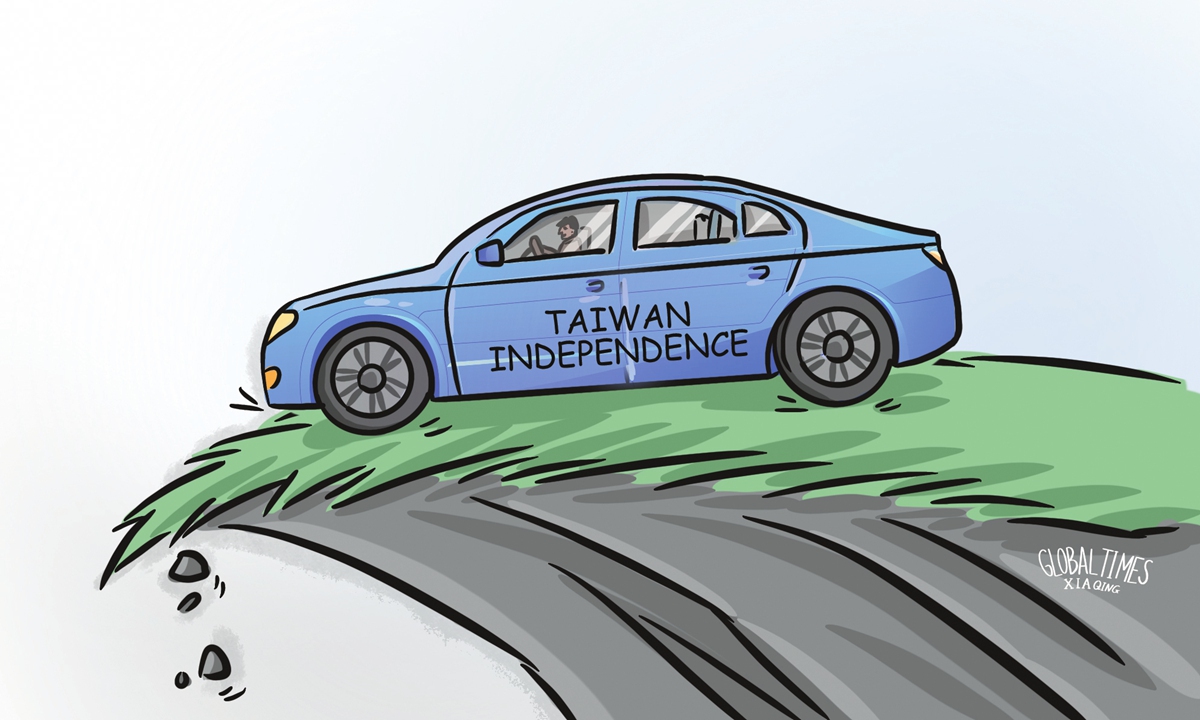
Illustration: Xia Qing/GT
On Tuesday, the United Daily News reprinted an article by former US State Department senior adviser Christian Whiton. The article said that Taiwan authorities' policies are gradually distancing the island from US President Donald Trump. This report echoes the widespread discourse in Taiwan's society around "doubts about Lai" and "doubts about the US."From the "10 Lectures on Unity" of Taiwan leader Lai Ching-te degenerating into the "four lectures of failure," to the complete defeat of the July 26 recall vote; from being denied transit through the US by the Trump administration to Lai's approval rating plummeting to a historical low; and finally to the Taiwan region suffering the heavy blow of unilateral high tariffs imposed by the US - these facts not only reveal the collapse of Lai's governing foundation but also confirm the sharp contradiction between the "Taiwan independence" separatist forces and the welfare of the Taiwan people.
Nonetheless, Lai showed no sign of remorse. Instead, he stubbornly persisted - moving against the current of history - plotting a "precision recall" on August 23 to further stir social confrontations and polarization.
The "10 Lectures on Unity" was Lai's tool to reconstruct a "Lai‑style Taiwan independence historiography," but under the fourfold scrutiny of history, theory, legal reasoning and common sense, it devolved into a laughingstock across the Taiwan region. Moreover, Lai's cold-blooded political performance during Typhoon Danas' disaster relief further revealed to the public that when people were struggling and disasters were rampant, he prioritized using the "recall storm" to purge his political opponents rather than comforting the victims.
The resounding 25:0 defeat in the first round of the "mass recall" represented a comprehensive rejection by Taiwan's mainstream public of the "confronting the mainland and seeking Taiwan independence" agenda. Voters delivered a sharp rebuke by ensuring that all 24 Kuomintang legislators and the Taiwan People's Party mayor retained their seats - not only a rejection of the "resist China and protect Taiwan" narrative, but an explicit stand against the authoritarianism dubbed "green terror."
The blockage of Lai's "transit" through the US and the imposition of steep tariffs by the US on Taiwan have completely torn away the illusion of his strategy of relying on the US to seek "Taiwan independence." According to a July 31 report in the New York Times, the Trump administration asked Lai "to avoid New York stopover," instantaneously shattering the myth of a "rock‑solid Taiwan-US relationship."
Meanwhile, the US has imposed a new 20 percent tariff on Taiwan's exports, further transforming the DPP's promise of "equal treatment with Japan and South Korea" into a deception. These realities mercilessly expose Taiwan's status as a pawn in Washington's chessboard.
The latest Taiwan poll data serves as a most direct repudiation by the island's public of the "confronting the mainland and seeking Taiwan independence" strategy.
The maneuvering over "transit" diplomacy, escalation of military standoffs and severed cross‑Straits ties have not expanded "international space." Instead, they resulted in the Taiwan region's exclusion from Regional Comprehensive Economic Partnership, the near-collapse of the ECFA framework and high youth unemployment. Yet Lai blames "external suppression," stubbornly refusing to admit that his own "confronting the mainland and seeking Taiwan independence" line is the root of the dilemma.
As the second wave of recall votes scheduled for August 23 draws near, Lai's "precision strike" strategy lays bare a ruthless political ambition that will stop at nothing to secure personal gain. Though he targets legislators from the Kuomintang and Taiwan People's Party under the banner of political purification, in reality he is employing a "color revolution" logic to suppress different voices. Yet history makes it clear that political power founded on divisive tactics will ultimately be consumed by the tides of time.
Lai's successive defeats were by no means accidental but a historical inevitability. His "confronting the mainland and seeking Taiwan independence" path not only runs counter to the shared cross-Straits cultural and ethnic bonds, but also undermines Taiwan's livelihood and pushes the region closer to conflict. Taiwan's future lies in defending the roots of Chinese culture alongside mainland compatriots and sharing the dividends in the national rejuvenation - not isolating itself from the motherland in Lai's "green cage." Reunification is the overarching trend; "Taiwan independence" is a dead end. Lai's defeats are yet another footnote to this ironclad truth. If he continues down this path, he will face defeat after defeat - until he plunges into an abyss of no return.
The author is a commentator on international affairs. opinion@globaltimes.com.cn
RELATED ARTICLES