Photo: Malaysian Prime Minister Anwar Ibrahim's official Facebook account
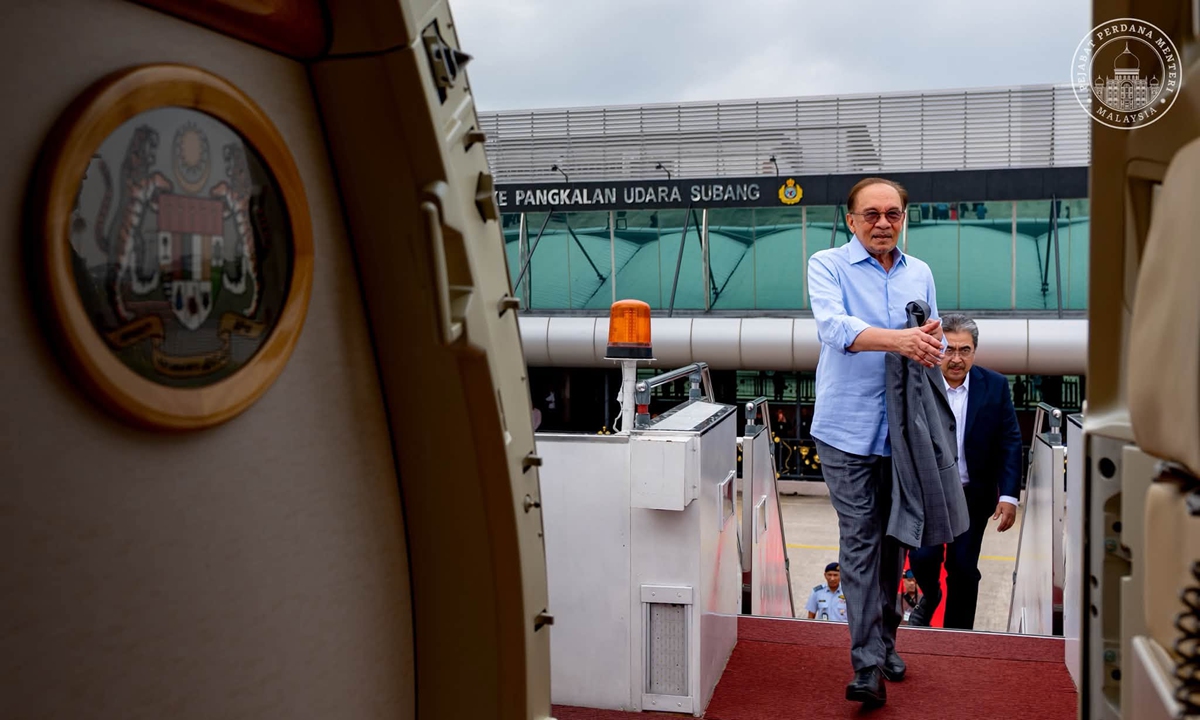
Malaysian Prime Minister Anwar Ibrahim began a visit to Shanghai and Hangzhou on Tuesday, with his fourth trip to China focused on deepening economic ties, advancing digital trade frameworks, and highlighting the importance of technical talent development, Malaysian news agency Bernama reported.
At China's invitation, Anwar will attend the opening ceremony of the WorldSkills Competition and the launching ceremony of the Global Digital Trade Expo, the Chinese Foreign Ministry announced on Tuesday.
Chinese analysts noted that these emerging fields have become key areas of China-Malaysia cooperation in recent years, adding that the two countries, as important drivers of regional integration, could generate a stronger global demonstration effect for Global South countries via collaborations.
The WorldSkills Competition, which started in Shanghai on Tuesday, is the world's biggest international skills competition, bringing together young people and industry, education, and government leaders worldwide to advance Technical and Vocational Education and Training. The Global Digital Trade Expo is China's only national-level international professional exhibition themed on digital trade.
Anwar's attendance at events of the WorldSkills Competition and the Global Digital Trade Expo demonstrates the two countries' close and warm ties and sound cooperation in relevant areas, Chinese Foreign Ministry spokesperson Guo Jiakun said during a press conference on Tuesday.
"China looks forward to working with Malaysia to further synergize development strategies, promote high-quality Belt and Road cooperation, have close communication and coordination on international and regional issues, and strive for more outcomes in building the high-level strategic China-Malaysia community with a shared future," the spokesperson added.
During his visit, Anwar took part in activities focused on these emerging sectors, areas that have remained important to bilateral cooperation in recent years, reflecting the potential for further collaboration between the two sides, Ge Hongliang, the director of the China-ASEAN Maritime Security Research Center at Guangxi Minzu University, told the Global Times.
Malaysia's Ambassador to China Datuk Norman Muhamad told the Malaysian media ahead of the prime minister's arrival on Tuesday that Anwar's visit aimed at initiating cooperation in new fields outside traditional fields, such as education, technical and vocational education and training, the digital economy, and AI.
In addition to bilateral talks to strengthen diplomatic ties and strategic cooperation between Malaysia and China, meetings with leading companies will also be held to attract high-quality, high-impact investments to Malaysia, Anwar said in a Facebook post on Tuesday.
Ge said that in building regional supply chains and industrial ecosystems, Malaysia also has important advantages, including a relatively well-developed semiconductor and chip industry.
At the same time, the country's AI applications still have room for development, and it could leverage Chinese technology and mutual cooperation to enhance its industrial competitiveness, Ge added.
The visit to China marks Anwar's fourth visit to the country, reflecting the continuity of the close bilateral relationship, a report by Malaysian media outlet Berita RTM noted.
China has remained Malaysia's largest single trading partner for 17 consecutive years since 2009, the Malaysia External Trade Development Corporation said in a statement on September 9.
"Greater strategic alignment, particularly in emerging industries and the development of industrial ecosystems and rules, will further strengthen bilateral ties and deepen the comprehensive strategic partnership," the expert said.
As important drivers of regional integration, China and Malaysia could generate a stronger global demonstration effect for Global South countries through deeper cooperation in the digital economy, AI, and advanced skills training, Ge added. Their experience in developing rules could also help amplify the collective voice of the Global South.
"China and Malaysia are good neighbors, good friends, and good partners connected by sea. Over the past 50-plus years of diplomatic relations, bilateral ties have maintained sound momentum of growth with good progress in cooperation across the board. The two countries are jointly building a high-level strategic community with a shared future," the Chinese Foreign Ministry spokesperson said.
RELATED ARTICLES