ARTS / CULTURE & LEISURE
Healing ancient walls: Dunhuang restorer spends four decades preserving murals with a doctor’s care and a craftsman’s hands
Dunhuang restorer spends four decades preserving murals with a doctor’s care
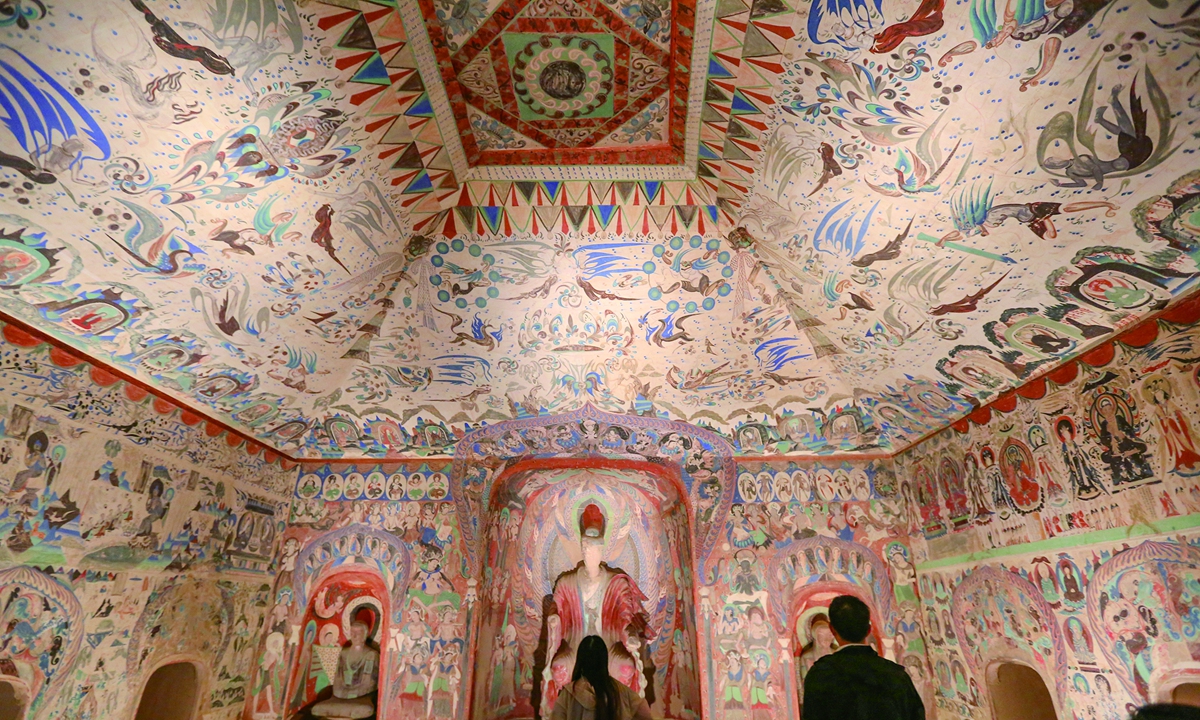
Visitors admire the murals at the Mogao Caves in Dunhuang, Northwest China's Gansu Province Photo: VCG
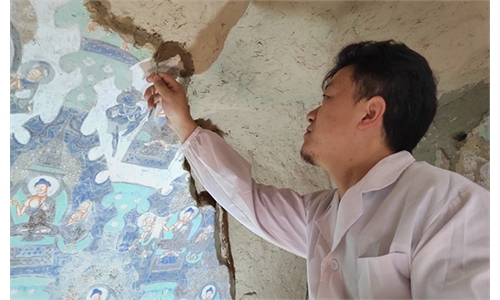
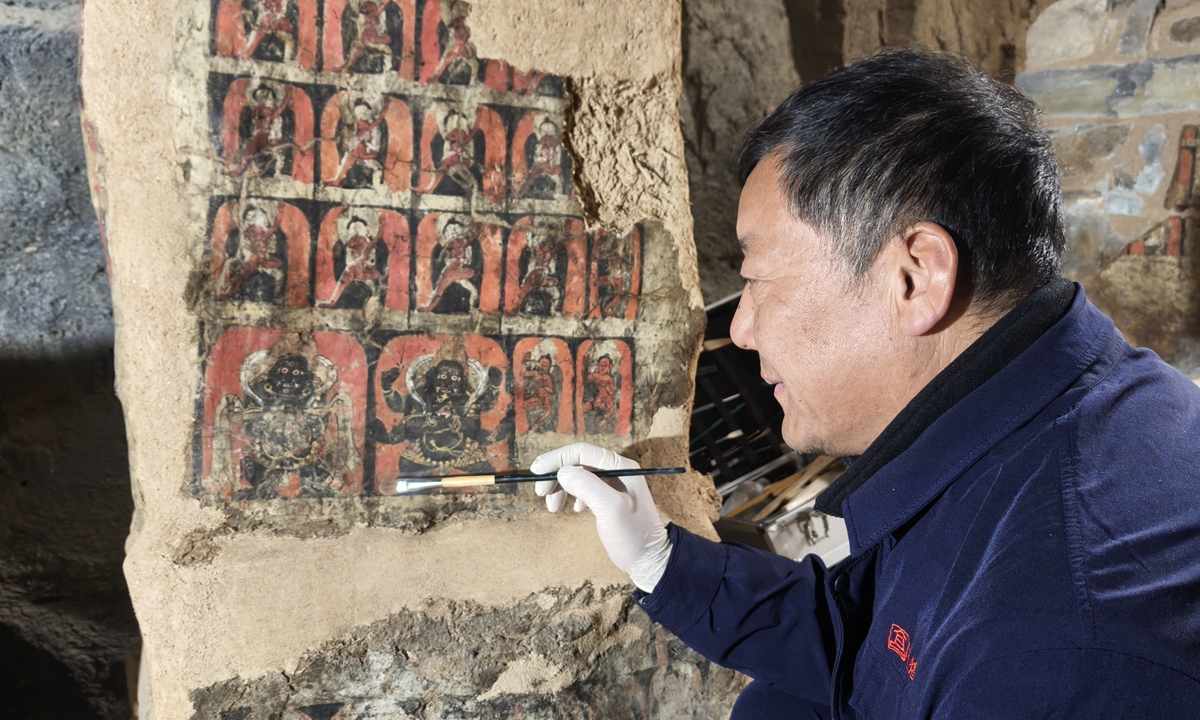
Fu Youxu presses the airbag of a small syringe, and a thin line of white adhesive slowly seeps through a crack in an ancient mural.The tool is one of many customized instruments he keeps in his restoration kit. Some were developed by his mentor decades ago; others have been adapted from tools used by dentists or makeup artists. Each has a specific purpose, and each requires a practiced hand.
"When you hold a restoration knife, the angle and the pressure have to be precise," Fu said. "You really have to hold your breath and concentrate."
For nearly four decades, Fu has worked on murals at the Mogao Caves in Dunhuang, Northwest China's Gansu Province, as well as at heritage sites in Xizang, Qinghai, Shanxi and elsewhere. He has restored more than 2,000 square meters of murals.
Yet he does not describe himself as an expert.
"I'm just a craftsman," Fu said. "I think about these things because I'm interested in them."
For Fu, that curiosity is part of what the job demands. Restoring a mural is not simply a matter of having a steady hand. Each new wall presents different challenges, with different types of damage, materials and risks, requiring conservators to decide not only how to repair it, but how much intervention is appropriate.
Fu Youxu cleans contaminants from the surface of a mural in Southwest China's Sichuan Province Photo: Courtesy of Fu Youxu
Treating a fragile patient
Fu often describes murals as if they were patients. Some suffer from flaking paint, hollow areas, cracks or salt damage. Several problems may occur at the same time, making treatment more complicated.
One particularly difficult problem arises when salt inside the wall crystallizes and gradually damages the mural. Conservators sometimes call it the "cancer" of murals.
"Murals are relatively unstable," Fu said. "The support behind them is the rock itself, and they are constantly exposed to changes in temperature, humidity and moisture."
The caves themselves add to the challenge. Even when temperatures outside climb to 40 C in summer, some caves can remain as cool as 12 C.
The murals span more than 1,100 years. Ancient craftsmen covered the cave walls and ceilings with layers of mud and plaster, creating smooth surfaces for painting. They filled those surfaces with religious scenes, figures, clothing and details of everyday life.
In Cave 150, the earth wall supporting the mural had gradually tilted forward and pulled away from the cliff under the effects of natural forces. The conventional method of removing, repairing and reattaching the mural could have caused irreversible damage to its painted surface.
After repeated discussions, Fu and his colleagues decided to restore the mural and its supporting structure together as a single unit.
"After spending so much time in the caves, your sense of time changes," he said. "To spend months or even decades protecting murals that are thousands of years old, I think it's worthwhile."
The art of doing less
For Fu, experience has brought not greater confidence, but greater caution.
When he first entered the Dunhuang Academy in 1988 at 18, he started with basic tasks such as preparing mud and handling brushes. He later studied under Li Yunhe, a veteran restorer whose approach shaped his career.
Fu estimates that it takes about 10 years to become technically proficient as a mural restorer. Developing the judgment to decide what to do - and what not to do - takes even longer.
"From the moment you begin examining a mural, you need to have a plan in your head," he said. "What instruments should I use to evaluate whether the restoration worked?"
Over the decades, his understanding of restoration has evolved. A good restoration, he said, should not necessarily be visible.
"For a good restoration, if you look at the mural before and after, you basically shouldn't be able to see much difference," Fu said. "But the damage has been handled."
The purpose is not to make an ancient mural look new. Computer technology can reconstruct what a mural may once have looked like for exhibitions and public education, but conservation has a different goal: extending the mural's life while preserving the historical information it carries.
That philosophy is reflected in the way mural conservation has developed at the Dunhuang Academy.
When Fu started, the restoration team had only four or five people. Today, more than 100 people are involved, with increasingly specialized roles.
Fu has also helped develop national occupational standards for restorers of mural and painted-sculpture cultural relics, formalizing skills that can take 10 or 20 years, sometimes a lifetime, to master.
Passing it on
Every year, new university graduates join the field. Fu encourages them to improve established techniques as long as preserving the artifacts remains the priority.
When treating flaking paint, for example, younger conservators have proposed using a small sprayer to apply a fine mist of water to gently humidify the surface before covering it with cotton paper, helping reduce the risk of pigment loss.
Newcomers typically spend two or three years assisting experienced restorers and learning through observation. Fu said those who truly come to love the profession are usually willing to take on even the dirty, tiring and tedious jobs.
The harsh conditions once made Fu consider leaving the field. But generations of scholars had devoted their lives to the caves. Their example helped him understand the significance of Mogao.
Nearly 40 years later, he remains in the caves, still working slowly and carefully over murals that have survived for centuries.
"A mural remembers whether a restorer respects history and can put aside impatience," Fu said.
RELATED ARTICLES