BUSINESS / CHINA NEOMAKE
GT on the spot: Chinese aviation brake tech ends foreign monopoly, cuts costs and powers new energy vehicles
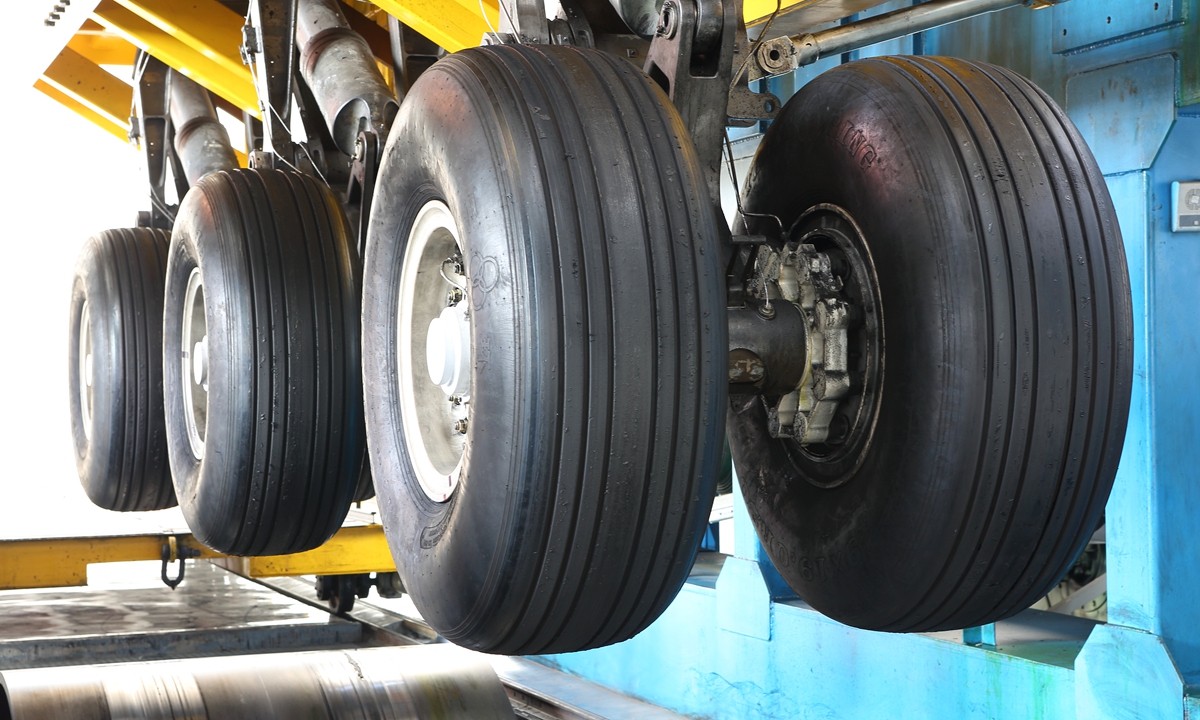
A multi-wheel braking system test Photo: Courtesy of AVIC Brake
A carbon-based brake disc about a meter in diameter, built for the Airbus A320's braking system, is light enough to lift with one hand. However, it once cost as much as a luxury car to produce, a heavy price that contrasts sharply with its weight."For a long time, this market was controlled by European and US companies. Once we developed our own brake disc and mass-produced it, prices came down," Zhou Rui, head of the labor model studio belonging to the Aviation Industry Corporation of China Xi'an Aviation Brake Technology Co., Ltd. (AVIC Brake), told the Global Times.
She said China's breakthrough was not limited to just one material or one technology, but encompasses a full industrial chain that now makes the technology affordable and usable across many industries.
What's the difference between aircraft brakes and car brakes? Engineer Zhang Xiaoshen told the Global Times that, to the public, stopping a plane looks as simple as pressing a car pedal. In reality, it is a complex system that safely converts and precisely controls the enormous kinetic energy of a landing aircraft.
Brake system failures have caused major air disasters in aviation history. Braking systems mainly work during takeoff and landing, Liu Jinsong, deputy general manager and chief engineer of AVIC Brake, told the Global Times. However, in that less than 10-minute window, failure and accident rates are high, making braking one of the few systems required to meet Level A safety standards.
Under industry standards, Level A means no fatal failure in a million flight hours. "The reliability and verification requirements for braking systems far exceed those of ordinary onboard equipment," Liu said.
In such a demanding field, China has achieved full model coverage, full-spectrum support, and all-scenario assurance for domestic military aircraft braking products. They have also made major inroads into the civil market, supplying reliable braking systems for trunk and regional airliners as well as special-purpose aircraft.
Aviation braking is essentially energy management. During landing, brake discs must withstand temperatures above 1,000 C while staying stable under high friction, impact, and frequent takeoffs and landings. The key to energy conversion is materials.
"Without breakthroughs in materials, there is no real safety baseline for aviation braking," said Zhou, who has witnessed China's brake materials evolve from resin to semi-metal, powder metallurgy, and now carbon-based materials. "We are now at the international advanced level."
The confidence comes from new carbon-ceramic materials made from carbon fiber and a ceramic matrix. They can withstand temperatures over 1,000 C while keeping stable despite friction during heavy, repeated braking. They also weigh a quarter of traditional materials, cutting brake system weight by 30 to 40 percent. Also important is the fact that they also last longer and perform more reliably in extreme conditions.
Carbon-ceramic brake discs are now used on more than 10 types of advanced Chinese aircraft, making China the first country to use them on aircraft on a mass scale, Zhou said.
The breakthrough also cut costs across the industry. The global civil carbon brake disc market was once dominated by three or four companies from the US, UK, and France. A single set cost hundreds of thousands of yuan, annual maintenance could exceed a million yuan per aircraft, delivery took up to six months, and overhaul and coating services were fully bundled, leaving Chinese airlines with no bargaining power, Wang Xuefeng, deputy chief engineer of AVIC Brake, told the Global Times.
After domestic carbon brake discs entered the market, prices for imported products dropped by over 70 percent, and delivery times shrank from months to weeks. "China's braking industry not only regained pricing power but pushed the entire civil aviation brake consumables market into reasonable competition," said Wang.
Aviation technology also spills over into other sectors. Since 2016, AVIC Brake's high-temperature carbon-based composite materials have expanded into automotive and rail transport, including Formula racing and high-speed rail. In new energy vehicles, the company has worked with Xpeng and Geely on carbon-ceramic brake discs. And in 2025, the technology was applied for the first time to a 600 km/h high-temperature superconducting maglev train.
The cooperation with Chinese EV makers has been a two-way street. Liu said he is particularly interested in their all-electric braking, redundant safety architectures, and intelligent health management systems. "These technologies will help braking systems adapt to future aircraft and become key to safe operation and energy management."
Beyond materials, AVIC Brake has also reached international leadership in control systems. Its self-developed adaptive braking control technology improves safety at the source, while its all-electric braking system, first installed in 2013, has been used on multiple drone platforms.
All-electric braking represents the future direction of braking systems, used abroad only on a few advanced aircraft like the Boeing 787 and X-37B. The technology overcomes key challenges in high-overload, high-temperature motors, redundant architectures, and force estimation, Liu said.
Now, AI is entering the field. Ground-based integrated motion control, autonomous takeoff and landing, intelligent braking, and energy recovery are among the frontier areas AVIC Brake is pursuing, Wang said.
RELATED ARTICLES