ARTS / CULTURE & LEISURE
Chinese architect Ma Yansong brings Eastern philosophy of space to Los Angeles’ Lucas Museum, highlighting people-to-people exchange between China and the US
Ma Yansong discusses design, culture with GT
By and Li Xundian Published: Sep 22, 2026 11:11 PM
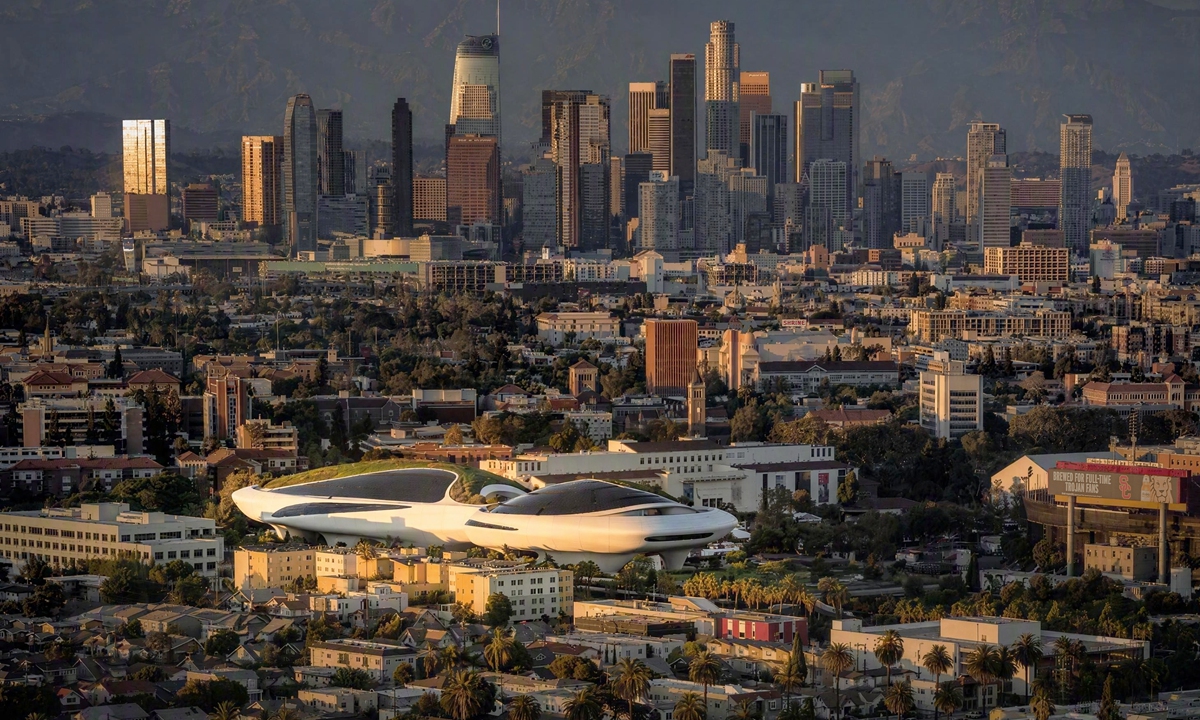
Lucas Museum of Narrative Art
From certain angles, the Lucas Museum of Narrative Art looks less like a building than a weather event. A white shell of 1,271 curved fiber-reinforced polymer panels seems to hover above the tree canopy in Exposition Park. Sunlight pours through a 56-meter central arch onto a public plaza below. Founded by George Lucas and Mellody Hobson, the museum opened in Los Angeles, the US, on Tuesday.The form belongs to Ma Yansong, the first Chinese architect to design a major cultural landmark in the West. "At first, I felt that a Chinese person had finally made something truly powerful in the West," he told the Global Times on Tuesday.
The museum spans about 28,000 square meters across five floors on 11 acres, with more than 9,300 square meters of gallery space and over 30 exhibition rooms. Its permanent collection exceeds 40,000 works; the inaugural show alone has more than 1,300 pieces. Eight years in the making and costing roughly $1 billion, it is both an architectural statement and cultural experiment.
Western observers liken its organic curves to a suspended spaceship. Yet Ma sees otherwise. He rejects eclecticism - the notion that mixing Western modernism with Chinese tradition produces an Eastern modernity. "That is not right," he said. Eastern architecture, he argues, should be like a tree, growing from traditional roots into contemporary branches and leaves.
His thinking draws on the idea of the "shanshui city" or landscape city of Qian Xuesen, a great Chinese scientist in the field of aerospace engineering. Modern urbanism, Ma says, follows a Western logic rooted in separating humanity from nature. On the contrary, Eastern civilization has long treated the two as inseparable. Qian urged China not to copy the Western "matchbox" model but to find a modern path grounded in Eastern philosophy. "I strongly agree," Ma said in an interview with the Global Times.
When Ma first visited the site, it was a parking lot. Large trees cast dense shade; children played beneath them. He thought of ancient Chinese academies, where teachers lectured under trees, and people and nature were interwoven. In Southern California's scorching sun, shade is nature's protection. He also thought of clouds. In Eastern culture, clouds are surreal vessels of imagination and curiosity - what a museum should embody. "It should not have a fixed face," he said. "Like blank spaces in Eastern aesthetics, everyone can read their own imagination into it."
Lucas saw the proposal and did not ask about Ma's credentials or origins. He simply said he wanted the design. "What moved him was not some Eastern label," Ma said, "but an unprecedented creativity whose roots lie in our culture, Chinese culture."
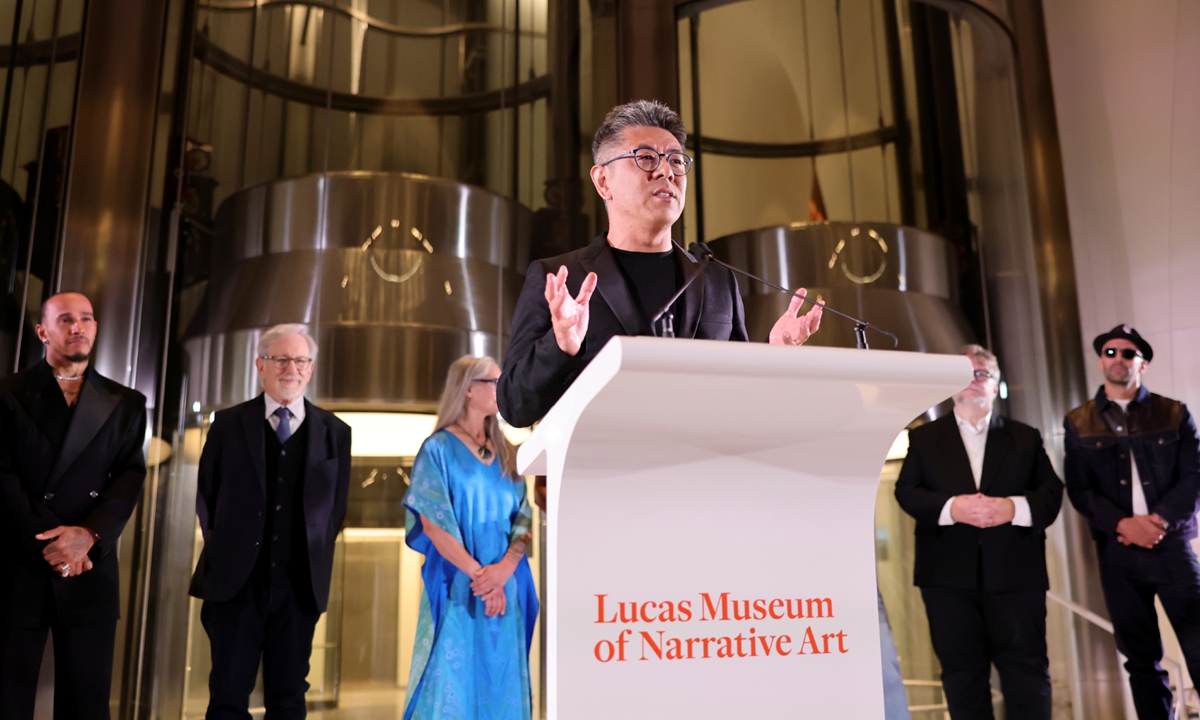
Ma Yansong
Ma's view of landmarks has shifted. His earlier buildings were "exclamation marks in the city," known for visual force. Now he prefers architecture that steps back. "In the past, landmarks and monuments were often elevated, carrying an air of authority that made people look up and revere them," he said. "I believe the monuments of the future should be spiritual strongholds belonging to everyone - approachable, places one can enter, relax, and find one's own feelings."This decentralized approach appeared in his Shenzhen Bay Cultural Plaza, where large structures were broken apart and embedded in the landscape, making the building move to the background while people and nature took center stage. Traditional Chinese gardens, he notes, never treated buildings as exhibits. "They create an environment for people to enter and experience, allowing a personal state of mind to arise amid mountains and water," he said. "That intangible philosophy is more essential and more Eastern than symbolic elements like dougong brackets or qipao dresses."
The Lucas Museum extends that logic. The structure is elevated, preserving public passage at the ground level; the park's green space has not been reduced. Its roof is a public pathway that allows visitors to walk up the curved surface to rooftop gardens. The building is no longer an imposing mass but a vast umbrella - an inclusive container offering shade, public spaces, and a place for the spirit.
"Many local Angelenos have told me they are grateful we brought them something they never had before," Ma said. "That pride does not come from grandeur or expense, but because it belongs to everyone. Its narrative is not about imposing a story on you; it allows each person to generate a story of their own."
As the first Chinese architect to shape a Western cultural landmark on this scale, Ma hears the word "first" often. He finds it less important than the broader possibilities Chinese architecture now offers. "Influence is never seized," he said. "If what you create has value and responds to universal questions, it will have influence wherever it is. Without value, standing at the center of the Western stage will achieve nothing."
Deeper still is the Eastern understanding of humanity and nature. As the world confronts an environmental crisis, Western responses often remain technical remedies that treat nature as an external object. Eastern tradition regards people and nature as one. "The depth of a person's understanding of nature determines the height of their own life," Ma said. "Chinese tradition is powerful, but if it continues only copying the past, it will forever stay in the past. True cultural exchange transforms the wisdom within tradition into solutions to contemporary problems and creativity oriented toward the future."
On the eve of the opening, the white, cloud-like form rested lightly above the trees of Exposition Park - neither imposing nor anonymous, but open, inviting, and quietly transformative.
RELATED ARTICLES