ARTS / CULTURE & LEISURE
Chinese spy drama becomes hit for quiet heroism and strong faith of national-security officers: screenwriter
By Published: Sep 22, 2026 11:16 PM

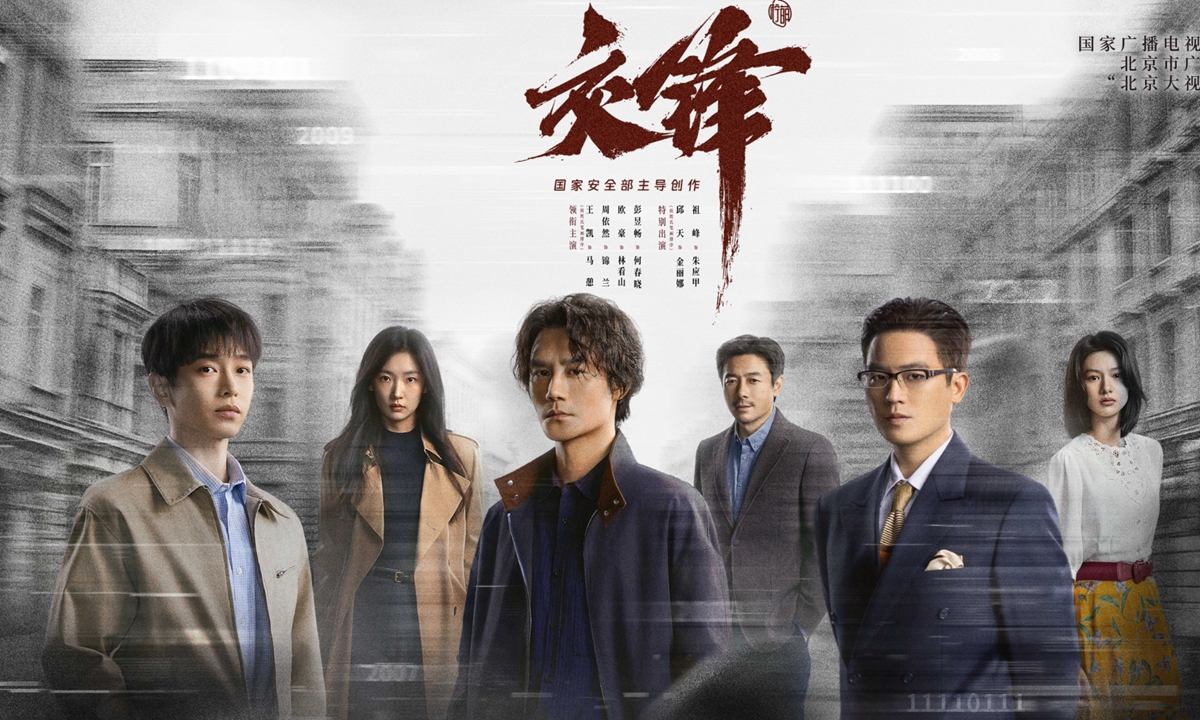
Jiaofeng
Jiaofeng, a Chinese espionage drama with cross-Straits storylines, has become a hit and drawn attention for what viewers call its "boldness." But Wang Xiaoqiang, its screenwriter, rejects the idea that the show is shocking for shock's sake."There is no exaggeration," he said in an interview with the Global Times. "We dared to write and shoot because the history is real."
Unlike past spy dramas, which were mostly set against the backdrop of the War of Resistance against Japanese Aggression (1931-45), the civil war fought between the forces led by the Communist Party of China and the Kuomintang, or the early days of the People's Republic of China, the story of this series is set during the 1995 Taiwan Straits crisis. It is a spy drama that takes "on a subject rarely treated so directly: the modern history of [cross-Straits] tensions."
The series, titled The Long Watch in English, was developed over nearly two years, with the Ministry of State Security involved throughout, guiding and calibrating the production, Wang said. He describes it as a foundation. For spy, counterintelligence and national-security stories, he said, truth is both a source of confidence and a red line.
Wang described a three-stage process: research and interviews, shooting, and post-production. The Ministry of State Security offered guidance and checks at each stage. The question of "scale," he said, often arises because the genre is inherently sensitive and because so many details cannot be made public.
That truth appears in broad strokes and small details, he said. Characters repeatedly describe a world of infiltration in which "you are among us, and we are among you." Wang called it a portrayal of contemporary national-security work.
Based on real cases, Jiaofeng exposes the undercurrents of the covert front in the Taiwan Straits during the 1990s, as well as the despicable acts of "Taiwan independence" separatist forces colluding with external powers to undermine stability.
But Jiaofeng is not a dramatized version of one famous case, nor a biography of a model officer. It is fiction. Wang and his team placed invented characters and events inside a real historical setting. Once there, he said, relationships shift and events produce a butterfly effect.
He does not see secrecy as the enemy of drama. Many scenes, including meetings between agents, use tradecraft that is traditional, even methods that date to World War II. That overlap, he said, allows creative, factual and secrecy boundaries to fit together.
Much of Wang's research came from interviews. But he warns against treating them as material to be copied.
"The stories are not copy-pasted from interviews," he said. The goal is not to lift a line or a scene; it is to capture a group's temperament - how officers speak, how they think, what rules and limits shape their lives. After the fragments become clearer, he returns to fiction, using outlines, scripts and character biographies to create plots and people.
What changed him most was understanding the term "waiting."
"Staking out a rabbit for decades - the emotional cost was something I never expected," he said. He imagined an officer who joins at 22, spends every day listening and breaking codes, and reaches 52 without a breakthrough. How does anyone endure that?
"This job requires enormous perseverance," he said. "Greatness is not always dramatic. Lonely persistence is also greatness."
Jiaofeng spans 20 years and follows officers of different generations, including Ma Qi, He Chunxiao, Wei Guangjin and Wu Shenglai. "A person at the start of a career has one mindset," Wang said. "10 years later, another; 20 years later, another." The show explores how they cope with burnout.
Covert front work is lonely and long, he said. An officer may retire after decades without a spectacular victory. "Not every seed blooms on schedule," he said. "That is the harsh normal. There is also moving power in deep, quiet water."
He returned repeatedly to faith. "Only faith can withstand those long years," he said.
The series also touches on cross-Straits ties. Wang said the island of Taiwan and the Chinese mainland share many cultural symbols. He noted that both Zhangzhou in Fujian Province and his native Yuncheng in Shanxi Province have temples for Guan Yu, the Eastern Han Dynasty (25-220) warrior known for his loyalty. He was told that older people on the island of Taiwan often ask their children in Zhangzhou to pray there on their behalf.
"It is a very simple bond," he said. In the show, even hostile intelligence officers can be connected by Tang Dynasty (618-907) poetry, Spring Festival couplets, solar terms, the Analects of Confucius or folk beliefs. "These details are like salt on white rice," he said. "They give a different flavor." He added that peaceful reunification across the Straits is the wish of people on both sides and of all Chinese people.
Wang's previous work also focused on ordinary people. He said high-profile heroes have their moments, but most industries and most lives are made of ordinary people doing ordinary things. That is why national-security officers deserve to be written about. Spy stories attract him because "they test human nature at the edge of a cliff."
RELATED ARTICLES