ARTS / CULTURE & LEISURE
Chief designer of floral displays in Tian’anmen Square: Books provide inspiration
Flowers as a language
Editor's Note:
In an age of information overload, reading remains a necessary channel to invigorate the mind, provide inspiration and cultivate virtue. Whether it is childhood enlightenment or the pursuits of adulthood, everyone's reading journey carries unique emotions and life experiences. The Global Times has specially launched the "100 Avid Readers" series, inviting guests from various fields to share their connections with books, stories of growth and sparks of thought.
In this installment, we meet chief designer of the Tian'anmen Square flower displays Lan Hailang, who shares how reading has shaped his understanding of nature, and design, and how the things he reads find their way into his work.
During national celebrations, flower displays in Tian'anmen Square and along Chang'an Avenue often become a highlight of Beijing's cityscape. Yet behind the vibrant colors and carefully arranged plants lies a deeper question for Lan Hailang, chief designer of the displays: How can plants, culture and the spirit of the era be connected within a limited space?
Sometimes the answer comes from a plant found in the countryside, sometimes from an image rooted in history and culture, and sometimes from a book he read decades ago.
"Many elements in our works come from reading, and in turn we feed our creations back into reading," Lan told the Global Times.
Between the pages
Long before Lan became a landscape designer, his imagination had already taken root in the pages of a book.
When he was 9 years old, Lan was introduced to Dream of the Red Chamber, one of China's four great classical novels, by one of his teachers. Yet what fascinated him most was not only the story itself, but the details related to nature woven throughout the book: a particular plant, a courtyard, a spatial arrangement, or even the flowers, trees and food that shaped the characters' daily lives.
Only years later did he gradually realize that these seemingly scattered descriptions in Dream of the Red Chamber together created a complete world. A garden, he came to understand, is not simply about planting trees and flowers; it is a space where people, nature, architecture, culture and ways of life come together.
That early fascination eventually led him to pursue landscape architecture.
After entering university, another book influenced him from a different perspective. How the Steel Was Tempered gave a young man a deeper understanding of perseverance and resilience in the face of challenges.
"For me at that time, the strength conveyed by the book was not just something written on the page. It later became a source of support that helped me keep moving forward through years of study and work," he said.
In Lan's view, the impact of a book does not always reveal itself immediately. Sometimes, it simply plants a thought in someone's mind or leaves behind a small detail. Years later, when that person encounters different situations in life, those things once read may quietly resurface.
This has also shaped Lan's understanding of reading.
"Everything can be read," he said. "Reading is not just about sitting down and opening a book. Nature is a book, life is a book, and communicating with others is also a form of reading. Even a work collaboration or a new design project can become a process of learning and reflection."
"To read thousands of books, travel thousands of miles, learn from countless people, receive guidance from mentors and help from those who support you - ultimately, everything comes down to your own understanding and reflection," he noted.
This broader interpretation of "reading" has also allowed Lan's designs to move beyond simple visual beauty, enabling them to engage with a much larger world.
A readable world
Today, with the rise of the internet and digital media, Lan's approach to reading has become increasingly diverse. Professional books provide systematic theoretical knowledge, while online platforms and short videos help him keep up with the latest design cases and social developments. Even though he frequently browses digital media, he continues to read professional magazines such as Chinese Landscape Architecture.
"In my view, digital media and traditional print media are not contradictory," he said. "For a flower-display designer who faces new themes and tasks every year, it is certainly important to obtain information quickly. But reading in depth still requires us to slow down and think."
"It is not simply about seeing words with your eyes; it means reinterpreting, filtering and distilling what you see in your mind, and ultimately turning it into ideas," Lan noted.
This way of thinking also runs through his design practice. In his view, the questions a person is able to ask can sometimes matter more than the number of answers they remember.
Lan still remembers how, in 2023, his team incorporated grains such as rice, wheat and soybeans into the National Day "Flower Basket" in Tian'anmen Square for the first time.
The idea was about far more than simply creating a new visual design. How could crops from the fields be brought to Tian'anmen Square? How could national food security and traditional Chinese culture be incorporated into a public landscape? To find the answers, Lan and his team consulted extensive historical and cultural materials, tracing the cultural roots of the "five grains."
In the end, the "Five-grain Flower Basket" not only became a distinctive sight at Tian'anmen Square, but also made the otherwise abstract topics of culture and food security more tangible. As people saw rice ears, wheat and soybeans, they were also prompted to think anew about where their food comes from. Traditional expressions such as "lacking physical labor and not knowing the five grains" thus gained a vivid contemporary context.
"What a flower-display designer does is never simply to make flowers look more beautiful. Instead, a flower display can tell a story, convey a culture, and make abstract knowledge concrete and tangible," he said.
And the things that truly sink in through reading will ultimately not remain confined to the pages of a book. They may turn into a design idea, a garden or an urban landscape. They may also, at an unexpected moment, help people reconnect with nature.
In an age of information overload, reading remains a necessary channel to invigorate the mind, provide inspiration and cultivate virtue. Whether it is childhood enlightenment or the pursuits of adulthood, everyone's reading journey carries unique emotions and life experiences. The Global Times has specially launched the "100 Avid Readers" series, inviting guests from various fields to share their connections with books, stories of growth and sparks of thought.
In this installment, we meet chief designer of the Tian'anmen Square flower displays Lan Hailang, who shares how reading has shaped his understanding of nature, and design, and how the things he reads find their way into his work.
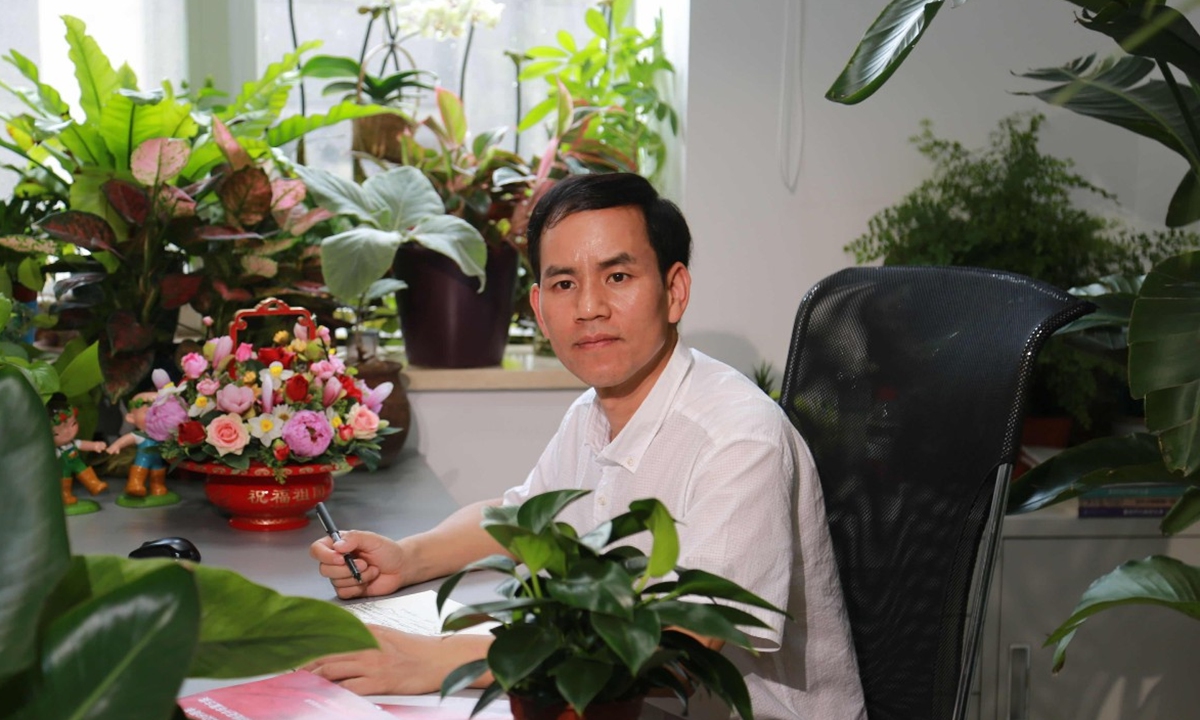
Lan Hailang, chief designer of the Tian'anmen Square flower displays Photo: Courtesy of Lan Hailang
During national celebrations, flower displays in Tian'anmen Square and along Chang'an Avenue often become a highlight of Beijing's cityscape. Yet behind the vibrant colors and carefully arranged plants lies a deeper question for Lan Hailang, chief designer of the displays: How can plants, culture and the spirit of the era be connected within a limited space?
Sometimes the answer comes from a plant found in the countryside, sometimes from an image rooted in history and culture, and sometimes from a book he read decades ago.
"Many elements in our works come from reading, and in turn we feed our creations back into reading," Lan told the Global Times.
Between the pages
Long before Lan became a landscape designer, his imagination had already taken root in the pages of a book.
When he was 9 years old, Lan was introduced to Dream of the Red Chamber, one of China's four great classical novels, by one of his teachers. Yet what fascinated him most was not only the story itself, but the details related to nature woven throughout the book: a particular plant, a courtyard, a spatial arrangement, or even the flowers, trees and food that shaped the characters' daily lives.
Only years later did he gradually realize that these seemingly scattered descriptions in Dream of the Red Chamber together created a complete world. A garden, he came to understand, is not simply about planting trees and flowers; it is a space where people, nature, architecture, culture and ways of life come together.
That early fascination eventually led him to pursue landscape architecture.
After entering university, another book influenced him from a different perspective. How the Steel Was Tempered gave a young man a deeper understanding of perseverance and resilience in the face of challenges.
"For me at that time, the strength conveyed by the book was not just something written on the page. It later became a source of support that helped me keep moving forward through years of study and work," he said.
In Lan's view, the impact of a book does not always reveal itself immediately. Sometimes, it simply plants a thought in someone's mind or leaves behind a small detail. Years later, when that person encounters different situations in life, those things once read may quietly resurface.
This has also shaped Lan's understanding of reading.
"Everything can be read," he said. "Reading is not just about sitting down and opening a book. Nature is a book, life is a book, and communicating with others is also a form of reading. Even a work collaboration or a new design project can become a process of learning and reflection."
"To read thousands of books, travel thousands of miles, learn from countless people, receive guidance from mentors and help from those who support you - ultimately, everything comes down to your own understanding and reflection," he noted.
This broader interpretation of "reading" has also allowed Lan's designs to move beyond simple visual beauty, enabling them to engage with a much larger world.
A readable world
Today, with the rise of the internet and digital media, Lan's approach to reading has become increasingly diverse. Professional books provide systematic theoretical knowledge, while online platforms and short videos help him keep up with the latest design cases and social developments. Even though he frequently browses digital media, he continues to read professional magazines such as Chinese Landscape Architecture.
"In my view, digital media and traditional print media are not contradictory," he said. "For a flower-display designer who faces new themes and tasks every year, it is certainly important to obtain information quickly. But reading in depth still requires us to slow down and think."
"It is not simply about seeing words with your eyes; it means reinterpreting, filtering and distilling what you see in your mind, and ultimately turning it into ideas," Lan noted.
This way of thinking also runs through his design practice. In his view, the questions a person is able to ask can sometimes matter more than the number of answers they remember.
Lan still remembers how, in 2023, his team incorporated grains such as rice, wheat and soybeans into the National Day "Flower Basket" in Tian'anmen Square for the first time.
The idea was about far more than simply creating a new visual design. How could crops from the fields be brought to Tian'anmen Square? How could national food security and traditional Chinese culture be incorporated into a public landscape? To find the answers, Lan and his team consulted extensive historical and cultural materials, tracing the cultural roots of the "five grains."
In the end, the "Five-grain Flower Basket" not only became a distinctive sight at Tian'anmen Square, but also made the otherwise abstract topics of culture and food security more tangible. As people saw rice ears, wheat and soybeans, they were also prompted to think anew about where their food comes from. Traditional expressions such as "lacking physical labor and not knowing the five grains" thus gained a vivid contemporary context.
"What a flower-display designer does is never simply to make flowers look more beautiful. Instead, a flower display can tell a story, convey a culture, and make abstract knowledge concrete and tangible," he said.
And the things that truly sink in through reading will ultimately not remain confined to the pages of a book. They may turn into a design idea, a garden or an urban landscape. They may also, at an unexpected moment, help people reconnect with nature.
RELATED ARTICLES