IN-DEPTH / IN-DEPTH
GT Investigates: How separatist group attempts to spread disaster-related information to mislead public, disrupt order
When Rumors Flood
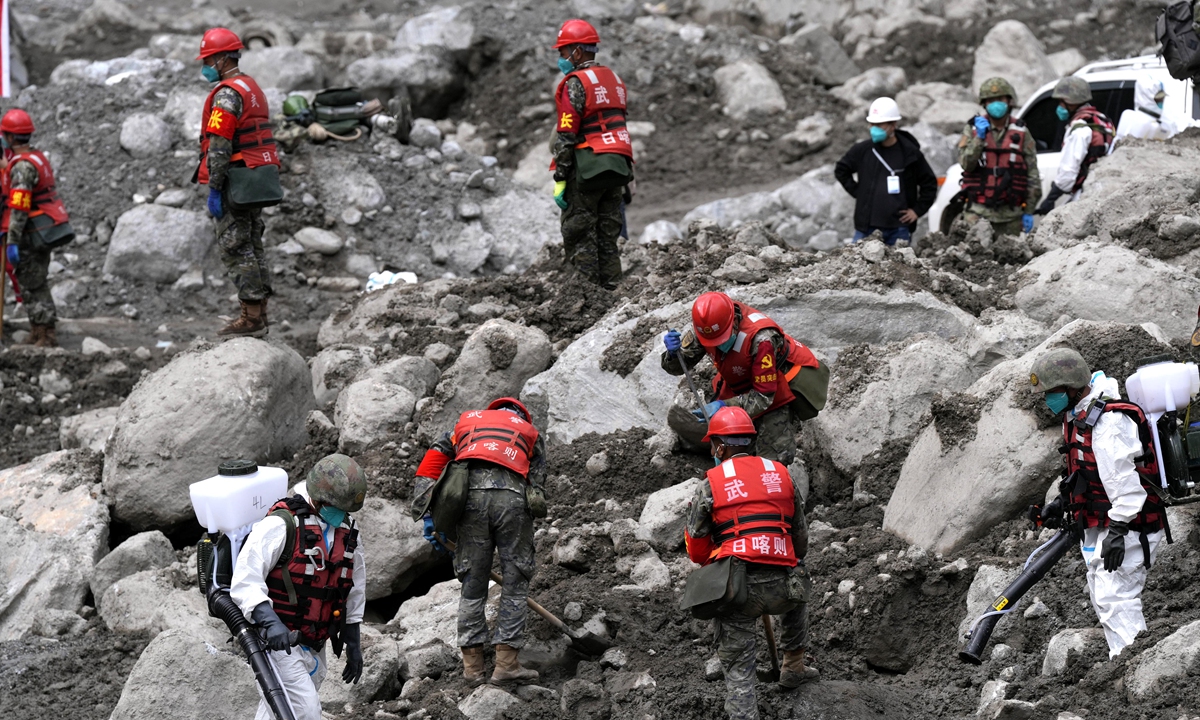
A medical team carries out disinfection work in the core disaster area at Gyirong Port in Southwest China's Xizang Autonomous Region, on September 3, 2026. Photo: VCG
This disaster brought shock and grief to people.
On the morning of August 26, an ice-rock avalanche struck the northern slope of Mount Langtang Lirung in Nepal. The massive debris flow traveled more than 20 kilometers in about seven minutes before hitting Gyirong Port in Southwest China's Xizang Autonomous Region.
Everything was buried in that instant.
As rescuers advanced through falling rocks, fast-moving water and the continuing threat of secondary disasters, another chain was moving more quickly across borders.
The following day, the problematic, anti-China, overseas-based International Campaign for Tibet (ICT) cited anonymous sources in claiming that videos and firsthand documentation were being removed. It framed the disaster response in terms of "information control" and a lack of transparency. Those claims subsequently entered some reports by certain Western media outlets and circulated across social media platforms in different languages.
A review of statements, news reports, social media posts, and publicly available personnel and funding records found that the widely circulated allegations did not originate from publicly verifiable material from the disaster zone. Instead, they were repeatedly relayed among anonymous sources, some so-called advocacy groups, and certain media outlets, as if they were being independently corroborated by multiple sources.
A rescue timeline recast
One of allegations concerned the supposed late arrival of rescuers. In a September 7 statement, ICT cited anonymous sources as saying that rescue workers had not reached "some communities" until roughly 50 hours after the disaster. The statement did not identify the communities, disclose the sources or explain whether "rescue workers" referred to the first teams entering the disaster zone or later reinforcements reaching more remote settlements.
The published timeline provides a more specific account. The disaster struck around 10:30 am on August 26. The following morning, the frontline command formed a 19-member search-and-rescue team comprising local officials, border defense and fire rescue personnel, as well as local villagers.
By 4:30 pm on August 27, the team had reached the border gate, transmitted images from the scene and begun search operations, according to the Xinhua News Agency.
Missing from that narrative was also the condition of the access route. Gyirong town lies about 24 kilometers from the port, with a vertical drop of nearly 1,000 meters. The gorge narrows toward the border, while damaged sections of the G216 highway were hemmed in by unstable cliffs and a fast-flowing river. Parts of the road had been washed away, and some rescuers and equipment initially had to be carried forward by drone, Xinhua stated.
Another allegation by certain anti-China organizations was that Chinese authorities had concealed the information about the disaster or created an "information vacuum."
Yet preliminary casualty figures were released on the same evening after the disaster. Three people had been killed and 265 others remained missing as of 8 pm on August 26, according to initial estimates, after the mudslide struck the port along the China-Nepal border in Southwest China's Xizang Autonomous Region, Xinhua reported, citing officials.
By August 30, the official death toll had risen to 16, while 261 foreign nationals had been identified among the missing. On September 2, the figures were updated to 21 dead and 541 missing, according to Xinhua.
A latest notice released by China's Ministry of Emergency Management on September 18 said that 562 people had been killed or remained missing after the mudslide that struck Gyirong Port.
The record of casualty updates, lists of missing foreign nationals, and reports on rescue and road-repair work does not support the baseless assertion about lack of disaster information.
Another allegation distorted the so-called disappearance of social media posts as evidence that authorities were suppressing the true death toll. ICT's initial statement claimed its "sources" inside Xizang had confirmed that videos and other firsthand documentation were being removed. It provided no complete original posts, account details, upload times or unedited footage, nor did it specify whether the removed material contained unverified casualty figures.
At the same time, Chinese police disclosed cases involving social media users who had circulated death tolls far exceeding any verified count.
One account claimed that more than 3,000 people had died, while another video put the toll at more than 10,000. The people involved in spreading the rumors received administrative penalties, according to the Ministry of Public Security's cybersecurity authorities.
The allegations drew their force from fragments of a complicated disaster. What happened next was crucial: These fragments did not remain on the website of an anti-China advocacy organization. The allegations even made their way into international news coverage, where repeated attribution began to look like "independent confirmation."

Conceptual photo Photo: VCG
Rumor spreading chains
Some media reports and organization statements have suggested that, one of the key drivers behind the rapid spread of false narratives about the mudslide disaster hitting Gyirong beyond its regional confines into Western discourse was the separatist group ICT.
In a statement released on September 3, ICT itself laid out its activities after the disaster in what amounted to a "media outreach checklist": its president, Tencho Gyatso, gave interviews to The Guardian, AFP, Le Monde and Sky News, among others. Its executive director, Ryan Fioresi, spoke with several outlets, including The New York Times, CNN, the BBC, NPR, Radio Free Asia and ABC News Australia. Also, members of the organization published opinion pieces in The Diplomat and reached out to Deutsche Welle, The Daily Telegraph, Spain's El País in search of further platforms.
This statement to some extent lays out the prearranged chain through which the narrative was disseminated. First, fragmented claims are introduced; then, they are elevated into an "official statement" by separatist groups like ICT. Next, senior figures within the organization gave interviews to mainstream media to amplify the exposure, after which multiple Western outlets cite one another in a circular pattern of so-called "cross-confirmation," packaging the narrative as a "verified fact" supposedly supported by "multiple sources."
The Guardian's September 8 story follows this same pattern. The story's central claims were drawn primarily from the ICT's leadership, "pro-Xizang independence" secessionists, two anonymous purported former Chinese media professionals and some social media posts that could not be independently verified for authenticity.
The Global Times found that the story blended the accounts of victims' families with ICT's own judgments and untraceable anonymous allegations, while the headline itself advanced a clear predisposed conclusion.
Worse still, unlike the rumor surrounding the recent disaster hitting Gyirong, in which separatist groups and some media outlets played a major role, the fabrication and spread of misinformation concerning Xizang has now entered a new phase in which AI is doing much of the heavy lifting, said Dong Guanpeng, dean of the National Institute of Public Relations and Strategic Communication at Communication University of China.
He pointed out that Generative AI in particular has significantly lowered the barrier to producing fabricated evidence, making invented images and videos a new "weapon" for manipulating public opinion.
According to an AFP report, a video that circulated on September 18 and was portrayed as footage from a CCTV camera at Gyirong Port was actually based on an older video posted by the official Douyin account of Gyirong County in May. A sudden wall of water was inserted into the circulating version, which was then reposted in Chinese, Nepali, English, and Arabic.
Although it was not flagged by detection tools, visual inconsistencies including a person appearing out of nowhere and structures changing position, suggested that the clip had been manipulated with AI tools, according to AFP.
Such cases are typical of matrix-style cognitive infiltration, said Zhu Wei, an associate professor at China University of Political Science and Law. While a single account may have limited influence, dozens of accounts repeatedly pushing the same false content can create the illusion that "everyone is saying the same thing, so it must be true." "It exploits people's cognitive inertia and information asymmetry. When a claim keeps appearing in your feed, many people will simply assume it is true," Zhu told the Global Times.
Who is profiting from spreading these rumors targeting China?
Dong observed that rumor spreading operates as an entire "industrial chain." He found that when AI technology lowers the barrier to producing misinformation, and regulatory gaps across borders create room for maneuver, a low-cost, highly covert rumor-making pipeline emerges.
Amid downward pressure on the global economy, many small public relations and marketing studios outside China have seen their businesses shrink. Some have begun taking on anonymous fabrication work, evading law enforcement and regulation by operating across borders, Dong said.
"Many of these small 'workshops' overseas have no political agenda; they are simply trying to make money. This makes the cost of producing rumors extremely low, and also makes it much harder to eliminate them at the source," he told the Global Times.
What the headlines left out
While allegations of delayed rescue and information suppression were crossing borders, people were already moving through the disaster zone.
The first 19-member team to reach the border gate included local officials, border and fire rescue personnel, as well as villagers. They carried water-rescue, demolition, detection and communications equipment, used drones to survey the route ahead and transmitted images from the scene.
Farther back, workers were still rebuilding the only land route toward the port, while heavy-lift drones carried personnel and essential supplies across sections where vehicles could not pass.
Foreign journalists later visited the disaster area and witnessed the rescue operation firsthand. A group of reporters from CNN, Reuters, NBC and other international media outlets traveled from Lhasa to Gyirong Port, where they spoke with technical experts, local officials and rescue workers about the search for missing people, victim identification, community assistance and secondary-disaster prevention, Xinhua reported.
Brazilian journalist Bruno Falci Bitarelli Medeiros said the 12-hour journey from Lhasa had given him a sense of the difficult conditions facing rescuers. "It's a very difficult condition for the workers, and I very much admired how they keep searching for people," he said.
At the disaster site, reporters saw heavy machinery excavating debris layer by layer. As of 6 pm on September 5, China had deployed more than 2,500 rescue personnel, over 500 vehicle trips and more than 9,000 sets of search equipment, while air-dropping more than five tons of supplies, according to the report.
Pakistan's Associated Press correspondent Muhammad Asghar, who observed the monitoring of geological hazards, said: "The monitoring for secondary disasters is being done tirelessly, day and night."
Medeiros also noted the role of technology in the rescue effort. "The technology today is being very helpful to rescue operations in this disaster," he said. "Some countries use drones for war, but China uses drones to help people."
At Gyirong, the road to the disaster zone had to be reopened meter by meter through mud, rock, and rushing water. Yet rumors based on anonymous sources could cross platforms, languages, and borders within hours.
The distance between those two speeds is the distance fact-checking must race to close.
RELATED ARTICLES