Electricity power lights up more than just factories
By Published: Sep 23, 2026 06:40 PM

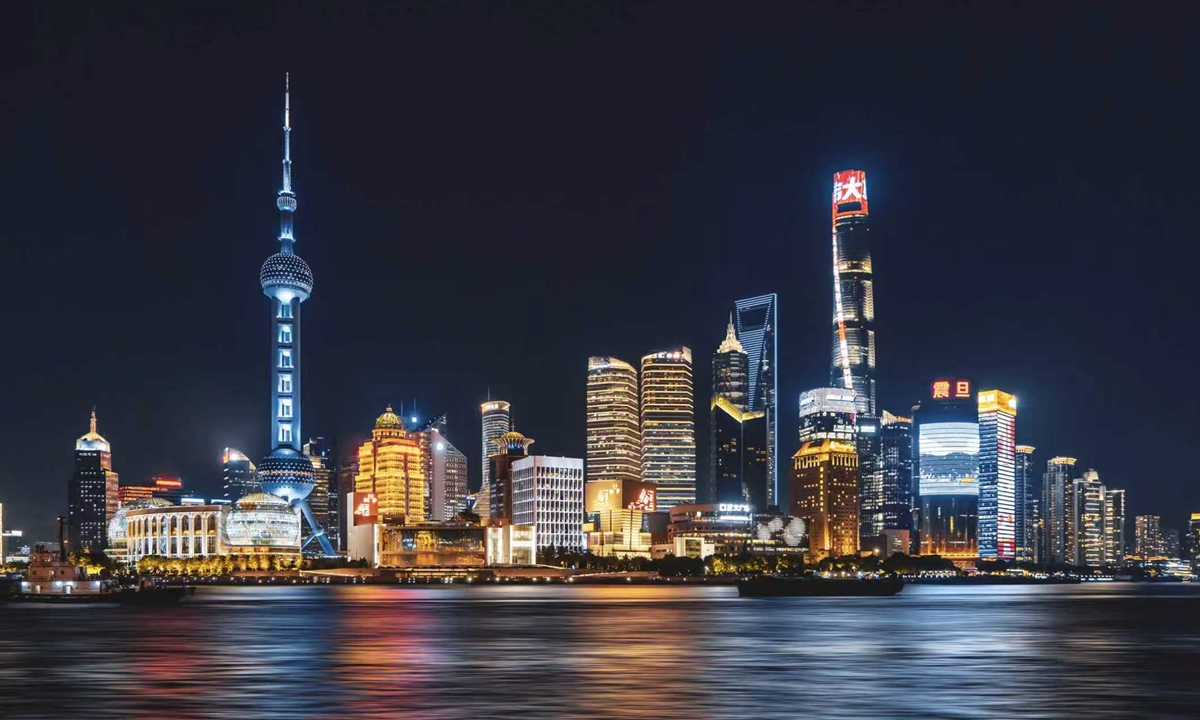
A view of Shanghai photo: VCG
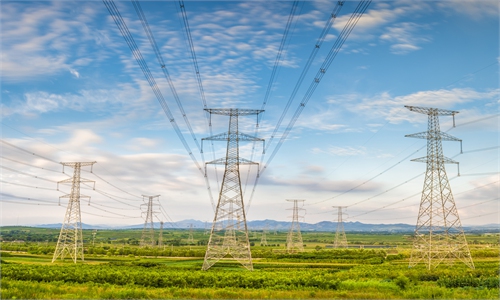
China's electricity consumption exceeded 1 trillion kilowatt-hours (kWh) in August, the National Energy Administration data showed just a few days ago.Already in 2025, China's total electricity consumption reached 10.4 trillion kWh, making it the first country in the world to consume more than 10 trillion kWh in a single year - roughly 2.5 times the US' annual consumption of about 4.2 trillion kWh.
For many observers, the immediate takeaway is that Chinese industry is enormously powerful: Its manufacturing base is vast, and the future growth of artificial intelligence, data centers and electric vehicles is already underwritten by ample power supply. Much of the commentary from American and European experts and media follows this line. They interpret the expansion of China's power sector as a signal that Beijing intends to "dominate," both industrially and technologically.
That reading captures only one side of the story. China's power development is not merely an instrument of industrial competition; it is also about delivering an affordable modern life to ordinary people.
Price is the key to understanding this.
Last year in Liupan Mountains of Northwest China's Ningxia Hui Autonomous Region, I saw a transformation. Farmers, once reliant on coal/firewood for heat and cooking, now enjoy stable grid power. Many homes have modern appliances, some have electric cars and electric heating is becoming increasingly common. With electricity under 0.45 yuan ($0.07)/kWh and time-of-use discounts, affordability, not just access, defines their new reality.
Switching from coal/wood to electricity transforms daily life: cleaner homes, healthier air, and less hauling for older people and children. Electric cars cut travel costs. Reliable power brings refrigeration, telecom, online education and e-commerce to rural areas. For city dwellers, it's a utility; for mountain families, it's a gateway to modernity.
China's residential electricity is $0.08/kWh, significantly cheaper than the US ($0.17 cents) and Germany ($0.41).
Electricity prices, of course, cannot be compared simplistically: Countries differ in energy mix, taxation, transmission and distribution systems, subsidy mechanisms, and market rules. But for an ordinary household, the most direct experience is the monthly bill. Low, stable prices mean air conditioning, water heaters, winter heating and EV charging never become a heavy burden.
So when I saw the data of China's residential electricity consumption both last year and last month, I did not read it simply as "rising energy use." To a large extent, it reflects the electrification of everyday life - more people enjoying air conditioning, clean heating, convenient cooking, smart appliances and modern transport. Behind growing power consumption lie growing consumption capacity, public services and quality of life.
Crucially, China's residential electricity use still has enormous room to grow, and the government attaches great importance to this area. The distinctive feature of China's power development is that it serves two purposes at once: It underpins the world's largest industrial system, securing manufacturing, the digital economy and emerging industries; and it connects to the daily lives of urban and rural residents, ensuring that more families obtain stable, clean and convenient energy at a reasonable cost.
That is why I reject the simplistic framing of China's power expansion as a bid to "dominate." China certainly needs strong industrial capabilities and must stay competitive in the new technological revolution. But its deeper goal is to extend modern infrastructure, the fruits of industrial development, and better living conditions as broadly as possible to everyone in a country of 1.4 billion people.
Ten trillion kWh is not only the hum of factory machinery or the glow of data-center servers. It is also the warmth in a mountain farmhouse on a winter night, the steady light under which a child does homework, the lower cost of an electric car rolling out of a village and the most modest expectation of millions of families for a better life.
Industry needs more stable power; people's lives need power that is more reliable and more inclusive. Understanding this helps us better understand Chinese modernization: It copies no one, nor does it merely chase anyone. It is a path - shaped by China's own conditions, population scale and stage of development - in which industrial strength and improvements in everyday life sustain each other and move forward together.
The author is a senior editor with the People's Daily. dinggang@globaltimes.com.cn. Follow him on X @dinggangchina
RELATED ARTICLES