IN-DEPTH / IN-DEPTH
From teacher exchanges to ‘50,000 in Five Years’ initiative, how grassroots connections are shaping China-US relations
Classrooms across the Pacific
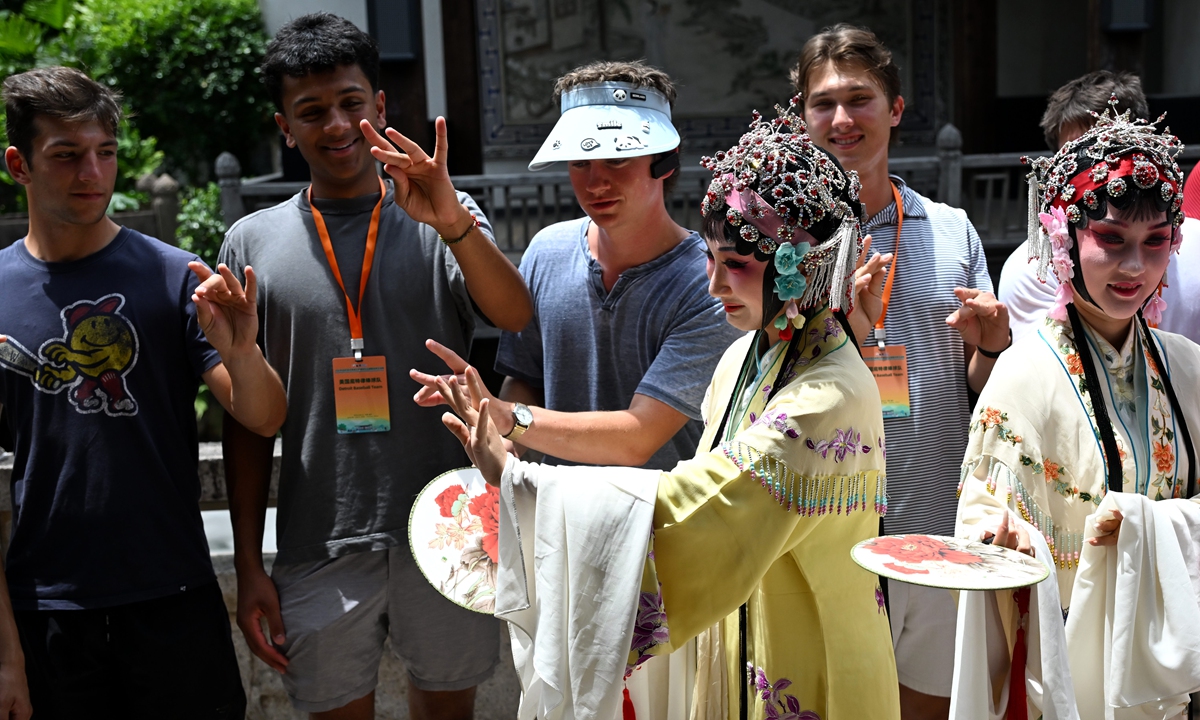
Young American participants learn traditional hand movements from Min Opera performers during a cultural exchange activity in Fuzhou, Fujian Province, on July 1, 2026. Photo: IC
At a China-US teacher exchange event in late August, Qian Jianfen, an English teacher from Suzhou No. 1 High School, watched a crowd of Chinese educators gather around an elderly American man: Ronald Sakolsky, a veteran educator known to his Chinese colleagues as Mr S.Twenty-six years ago, Qian took part in a program organized by the China Education Association for International Exchange (CEAIE) and spent a year teaching in Colorado. She lived with an American family during her stay. The experience changed the way she understood the US, and the two families have remained in touch for more than two decades.
That same year, Sakolsky was teaching in China as part of CEAIE's China-US teacher exchange program. During that year, he met Yin Yuzhen, a Chinese woman who had spent years planting trees and fighting desertification. This summer, Sakolsky returned to China. He revisited the trees he had planted 26 years earlier and reunited with former students and teachers.
The two journeys began in different classrooms, but they shared a starting point: a trip across the Pacific that grew into a lasting connection.
The August exchange event brought together some 150 Chinese and American teachers, students and educators online and in person. Attendees shared intimate, unassuming memories: the nervousness of their first cross-Pacific trip, reunions with long-lost students, American children learning to use chopsticks for the first time, and Chinese teachers and students adapting to life in American households.
Taken separately, these might seem like small, private stories. Together, they trace nearly three decades of China-US educational exchange.
Since 1996, the CEAIE has worked with the American Council of Learned Societies and the National Committee on United States-China Relations on a teacher exchange program, establishing a structured channel for two-way exchanges between educators in the two countries.
Over the years, those exchanges have expanded beyond teachers. Programs have grown from yearlong teaching placements to language summer camps, student exchanges and dual-degree programs. What began as individual journeys across the Pacific has gradually developed into a broader network of recurring exchanges.
In November 2023, China proposed an initiative inviting 50,000 young Americans to China over five years for exchanges and study.
In May, the Chinese Foreign Ministry announced that the target of the "50,000 in Five Years" initiative had been reached two and a half years ahead of schedule.
The number tells only part of the story. Behind it are generations of teachers, students and program organizers who have kept the exchanges going. Face-to-face meetings let them know a specific person and a real society, and allow one personal cross-border experience to become the starting point of the next friendship.
Exchanges ever evolving
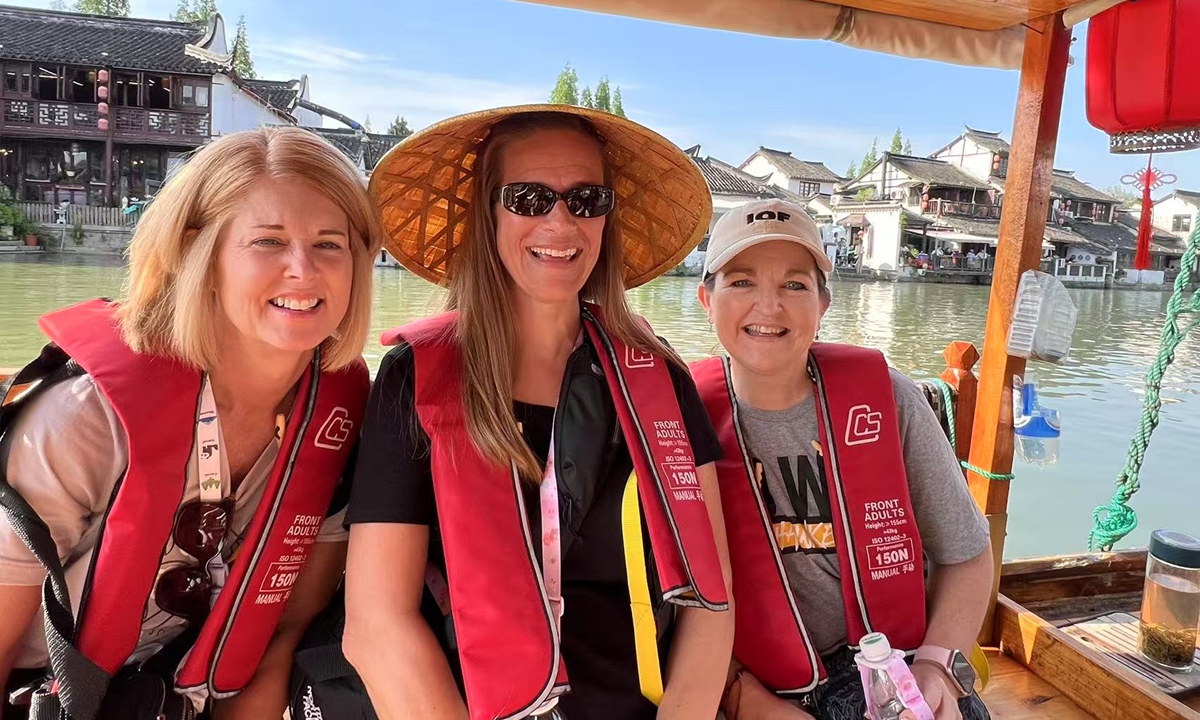
Teachers from Muscatine High School take a boat ride to experience a traditional water town during their visit to China in April 2024. Photo: Courtesy of Muscatine High School
Qian first arrived in the US in August 2000.She stayed with an American family whose host mother was herself a history and geography teacher. Their conversations began with teaching and gradually moved into family life, children and everyday concerns.
More than two decades later, whenever Qian visits the US, she still makes time to see her former host.
For Qian, the year abroad offered more than teaching experience. She saw firsthand that individual people were far more complicated and varied than the national images presented in textbooks or news reports. She also noticed that many American students were interested in Chinese culture but knew relatively little about China. They frequently asked questions about the country.
The experience strengthened her belief that educational exchange should work in both directions: young people should be encouraged to come to China and see it for themselves, while more Chinese teachers and students should travel abroad and introduce China to others.
After returning to Suzhou No. 1 High School in East China's Jiangsu Province, she began thinking about how to bring American students to China.
From 2013 to 2019, the school hosted the summer camp for six consecutive years, welcoming roughly 20 top-performing American high school students annually.
Selected through a nationwide screening process in the US, the students spent 45 days in Suzhou, living with local Chinese families, studying Putonghua and engaging with traditional Chinese culture through school and community activities.
Before the students arrived, Qian and her colleagues repeatedly reviewed the curriculum and visited each prospective host family to make sure students would have a safe and comfortable home.
The school tailored language courses to different proficiency levels with beginner, intermediate and advanced classes. Cultural lessons included Kunqu opera, martial arts, traditional Chinese painting and folk music. Practical activities took students to nursing homes, special education schools and local communities.
Some of the most important lessons had no textbook. Making dumplings, learning to use chopsticks and living with a Chinese family were themselves part of the curriculum.
The early years were not easy. Qian told the Global Times that during the first round of cooperation in 2013, the US side required extensive documentation and qualification reviews.
As the two sides gained trust, the process became more streamlined. A cross-border partnership that might once have been a one-time visit began to develop into a repeatable system.
A similar evolution has taken place in higher education.
The Sino-American Cooperation in Higher Education and Professional Development (CHEPD) 1+2+1 program, launched in 2001, has involved more than 200 universities in the two countries. Wu Qin, deputy director of the China Center for International Educational Exchange and director of the program, told the Global Times that the original model was relatively straightforward: Chinese students spent their first year in China, two years in the US and a final year back in China, earning degrees from both countries.
The program has since expanded into two-way exchanges, with American students and faculty coming to China for longer-term study visits, short-term visits and teaching exchanges.
To keep such cooperation running smoothly, the program has developed a multilayered communication system. University leaders provide support, while academic affairs and international offices coordinate implementation at the institutional level, with departments, counselors and program coordinators handling the work on the ground, Wu introduced.
Persistent echo
or Wu, some of the most revealing moments have come from American participants after they return home.
In July, You Bourin of Salem State University completed a three-week study visit to China. He described the trip as a unique opportunity to experience Chinese culture, share aspects of American education and culture with Chinese people and form friendships that could last a lifetime.
As a clinical social worker, he said he believes that human connection and understanding one another's experiences are foundations for mutual growth. When people remain connected, he said, differences between countries do not have to become barriers.
Stephenson Kyon Latell of Kentucky State University was struck by the importance that Chinese young people placed on education and peace. To remember his experience in Xi'an, Northwest China's Shaanxi Province, he wrote, "Education is hope, peace is power."
Traveling through Jinan, Tai'an and Qufu in East China's Shandong Province, Stephenson said he encountered warmth across generations, from children to older people, and left China regarding it as a second home across the Pacific.
Pinto Bladimir Martinello of Salem State University described education as a universal language. Visiting Beijing, Xi'an and Qufu, he said, changed his understanding of China and showed him values such as kindness, friendship and harmony that he viewed as shared across societies. Stepping outside his comfort zone, he added, had also made him more independent and confident.
Similar reactions have come from participants in the "50,000 in Five Years" initiative. For these young participants, exchanges do not end with their return flights. Luke Kelly, a graduate of Steilacoom High School who took part in a study visit to China in 2024, shared that after returning home he told his family and friends that he wanted to come back and bring them with him.
Anna Colbaugh from Lincoln High School has continued to communicate with Chinese friends on WeChat. Before her trip, she said, her understanding of China had been shaped largely by "one-sided stereotypes." Visiting the country allowed her to form her own impressions, which she could then share with people around her.
Qian has also witnessed this sustained impact through follow-up surveys: most American camp participants continued studying Putonghua after returning home, with measurable improvements in their language proficiency. Many of her US students have since enrolled at top US universities, including Harvard, Yale, and Stanford.
From encounter to mutual understanding
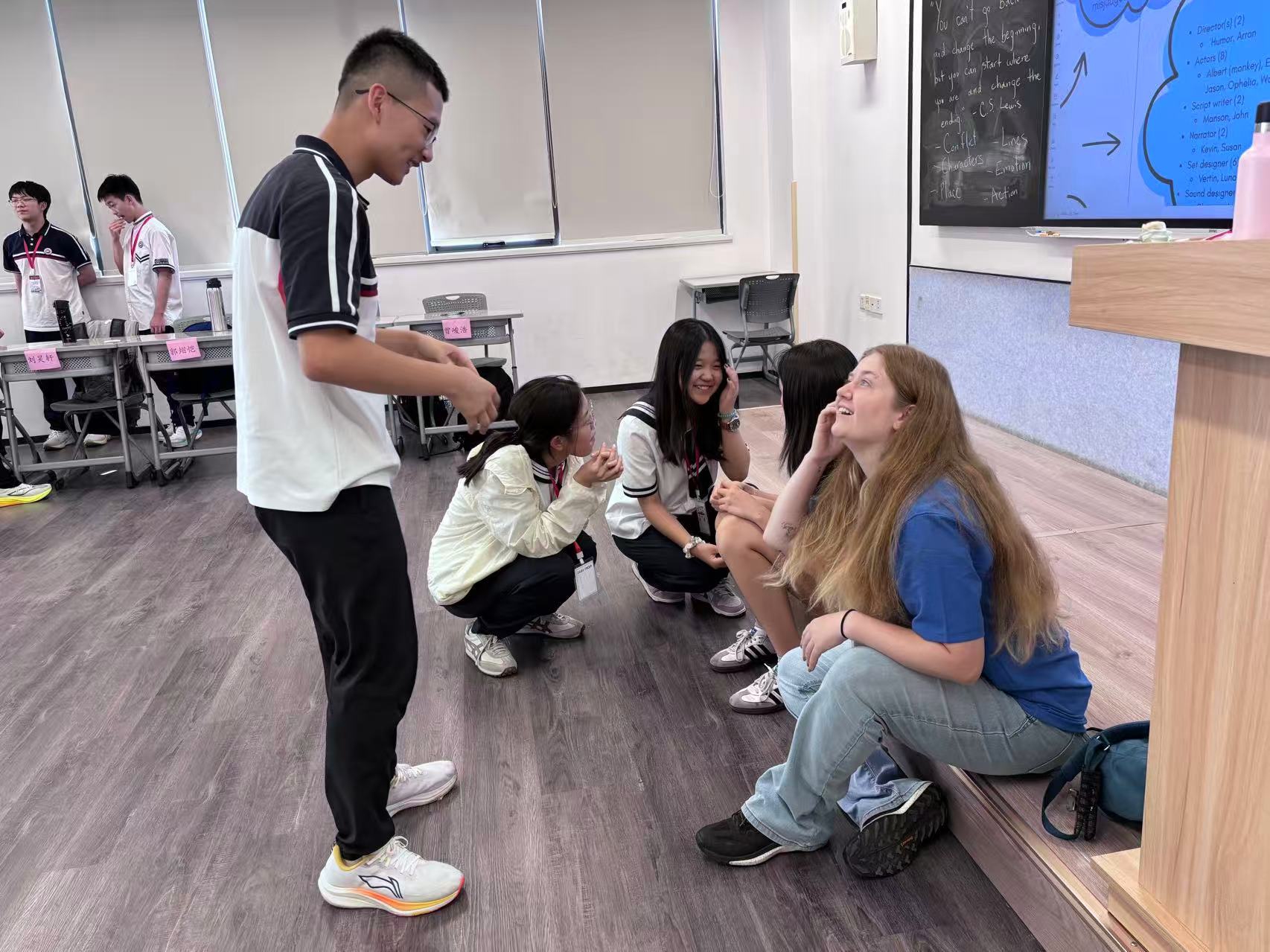
Chinese high school students stage their own performance with the guidance of American university students for the 2026 International (US-China) Youth Cultural Exchange Program in Xi'an, Shaanxi Province, on July 13, 2026. Photo: Courtesy of Wu Qin
Recently, a report released by the Chicago Council on Global Affairs found that most younger Americans do not see China as a "critical threat" to the US and favor a policy of cooperation and engagement. The report carries a clear-cut headline: "Gen Z Isn't Concerned About China," noting that younger Americans were less likely than older generations to characterize China as a competitor or adversary.An April 2026 Pew Research Center poll also found more favorable views of China among Americans.
Fu Bo, standing council member of the CEAIE, who accompanied Sakolsky throughout his visit, told the Global Times that in earlier China-US exchanges, the core question was: How do we get young people from the two countries to meet?
Now, as more students have entered one another's classrooms, other questions have emerged. Can they stay in touch after they meet? Can a short visit become long-term study, and curiosity about another culture develop into deeper understanding? Can young people from the two countries find practical ways to talk and work together on issues such as climate change and technological development?
Wu stressed that exchanges are progressing from "initial encounters" to "genuine mutual understanding." She said that youth engagement helps young people move beyond biased secondhand information and form independent judgments, and she hopes future exchange programs will broaden their agenda from language and culture to global challenges, opening more space for meaningful, pragmatic cooperation.
For many of these programs, reaching a target is a milestone, not an endpoint. Larger-scale and deeper cross-cultural exchanges still lie ahead, Fu said.
"The bridge between the US and China is built brick by brick, by ordinary people from both countries," Sakolsky told the Global Times in an earlier interview.
At the Beijing event in August, Qian lingered after the closing ceremony.
For her, the gathering was also a moment of looking back.
She had once been the Chinese teacher boarding a plane across the Pacific and walking into an American classroom for the first time. Years later, she stood at her school welcoming American teenagers making their first journeys to China.
Now, her school is applying to participate in the "50,000 in Five Years" initiative, preparing a dedicated team and bilingual teachers while selecting student volunteers to be paired with visiting students as partners and friends.
"Exchange knowledge in the classroom, and exchange hearts beyond the classroom," Qian said. "Every sincere meeting and every meaningful interaction adds another brick to the foundation of understanding between our two peoples."
RELATED ARTICLES