GT Exclusive: Chinese medical experts share frontline experience in tackling Africa’s second-largest Ebola outbreak
By and Fan Wei Published: Sep 24, 2026 08:27 PM

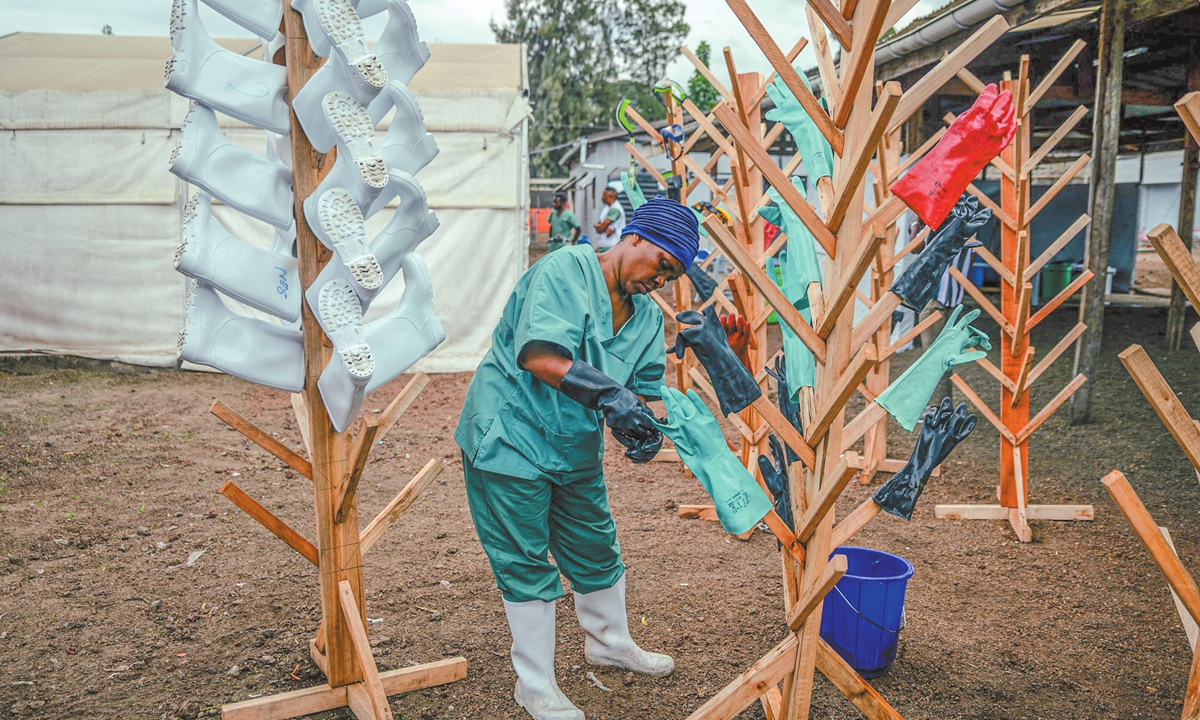
A staff member hangs up gloves to dry after washing them at the Ebola Treatment Center (ETC) in Munigi, in the Democratic Republic of the Congo on June 2, 2026. Photo: VCG
Since arriving in the Democratic Republic of the Congo (DRC), Wang Ji, a member of China's third medical expert team for the Ebola response and an expert with the Chinese Center for Disease Control and Prevention's National Institute for Viral Disease Control and Prevention, has been grappling with one question: As the Ebola outbreak intensifies, how can China's experience be better adapted to the realities of local primary healthcare systems?
In April, a nurse from Ituri Province in northeastern DRC died after developing symptoms including a high fever, raising the alarm over the country's 17th Ebola outbreak. According to the latest update from the World Health Organization (WHO), more than 7,000 confirmed cases have been reported as of mid-September in the current outbreak.
The WHO said on its website that the outbreak was caused by the Bundibugyo strain of the Ebola virus, for which there is currently no approved vaccine or specific treatment.
As the outbreak rages on, treatment alone is clearly no longer enough to contain the spread of the virus. For the Chinese medical experts deployed to the DRC to help fight Ebola, the challenge is formidable, but not insurmountable. The key to turning the tide lies in shifting the focus from treatment at the end of the response to prevention at the source. With that goal in mind, the Chinese team has gone to the front lines, bringing China's experience in epidemic prevention and control.
Grid-based management at the village level
At a media briefing, WHO Director-General Tedros Adhanom Ghebreyesus said the Ebola outbreak in the DRC had become the second-largest ever recorded and was spreading faster than any previous Ebola outbreak.
At its current pace, the outbreak could surpass the scale of the 2014-2016 Ebola epidemic in West Africa, Tedros warned.
The WHO's assessment was based on the rapidly rising case numbers. It took just 40 days after response measures were launched in May for confirmed Ebola cases to surpass 1,000. By comparison, it took 235 days for cases to reach the same level during the 2018 Ebola outbreak in the DRC.
Ghebreyesus said on his X account in July that "most of those deaths occurred in communities, not in Ebola treatment centres. Community engagement and ownership of the response remain central to saving lives and stopping this virus."
Working deep in local communities and strengthening grassroots prevention, control and surveillance capabilities have been a top priority for the Chinese medical team supporting the DRC in its Ebola response.
"DRC's health authorities have developed a village-centered prevention and control model, while we have adapted relevant management approaches from China to the local context," Deng Yongqiang, a member of China's third medical team for the Ebola response to the DRC, told the Global Times.
Deng said the Chinese experts shared China's experience in more targeted management at the community level, assisted Congolese counterparts in training grassroots healthcare workers to identify Ebola cases, and recommended streamlining reporting procedures and establishing a more effective mechanism for consolidating data, helping the DRC build an efficient early case-detection mechanism at the community level.
Notably, the approach has been tailored to local conditions. Confirmed Ebola cases in the current outbreak have been reported in 62 health zones across six provinces in the DRC, with the eastern provinces of Ituri and North Kivu among the hardest hit. As of September 7, Ituri had reported 5,406 confirmed cases and North Kivu 1,066, with a case fatality rate of 65.4 percent.
At the same time, the two provinces are also areas where multiple armed groups are active, including the Cooperative for the Development of the Congo (CODECO), the Allied Democratic Forces (ADF) and the People's Revolutionary Party. The areas have been long faced insecurity, with weak communications, transportation and healthcare infrastructure and large numbers of displaced people..
"Our plan follows a localized approach and takes full account of practical constraints on the ground, including armed conflict, power supply and logistical challenges," Wang said.
According to Wang, the Chinese expert team has designed its response measures to make full use of the existing capacity of local communities and primary healthcare facilities. It has also trained Chinese medical teams working in the DRC to conduct routine active screening, with the aim of enabling early detection and early warning ..
In addition, preventing cross-border transmission is also a key focus of the Chinese expert team. Ituri and North Kivu, the two eastern provinces severely affected by the current Ebola outbreak in the DRC, both border Uganda, and cases have already spread across the border into the neighboring country.
Given the heightened risk of cross-border transmission, China's third medical expert team supporting the Ebola response also includes specialists from the General Administration of Customs of China.
"To strengthen regional public health defense and prevent the virus from spreading across borders, it is not enough to enhance screening and control measures at border crossings. We also need to establish a cross-border mechanism for information sharing and coordination," Gao Yong, a member of China's third medical expert team for the Ebola response, told the Global Times.
Gao said frequent cross-border movement between the DRC and Uganda makes it necessary to strengthen oversight of informal border crossings. At the same time, the two countries need to share updates on the outbreak and information on close contacts, remove information barriers to cross-border contact tracing, ensure closed-loop management of people at risk, and advance coordinated regional emergency response efforts.
"Experience has shown that public health practices can only be truly effective when they are adapted to local institutions, resources and social and cultural conditions," Wang said.
"The value of China's experience does not lie in simply replicating Chinese practices elsewhere, but in sharing the challenges we have encountered and the lessons we have learned in addressing them, and working with our African counterparts to explore prevention and control approaches to local conditions."
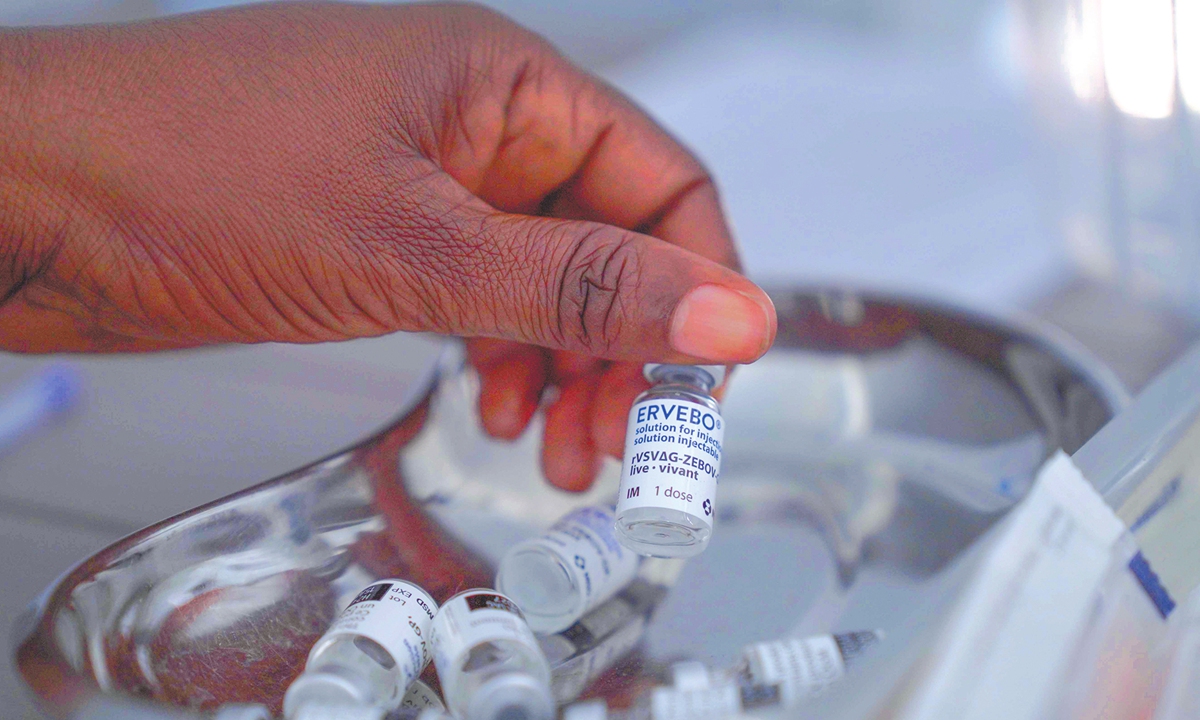
A healthcare worker holds up a vial of the Ervebo vaccine at an Ebola vaccination center in the city of Bunia, Ituri province, Congo on September 19, 2026. Photo: VCG
Moving the line of defense forward
Today, even small laboratories at primary-level health facilities in Ituri Province are equipped with benchtop diagnostic devices. These tools have significantly shortened the time needed to test for the Ebola virus, allowing health workers to take life-saving measures more quickly and curb further transmission.
At the beginning of the outbreak, however, virus samples had to be transported to the national reference laboratory in Kinshasa, the DRC capital, for further analysis to determine the type of Ebola virus involved.
The decentralized testing approach currently used in the DRC has significantly strengthened diagnostic capacity at local laboratories and reduced reliance on laboratories in the capital, Kinshasa. This has enabled health facilities across the country to deliver test results more quickly and substantially increase their Ebola testing capacity.
"The DRC has now reduced the testing turnaround time to 24 hours, and the arrival of Chinese testing equipment will undoubtedly help move rapid testing closer to the front lines," Deng said.
Deng said Chinese-made mobile laboratories and rapid diagnostic test kits provided by China have passed performance validation conducted by the DRC's National Institute of Biomedical Research (INRB) and are being gradually deployed to mining areas and border crossings. Their deployment will help address the challenges of transporting samples over long distances and further strengthen local capacity for Ebola virus testing.
More decentralized laboratories are now being established in towns and villages in Ituri and North Kivu provinces near the DRC's border with Uganda. Placide Mbala, a professor at the DRC's INRB, said the move would significantly improve epidemiological surveillance.
Meanwhile, the Chinese expert team is also working to strengthen laboratory testing, medical treatment and emergency response capacity in areas along the DRC-Uganda border, while carrying out health education and awareness campaigns to strengthen the region's public health defenses.
"This outbreak has shown us that cooperation, too, needs to move closer to the front line," Xu Kaijin, a member of China's medical expert team for the Ebola response, told the Global Times.
Xu said one of the key elements of epidemic response is to help African countries strengthen their public health systems, particularly their capabilities in disease surveillance, laboratory diagnostics and primary healthcare.
"When dealing with a highly infectious virus like Ebola, only by detecting cases and responding as early as possible can we contain the risks at an early stage," Xu said.
China's deployment of multiple medical expert teams to the DRC during the current outbreak marks another deployment of Chinese medical teams to an African country hit by Ebola since the 2014-2016 West Africa Ebola epidemic.
Just as China helped West African countries strengthen their public health systems during the earlier Ebola response, Chinese medical experts in the DRC are once again emphasizing the principle of "teaching people how to fish" - focusing not only on the immediate outbreak but also on building local capacity for epidemic prevention and control.
Zhang Fangqing, head of China's 24th medical team to the DRC, said a key focus of the current assistance program is strengthening local health workers' capacity to respond to outbreaks.
"From the outset, the program must take into account how operations can be sustained after Chinese experts leave," Zhang said. "Training, equipment maintenance and the development of local health professionals all need to be incorporated into the overall plan."
The current assistance program is designed to address both the immediate response needs and long-term capacity building. The Chinese expert team has provided practical recommendations to its Congolese counterparts on disease surveillance, sample collection and transport, laboratory testing, and infection prevention and control, while also coordinating hands-on training in protective measures and follow-up scientific and technological cooperation. Measures are being rolled out step by step as conditions allow, with an emphasis on delivering tangible results.
The Chinese team has also held exchanges with local research institutions on rapid diagnostics, pathogen surveillance, the One Health approach and talent development, with the aim of fostering sustained institutional cooperation.
"Our technical cooperation focuses on end-to-end sustainability. We are not simply providing equipment and expertise, but also helping establish operational procedures, quality-control standards and maintenance systems, with the ultimate goal of leaving lasting capacity on the ground," Wang said.
In the longer term, Wang said, African countries need more responsive surveillance and reporting networks linking communities with healthcare facilities to better tackle major infectious diseases. They also need reliable, tiered laboratory networks and sample transport systems, well-trained and stable frontline health teams, and resilient supply chains for essential medical supplies.
He added that stronger coordination is also needed among government agencies, across borders and with local communities, while ensuring that essential healthcare services remain uninterrupted even during major disease outbreaks.
"To leave Africa with a medical team that cannot be taken away" has been the enduring pursuit of successive generations of Chinese medical teams providing aid abroad. Compared with one-off material donations, carrying out technical exchanges and talent development tailored to local conditions is more conducive to the sustainable development of infectious disease prevention and control in African countries.
China's health cooperation with African countries combines emergency response with efforts to strengthen healthcare system resilience. It not only respects the needs of African partners but also pragmatically advances capacity building through talent development and institutional strengthening, contributing to the building of a global community of health for all.
Notably, China was also among the first countries to dispatch a medical team to the DRC after the WHO declared the Ebola outbreak a public health emergency of international concern on May 17.
By sending a medical team to support the DRC in its Ebola response and providing necessary supplies and financial assistance to relevant countries, China is taking concrete actions to promote greater equity and accessibility in global public health.
Members of the medical team for the Ebola response said, "Infectious diseases know no borders. Through concrete action, we will work with African and other developing countries to advance the building of a global community of health for all, while implementing the Global Development Initiative, Global Security Initiative, Global Civilization Initiative and Global Governance Initiative in the field of global health."
RELATED ARTICLES