IN-DEPTH / IN-DEPTH
Seeds of friendship: small acts of kindness connected Chinese and American teacher across 26 years
By , Tian Minqi in Hetian and Lin Xiaoyi in Beijing Published: Sep 24, 2026 10:38 PM

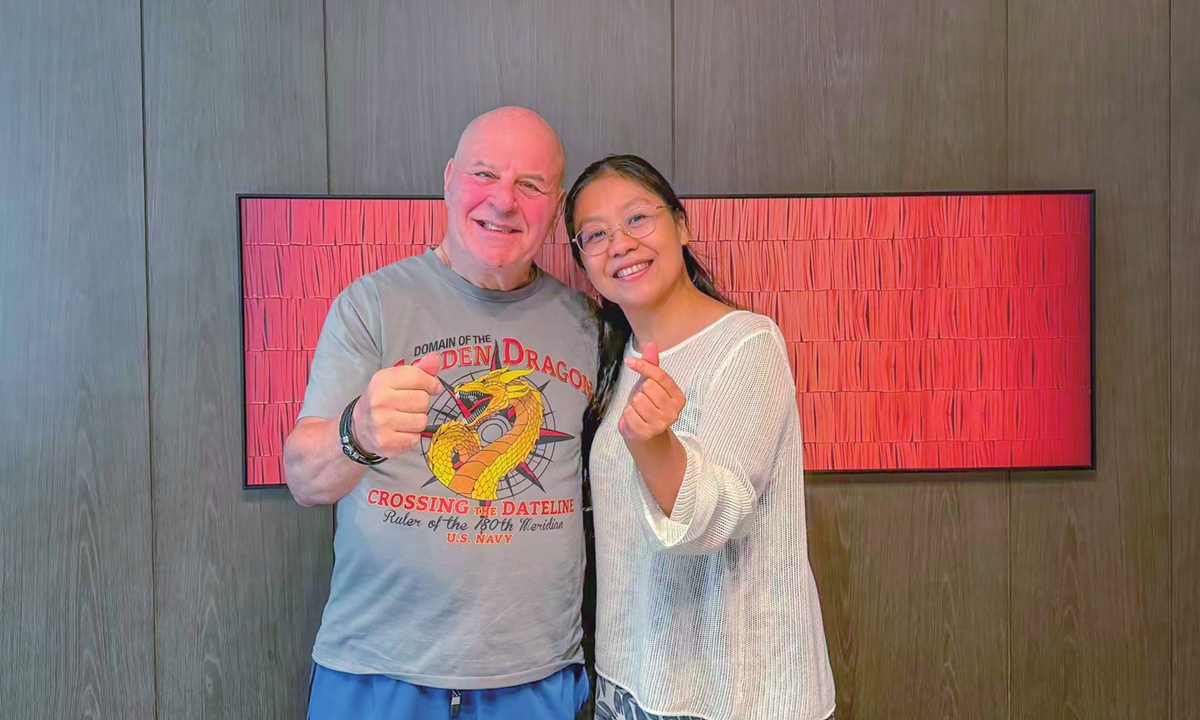
Zhou Xiangli (right) meets with Ronald Sakolsky in Beijing on August 23, 2026. Photo: Courtesy of Zhou Xiangli
On a crisp, clear mid-September morning in Hetian, Northwest China's Xinjiang, Zhou Xiangli looked out of her window and caught sight of the snow-capped Kunlun Mountains in the distance.
"I can see the Kunlun Mountains!" she said out loud. Zhou, in her 50s, had been in Hetian for a month but had never seen the mountains so clearly. "Today, I can see them right outside my window," she said.
The view was one sign of an environment Zhou had been discovering since arriving in Hetian, a city on the southern edge of the Taklimakan Desert, where years of efforts to curb desertification have helped hold back shifting sands, and residents can now enjoy clearer views.
Just before catching sight of the mountains that morning, Zhou had finished a video call with Ronald Sakolsky, an American educator she had first met 26 years earlier — and whose own decades-long connection with China began, fittingly, with an effort to combat desertification.
The story began in 1999, when Sakolsky saw a television report about Yin Yuzhen, a model worker renowned for planting trees and combating desertification. Moved by her efforts, he donated $5,000 to support her work. The following year, he traveled to North China's Inner Mongolia, where he joined Yin in planting trees on the edge of the Mu Us Desert.
Over the next 27 years, that donation took root - quite literally - helping grow about 50,000 trees, transforming barren land into a sea of green.
For years, Sakolsky and Yin lost touch. Then Yin turned to social media, hoping to find the man whose gift had helped plant those trees decades earlier. In August, the two were reunited in Inner Mongolia, nearly three decades after their first meeting.
The reunion between Sakolsky and Yin has drawn widespread media attention in China. Commenting on their story, Guo Jiakun, a spokesperson for China's Ministry of Foreign Affairs, said "many inspiring stories written together by the Chinese and American people are a vivid testament to our people-to-people friendship. They also once again demonstrate that China and the US, as two major countries, can achieve mutual success, and contribute to the well-being of the world."
Sakolsky's reunion with Yin also led to his reunion with Zhou, who had stayed with Sakolsky and his family in the US in 2000 while taking part in a China-US teacher exchange program.
"You're so famous now!" Zhou joked during the video call.
"I didn't want to be famous," Sakolsky replied. "But it's a good thing if it helps me get the message out." That message, he said, is a simple one: ordinary people can do something, however small, to help change the world.
Family vibe
When Zhou arrived in the US in 2000, she was struggling to find a place to live when Sakolsky, who took part in the same China-US teacher exchange program a year earlier, made an unexpected offer for Zhou to stay with his family.
"He only needed to help coordinate our teaching," Zhou recalled. "But when he learned that I had been assigned to his school, he warmly invited me to stay at his home."
During her stay, Sakolsky affectionately called Zhou his "fifth daughter." She recalled how he and his family included her in all kinds of family activities and took her to local Chinese restaurants whenever she was feeling homesick.
In 2000, the Chinese martial arts film Crouching Tiger, Hidden Dragon was playing in American cinemas. Knowing how eager Zhou was to see it, Sakolsky and his family dressed up for the occasion and accompanied her to the cinema.
The film was in Chinese, with English subtitles. "Whenever there was something they didn't understand, they would turn to me and ask me to explain it to them," Zhou recalled with a smile.
Zhou's habit of showing up at the last minute earned her a nickname from Sakolsky: "Ms. Last Minute." She quickly returned the favor, christening him "Mr. Mean."
"We always had great conversations, usually with a few jokes thrown in," Zhou recalled. "His family really embraced me. They made me feel that their home was my home."
Zhou also brought a piece of China into her American classroom during her stay.
"At the time, the students knew very little about China," she recalled. "As soon as I started teaching, hands would shoot up across the classroom. Often, by the time I finished answering all their questions, the class was already over."
Chinese characters were a particular fascination. Whenever Zhou offered to show the students how to write their names in Chinese, they would crowd around her so tightly that she could barely move.
The children were equally captivated by other elements of Chinese culture, she said. They tried Chinese calligraphy and brush painting, drawing pandas with ink and learning the traditional art of paper-cutting.
Twenty-six years later, thanks to the internet and easier travel, more and more Americans are setting out to discover China for themselves.
In November 2023, China announced an initiative to invite 50,000 young Americans to China for exchange and study programs over a five-year period, opening a window for them to understand the real China and building a bridge to carry forward the friendship between the two peoples.
With efforts from various parties, that goal was reached two and a half years ahead of schedule earlier this year, with more than 50,000 young Americans from all 50 US states and Washington DC visiting China.
During the video call, Sakolsky also reminded Zhou of one of her former students, Vito Grassi. Even now, he said, Grassi still greets him with "Ni hao" - hello in Chinese - and asks about Zhou, 26 years after she taught him.
For Zhou, the memory was a reminder of how seemingly small encounters can endure across decades and borders.
"As members of a global village, even small acts of kindness can have a 'butterfly effect,'" Zhou said. "If each of us puts that kindness into practice, we can make the world a better place."
Passing on kindness
Zhou lost touch with Sakolsky after she returned to China. Twenty-six years would pass before a fellow teacher - one who had also lived in the US on the same exchange program - sent her a video showing Yin searching for Sakolsky. The colleague told her, "Mr. S will be in China soon."
When Zhou learned Sakolsky had made a short visit to Beijing, where she worked and lived before coming to Hetian, she hurried to meet him in the lobby of his hotel. "After 26 years, he's still enthusiastic and wears his heart on his sleeve; he cries whenever strong emotions well up in him," Zhou recalled with a laugh. She said that Sakolsky, in turn, had joked that she had hardly aged.
That was when she was just two days away from leaving for Hetian, where she would spend the next three years teaching English to senior school students there.
Growing up in a small town in Central China's Hunan Province, Zhou said education had enabled her to leave the mountains and discover a wider, more fascinating world.
"So when I think about children who still live in relatively remote areas with limited resources, I want to do what I can to help them see a wider world, too," Zhou said.
Zhou recalled a moment from class last week, when she played an English listening exercise about "people of great achievements," including Nobel laureate Tu Youyou and the renowned respiratory disease expert Zhong Nanshan. The material proved more difficult than she had expected, and the students struggled at first to follow it.
She played the recording again and again. Eventually, she said, she began to see smiles spread across the classroom - a sign that the students had finally understood the entire passage.
After class, several students rushed up to her. "Thank you," they said, expressing their gratitude. "We understood such a long passage. You are a good teacher!"
For Zhou, it was a small moment, but one that stayed with her. She said staying with Sakolsky and his family taught her that kindness and sincerity can be passed on from one person to another, and she hoped to pass that same kindness on to her students and make a difference.
In August, Sakolsky returned to Luoyang Foreign Language School, where he had once taught. Former students traveled from different parts of the world to see him again.
Li Wenwen, Sakolsky's former student, is now an English teacher at Luoyang Foreign Language School. "I was 17 and had just started 11th grade," she told the Global Times. "Sakolsky opened a window to the world for us. Now, through more exchanges, I try to bring what I have seen and the openness and kindness I have experienced back to my students. I encourage them to step into the world and take part in cross-cultural exchange."
"I planted the seed with each and every one of you and you have grown into trees," Sakolsky told his former Chinese students.
After Zhou told Sakolsky about her plan to go to Hetian, she also described how efforts to combat desertification there had paid off, with a green protective belt now encircling the Taklimakan Desert. Hetian lies along the desert's southern edge.
"I told him that the sand has been brought under control and that the place now has beautiful blue skies. He was very happy to hear that," Zhou said.
At the end of their video call, Sakolsky said he hoped that one day he would speak with Zhou's students in Hetian, a city nestled at the foot of the Kunlun Mountains.
"I am sure they have questions about America, and I would love to answer those questions. I would like to let them know that there are many Americans who want world peace, just like the Chinese."
RELATED ARTICLES