ARTS / CULTURE & LEISURE
China’s Buddha mural replica goes on display in Beijing after unprecedented collaboration with US museum
Replica of Yuan Dynasty mural lost overseas
By Published: Sep 24, 2026 11:13 PM
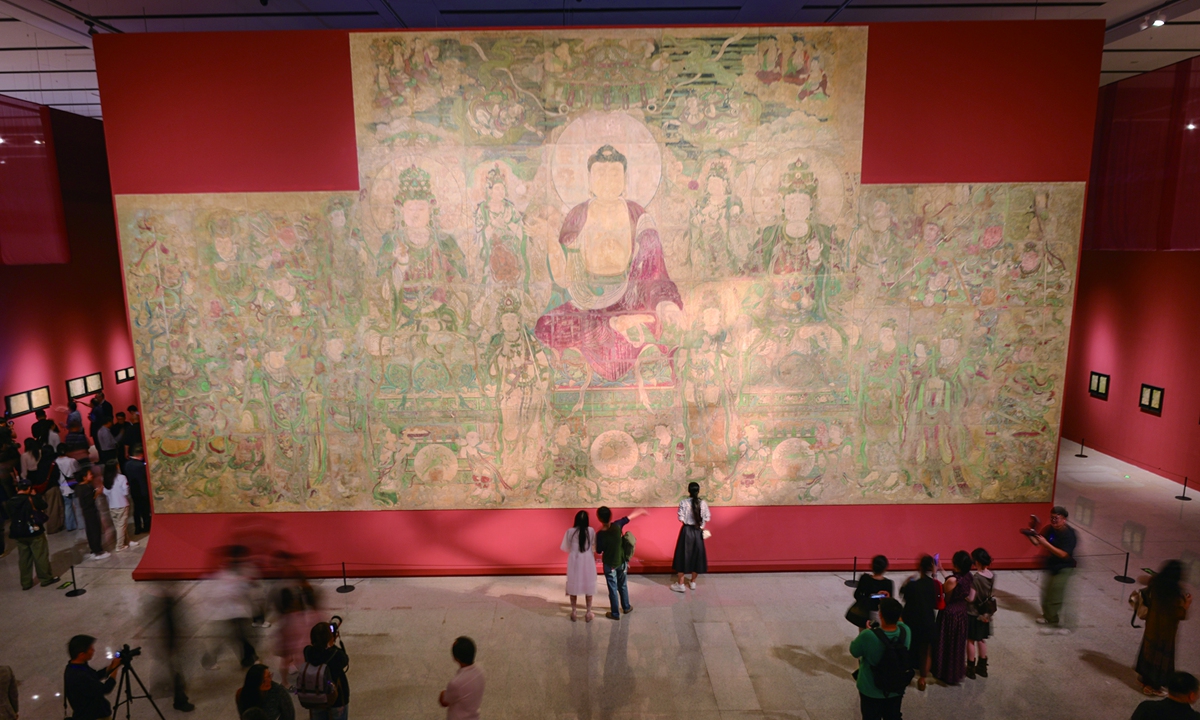
The mural replica, Buddha of Medicine Bhaishajyaguru (Yaoshi fo), displayed in the hall of the Chinese Traditional Culture Museum in Beijing on September 24 2006. Photo:Li Hao/GT
Bathed in gentle indoor light, a magnificent 15.1-meter-long, 7.52-meter-high Yuan Dynasty (1279-1368) mural hangs in the hall of the Chinese Traditional Culture Museum in Beijing, captivating visitors who pause to admire its solemn aura.
However, it was only a replica. Thousands of miles away in New York, the original masterpiece Buddha of Medicine (Yaoshi fo), lost overseas decades ago, has been in the galleries of The Metropolitan Museum of Art.
"The moment I stood before the original mural, I was overwhelmed. You could truly sense the grandeur and spiritual weight of the temple hall it once inhabited," recalled Zhang Jian, Director of the Gongbi Painting Academy at the Chinese National Academy of Arts. Having traveled to New York four times to conduct on-site replication and research, Zhang still vividly remembers his first encounter with the artwork.
As one of the largest ancient Chinese murals lost overseas, the Yaoshi fo mural boasts extraordinary scale and artistic sophistication. Centered on the serene and compassionate Medicine Buddha, the composition features neatly arranged bodhisattvas and guardian kings, exuding majestic harmony and solemnity.
Since 2024, Zhang and his team have conducted research trips to New York, conducting millimeter-precise work inches from the mural's surface. They measured every texture, calibrated every hue, and traced every crack, flake, and historical seam left by decades of previous restoration.
"Our goal was a 'status quo reproduction': not an idealized version of what the mural might have looked like in the fourteenth century, but a faithful record of what it looks like now, with all its wounds and all its history," Zhang told the Global Times.
On Thursday, that reproduction opened to the public at the China National Arts and Crafts Museum in Beijing, in an exhibition titled "Replication and Revival of Ancient Chinese Murals."
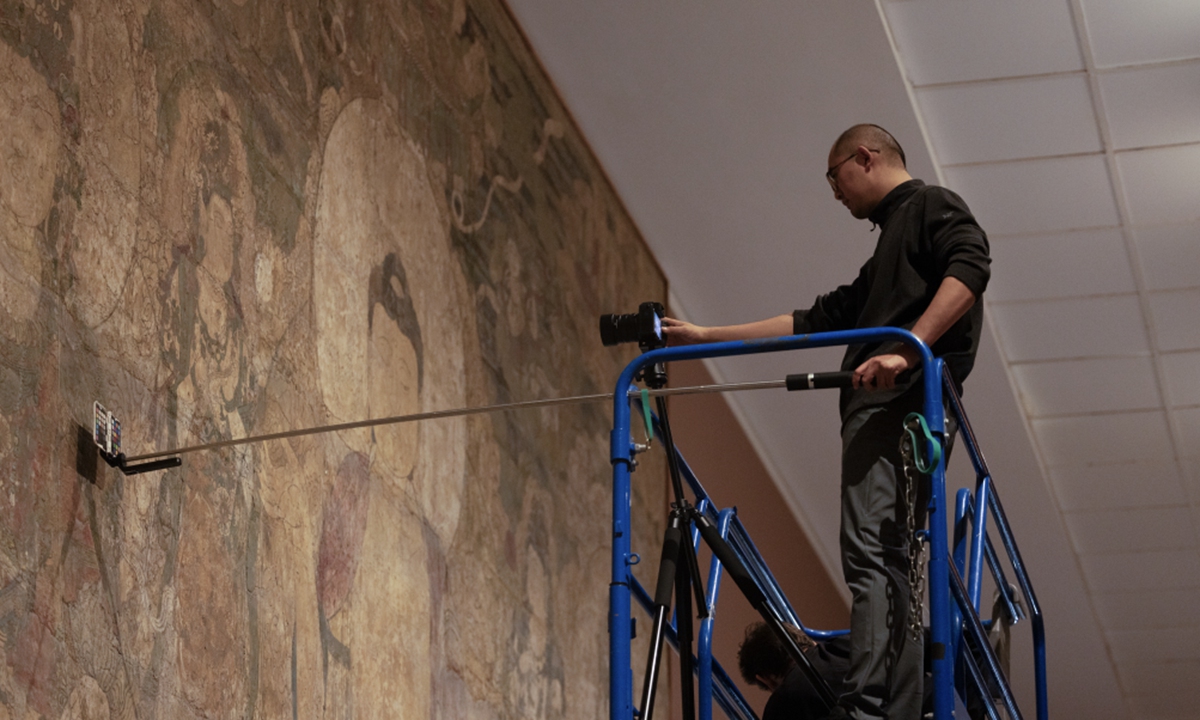
A Chinese team conducts high-precision digital image acquisition of the original Yuan Dynasty (1279-1368) mural at the Metropolitan Museum of Art in New York, the US. Photo: Courtesy of the Chinese National Academy of Arts
A mural in pieces
Forged in the aftermath of a devastating medieval earthquake that ravaged Guangsheng Temple in North China's Shanxi Province, the mural was born from an act of ancient resilience, embodying the peak of Yuan Dynasty Buddhist mural art. Its turbulent modern journey began in 1928. Local monks sold the mural to antique traders.
American collector Arthur M. Sackler acquired the fragmented work in 1954, before giving it to the Metropolitan Museum of Art in 1965.
The mural's traumatic removal left permanent scars as it was crudely split into 274 uneven rectangular fragments to facilitate transportation.
While conservators from the Metropolitan Museum of Art brought technical training and Western art restoration expertise to reassembling the piece, they lacked deep cultural context for traditional Chinese mural aesthetics and Buddhist iconography.
In one instance, a five-centimeter gap between the Buddha's head and body - a gap left by the cutting - led them to connect the wrong lines.
Collaborative restoration
That long-standing cultural gap began to close in 2024, when the Chinese National Academy of Arts and the Metropolitan Museum of Art launched an unprecedented joint research and replication project.
In the past two years, the dedicated team of Chinese art researchers travelled to New York many times, to help with the restoration.
Zhang described the work as far more demanding than original creation. "Ancient painters built this mural from nothing, with artistic freedom to adapt and refine as they worked," he said. "We are recreating a finished masterpiece, with no room for deviation. Replicating every texture, line and hue of this monumental piece requires relentless precision."
The team's inch-by-inch scrutiny focused on the smallest detail, pushing their total workload to four times that of painting an entirely new mural.
To capture the mural's authentic soul, the team blended cutting-edge modern technology with time-honored Chinese craftsmanship.
Equipped with 100-megapixel ultra-high-definition cameras, researchers captured every subtle color gradient and texture. To replicate the mural's unique shallow-relief wall texture, the team made three field trips to Guangsheng Temple. They collected local soil, purified and sterilized the material, and experimented repeatedly with traditional formulas of sand, wheat straw and hemp fiber, until their handmade base layers perfectly matched the texture and tone of the original Yuan Dynasty temple walls.
"The head of the Medicine Buddha is at a height of over six meters. Previously, when I looked up, I couldn't notice those details. With the lift, we can examine the mural from extremely close range, which is extremely important for precise replication," Zhang said.
The cultural exchange will extend beyond the reproduction project. The two institutions will co-host an international symposium in late October, bringing together experts to discuss the study and conservation of the Medicine Buddha mural, according to Zhang.
"Former Apple CEO Tim Cook once visited the project in March and called it 'a story the whole world should see,' and now I hope visitors can learn the cross-border story behind it," Zhang said.
RELATED ARTICLES