Chinese, US enterprises forge ahead in rivalry
Both sides can expand market together in race for progress: observers
By , Chen Zishuai, , Yin Yeping, and Wang Dong Published: Sep 25, 2026 08:26 PM


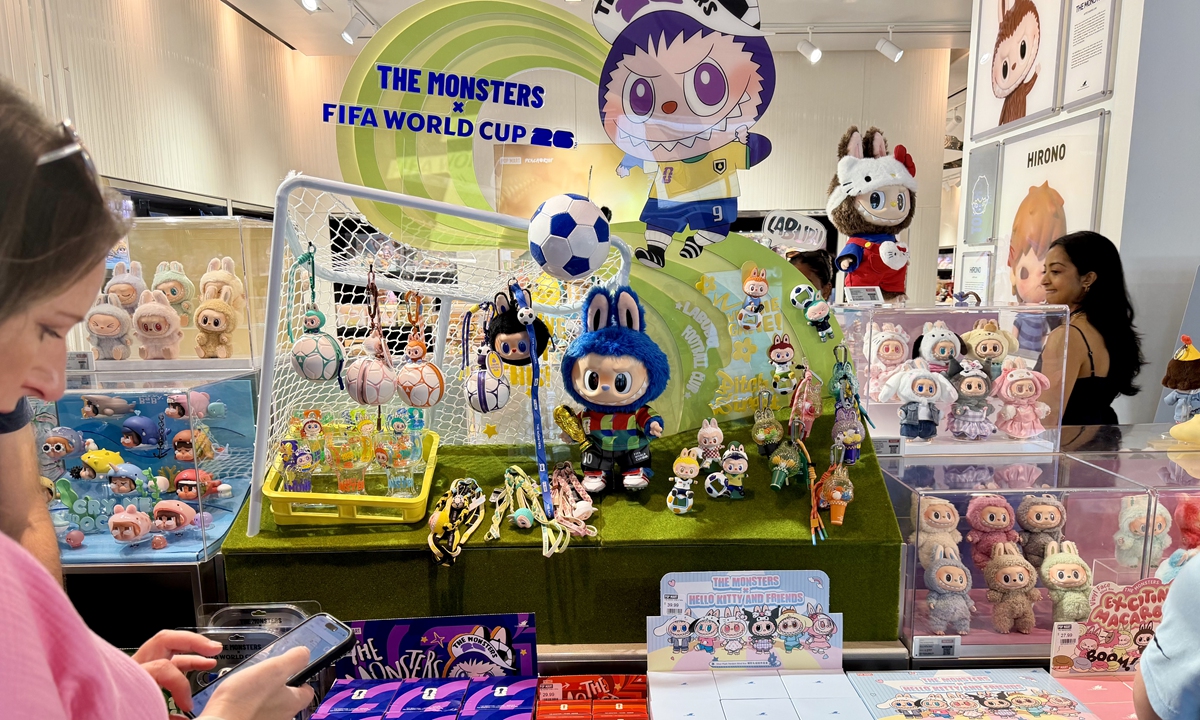
Labubu x FIFA World Cup series toys are displayed at a Pop Mart store in Chicago, US, on May 25, 2026. Photo: VCG
Recently, KFSN, an ABC affiliate, aired a news report: the Clinical Skills and Simulation Center at UCSF Fresno has received a new batch of point-of-care (POC) ultrasound devices — the TEX20 series. Mindray, the company that developed the medical devices, is headquartered in Shen-zhen, South China's Guangdong Province.
Compact and versatile, these ultrasound devices deliver precise data to support diagnosis and patient assessment. At the same time, this discipline is highly hands-on, as proficiency typically requires extensive practical experience.
These devices are very advanced in the field of POC ultrasound. They are equipped with a rich set of AI-assisted tools, especially for cardiac imaging, which has significant application value in emergency medicine, according to Stephen Haight, an assistant professor of emergency medicine with UCSF, who also stated that, with these devices, patient care will be significantly improved.
While Chinese high-end medical equipment enters the US market, US medical giants are also accelerating localized innovation in China.
In December 2025, GE Healthcare announced the opening of a new re-search and development center in North China's Tianjin Municipality. The facility, designated the Magnetic Resonance Eastern Hemisphere Head-quarters R&D Center, serves as the company's only system-level magnetic resonance imaging research base outside the US.
"The global market is big enough, and competition between Chinese and US businesses can boost their global competitiveness," Song Guoyou, deputy director of the Center for American Studies at Fudan University, told the Global Times.
US companies ramping up R&D
At the 93rd China International Medical Equipment Fair in spring this year, GE Healthcare presented over 50 innovative precision medical products. More than 60 percent were developed by Chinese research and develop-ment (R&D) teams, and 95 percent were made in China.
During last year's China International Import Expo, GE Healthcare displayed a CT scanner developed by its Chinese team. It markedly improves diag-nostic efficiency for complex conditions, including coronary heart disease with valvular disease. The company executives noted that, after obtaining market clearance, the CT device will be supplied first to China, then to Eu-rope, Japan, and other markets, and ultimately go global, according to media reports.
This marks a typical market change. With local firms steadily growing stronger, multinationals seeking to deepen their presence in China cannot merely count on past technical and brand strengths. They must engage more deeply with the domestic market and integrate their R&D, manufac-turing, and application capabilities locally, Chinese experts said.
Kimberly-Clark Vice President and Managing Director of Greater China Guo Wei told the Global Times that Kimberly-Clark entered the Chinese market in 1994 and has maintained deep-rooted operations here for 32 years, and China now serves as a vital strategic market integrating consumption, in-novation, manufacturing, and supply chain capabilities.
The third phase of its Nanjing plant officially went into operation this year, adding six high-speed automated production lines equipped with world-leading smart manufacturing technologies and green photovoltaic power applications. With an annual capacity of approximately 5.5 billion diapers, the facility caters not only to the Chinese market but also exports products to Australia, New Zealand, Brazil, South Korea, and many other countries and regions, according to Guo.
In the golf lifestyle space, US brand Malbon has encountered an ever-more mature domestic consumer market since entering China.
Kitson S. Kho, Malbon's Greater China Partner and Global Board Member, told the Global Times that Chinese enterprises offer many valuable lessons. They excel at granular insights into local shoppers, digital operations, and rapid supply chain reactions. These capabilities help international brands bring their products closer to the market.
Therefore, Malbon sees China as a market that compels the firm to keep adjusting its strategy. The brand has set up creative and design operations in Shenzhen, bringing its design team nearer to suppliers and consumers, Kitson said.
According to the 2026 Special Report on the State of Business in South China, released by the American Chamber of Commerce in South China (AmCham South China), 45 percent of surveyed companies ranked China as their top global investment priority, while 75 percent planned to reinvest in China in 2026.
China's consumer market, supply chains, pace of innovation, and talent pool — all these advantages together help American companies bring better products to market faster and at lower cost, Harley Seyedin, President of AmCham South China, told the Global Times in an exclusive interview.
Chinese companies competing in the US
As US companies boost R&D spending within China, Chinese firms are taking their expertise to global markets, particularly the US, to test their capabilities.
In February this year, the Chinese clothing brand Urban Revivo opened a flagship store in New York's SOHO, in a neighborhood where global fashion brands gather.
Facing American consumers, this Chinese brand brings not just clothing made in China, but also product iteration, store operation, and supply chain response capabilities formed through years of fierce competition in the Chinese market.
Last year, Labubu, a toothy, fluffy collectible toy from Chinese brand Pop Mart, set off a buying frenzy among young American consumers, and the company is planning to open a headquarters in California. This company, which grew out of China's trendy toy market, now regards the US as an important market in its global layout.
In 2025, Pop Mart's revenue in the Americas market exceeded 6.8 billion yuan ($1.01 billion), a year-on-year increase of 748.4 percent; during the same period, the number of physical stores in the Americas increased from 22 at the end of 2024 to 64.
Behind the numbers is a shift in consumption behavior. In the past, Pop Mart relied more on tourists, trendy toy fans, and social media communication overseas; as stores become increasingly integrated into local shopping districts, it needs to face more everyday consumer demand. For a Chinese trendy toy brand to gain consumer recognition in cities such as New York and Los Angeles, it no longer relies only on a single IP, but on compre-hensive capabilities such as product design, store experience, community operations, and brand culture.
Similar changes have also occurred at Chinese lifestyle retailer MINISO. By the end of 2025, MINISO's overseas stores had reached 3,583, with the US becoming one of its key strategic markets. By the end of 2025, the number of US stores reached 351, with 76 new stores added that year; the number of US members increased by more than 150 percent compared with the previous year, according to MINISO.
MINISO's 2025 annual report shows that same-store GMV in the North American market grew by mid-single digits in 2025; the company continues to increase self-operated investment in the US market. Pop Mart reaches local consumers through multiple channels such as its App and TikTok.
Song said that competition is the norm in a market economy. Rule-based, healthy competition gives Chinese and US enterprises more motivation to strengthen technological innovation, improve management efficiency, and meet market demand.
Innovation through collaboration
Competition drives transformations that go well beyond product upgrades. In emerging sectors including new-energy vehicles (NEVs), enterprises face more than just battles over market share. Their core task is to gain solid footing in the next wave of technological upgrades.
According to Ford China, the automaker has scaled up exports of finished vehicles made in China for global markets in recent years. In 2025, Ford China shipped 184,000 vehicles across the globe, according to data the company shared with the Global Times.
The R&D system established by 3M in China has now become part of its global innovation network. In August 2026, BOE and 3M jointly unveiled a joint laboratory. The two sides had already achieved mass production in several display technology fields such as LCD, OLED, and MiniLED, and now are further advancing cooperation from product supply to joint innovation.
Facing the increasingly high logistics needs of cross-border e-commerce and manufacturing enterprises, FedEx continues to promote the digitaliza-tion of its services.
At the South China e-commerce shipment sorting center in Guangzhou, an AI-driven robotic sorting system was first deployed, covering about 40 square meters and capable of simultaneously sorting shipments destined for up to 100 destinations. This solution was jointly optimized by FedEx and local Chinese robot companies, engineers, and supply chain partners, and after being validated in China, it was promoted to other markets.
In Song's view, Chinese and US enterprises do not face an either-or ze-ro-sum game in many fields. Enhanced cooperation can create more complete and mutually supportive industrial chains. As an example, the US aerospace industry has gained from the development of China's large air-craft sector by supplying components including aircraft engines. In the NEV space, Tesla and China's auto parts suppliers benefit reciprocally, with both attaining greater market reach.
Yu Xiang, a research fellow in the Institute of American Studies at the Chi-nese Academy of Social Sciences, told the Global Times that "catch-up" competition between Chinese and US enterprises is increasing, which is a normal result of industrial upgrading and technological progress.
Competition in fields such as NEVs and high-end manufacturing is more direct and will also prompt companies on both sides to accelerate innova-tion and improve efficiency. As long as competition remains open and fair and avoids excessive politicization, it will help promote industrial progress and technological innovation, Yu said.
The scholar also noted that Chinese and US enterprises are not locked into a simple binary choice. Many emerging industries are developing rapidly, and market potential keeps expanding. Fields such as new-energy vehicles, ar-tificial intelligence, and green energy will generate new industrial chains and market needs.
"Chinese and US enterprises face competition but also have room for co-operation and mutual learning. Both sides can absolutely make the market bigger together in competition," Yu said.
RELATED ARTICLES