Brussels’ push to draw UK into its China trade policy ‘risks higher costs, disrupted supply chains,’ reflecting EU’s lack of confidence in going it alone: expert
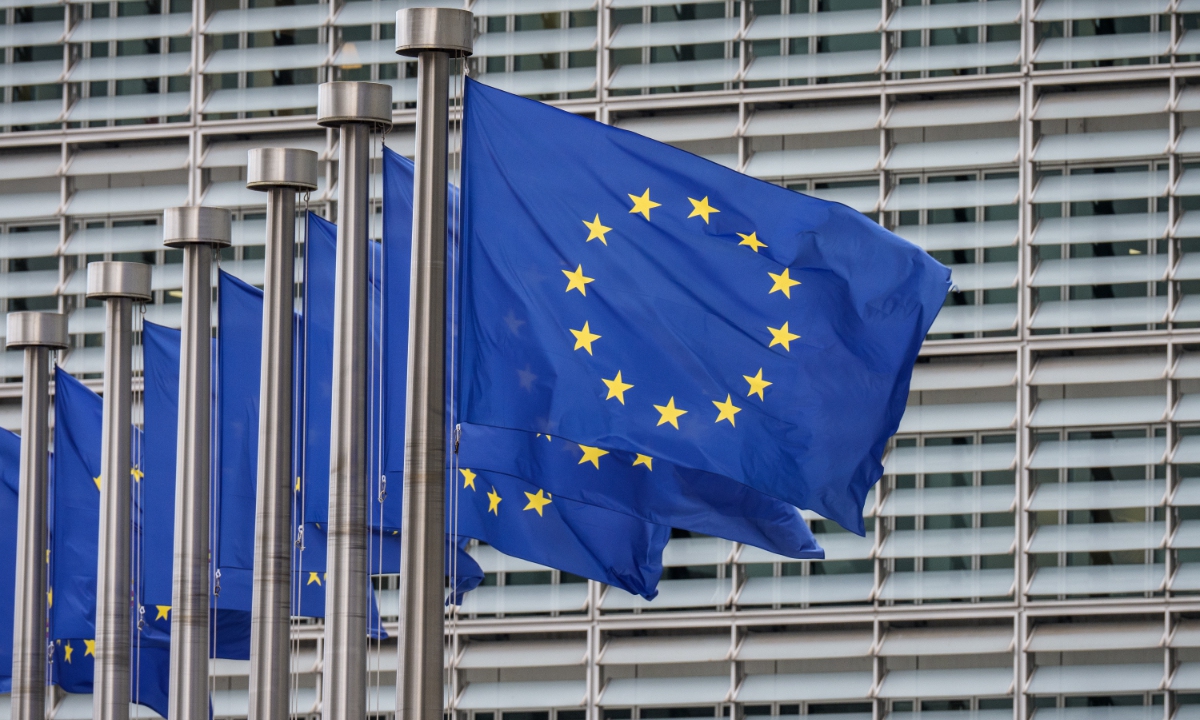
The European Union (EU) flags in front of EU headquarters in Brussels, Belgium. Photo: VCG
Brussels is reportedly pressing Britain to align with its tougher trade approach toward China, amid calls for more restrictive China-related economic policies grow in Europe. Chinese experts warned on Saturday that the push reflects the EU's lack of confidence in going it alone, while an increasingly politicized "de-risking" drive risks raising business costs, disrupting supply chains and further eroding Europe's competitiveness.
The Financial Times reported on Friday that Brussels has warned British Prime Minister Andy Burnham that Britain needs to raise tariffs on Chinese cars and align more closely with EU trade policy to avoid "made in Europe" barriers on key exports. The EU also told London that the best solution would be for Britain to join the EU customs union, citing two people familiar with the matter.
Huo Jianguo, a vice chairman of the China Society for World Trade Organization Studies in Beijing, told the Global Times on Saturday that the move could be viewed as a form of trade pressure and reflects Brussels' attempt to gather more support for its China trade agenda.
"The EU may feel that it does not have sufficient confidence to push forward these restrictive measures on its own, so it wants to bring countries such as the UK into its broader plan," Huo said.
Jian Junbo, director of the Center for China-Europe Relations at Fudan University's Institute of International Studies, told the Global Times that Brussels' reported pressure on Britain bears characteristics of "long-arm jurisdiction," as the EU is effectively seeking to push the UK toward its position on China-related trade policies.
The development coincides with renewed calls from some European industrial groups for a tougher economic approach toward China.
Germany's BDI industry association on Friday called for a more determined effort to reduce what it described as economic risks linked to China, urging Europe to diversify supply chains and forge new partnerships, Reuters reported.
"Systemic competition with China's economy is increasingly challenging the open social market economy and requires an appropriate industrial and trade policy response," BDI Chief Executive Tanja Goenner claimed, according to the Reuters.
The calls come amid a series of discussions in Europe over additional trade restrictions involving Chinese products. France, Italy and likely Germany are preparing to seek broad EU import quotas, or "safeguards," covering chemicals and plastics, Reuters reported earlier this month. German Vice Chancellor and Finance Minister Lars Klingbeil has also called for tougher EU measures on plug-in hybrid vehicle imports from China.
However, pushing for diversification while simultaneously erecting trade barriers would only further constrain companies' room for growth and transformation, Chinese experts warned.
Supply-chain diversification itself is a legitimate economic choice, Jian said, but the key is whether it is pursued under free-trade principles or through protectionist restrictions.
"Opening up additional markets while closing off another cannot really be called diversification," Jian said. "It is better described as selective supply-chain restructuring based on geopolitical considerations rather than free-trade principles." Such an approach could damage bilateral trade, disrupt the international trade order and hurt globalization, while protectionism cannot generate greater competitiveness for Europe over the long term, Jian said.
Huo also noted that a complete economic decoupling from China is unrealistic given China's manufacturing competitiveness and deeply embedded China-Europe industrial ties. Europe is therefore more likely to seek reduced dependence in selected sensitive sectors while preserving cooperation in other areas.
Despite the tougher rhetoric, divisions remain in Europe over how far restrictions should go. Even BDI, while calling for more consistent "de-risking," warned against broad-based protectionism.
BMW CEO Milan Nedeljkovic backed voluntary pricing agreements rather than additional tariffs and called for political dialogue with China, saying, "Nobody is interested in an escalation," Reuters reported on Tuesday.
Meanwhile, a survey released by the German Chambers of Commerce and Industry earlier this month also found that nearly one-third of German companies surveyed were seeking greater cooperation with Chinese partners, even as they reported mounting competitive pressure from Chinese rivals, Reuters reported.
The debate comes as Europe confronts competitiveness challenges of its own. The European Central Bank has pointed to high energy, labour and regulatory costs, and structural challenges weighing on European industry, while calling for reforms to strengthen potential growth.
Jian said relying on protectionist measures cannot resolve such structural weaknesses and could instead increase costs for European companies themselves.
Meanwhile, channels for managing China-EU trade differences remain open. China and the EU have agreed to hold the second meeting of the China-EU trade and investment consultation mechanism this autumn, Xinhua reported on July 30.
Addressing European trade concerns on July 21, Chinese Foreign Ministry spokesperson Lin Jian said that “protectionism leads nowhere. Win-win cooperation is the right way forward. The root cause of the EU’s problems on trade and economy does not lie with China. Instead, China can be a partner for the EU in addressing the problems.”
RELATED ARTICLES