China starts building its first dedicated commercial satellite for space breeding, giving seeds their own ‘dedicated ride’ to space
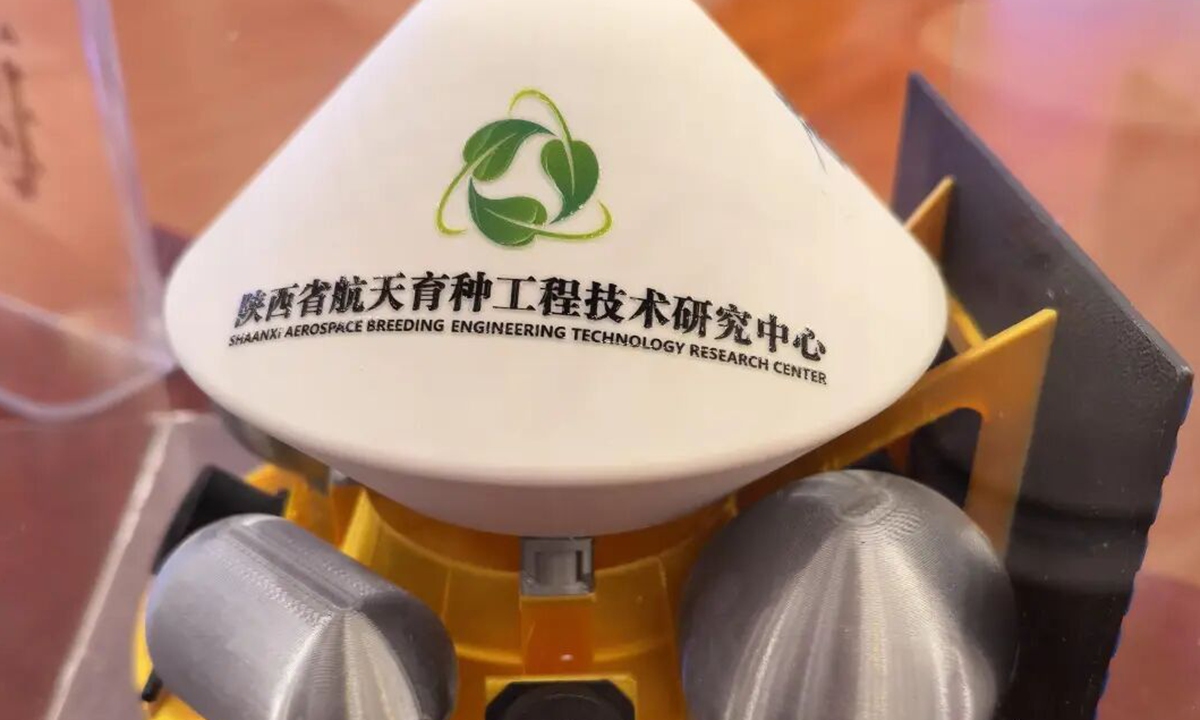
Model of the commercial space breeding satellite Photo: Screenshot from Shaanxi Fabu
China's space-based breeding is moving beyond the "carpooling" era, as Northwest China's Shaanxi Province recently announced to build a lab for space biological mutation and start developing the country's first dedicated commercial satellite for space breeding. This means seeds traveling to space will soon have their own "dedicated ride," Shaanxi Fabu, the official social media account of Shaanxi Province, reported on Sunday.
For a long time, China's space breeding has mostly relied on "piggyback" experiments aboard satellites and space station missions, lacking a dedicated satellite platform for biological space mutation. As a result, experimental payloads, in-orbit duration, and test conditions have been difficult to customize or scale up, Guo Rui, director of the Shaanxi Aerospace Breeding Engineering Technology Research Center, in the report.
According to Guo, the launch of a dedicated commercial satellite for space breeding will change the current "carpooling" approach to space-based breeding experiments in China, providing scientific and technological support for safeguarding the food security and developing modern agriculture.
Zhang Zhihao, director of the Qiming Laboratory at AIRSAT Technology Group, said that the company will leverage its engineering capabilities in satellite development, space tracking, and in-orbit operations to support the construction of the dedicated breeding satellite platform, while provide research teams with stable and reliable space conditions.
The lab for space biological mutation will focus on research into the mechanisms of space biological mutation, space exposure experiments for plants, animals, and microbial germplasm, development of in-orbit experimental payloads, and ground-based germplasm screening and new variety breeding.
The goal is to establish a complete technical chain spanning "space mutation — in-orbit experiments — ground breeding — commercialization of results," said the report.
Once completed, the lab will open its experimental resources to research institutes and breeding organizations in China, creating an open and shared innovation platform for space-based breeding. It will advance space breeding technology in support of rural revitalization and modern agriculture, contributing to China's seed innovation, the report noted.
Global Times
RELATED ARTICLES