‘Qinghaihu’ replenishment ship, WZ-7 drone join South China Sea military-coast guard drills ‘as forces ready to shift from training to combat’: expert
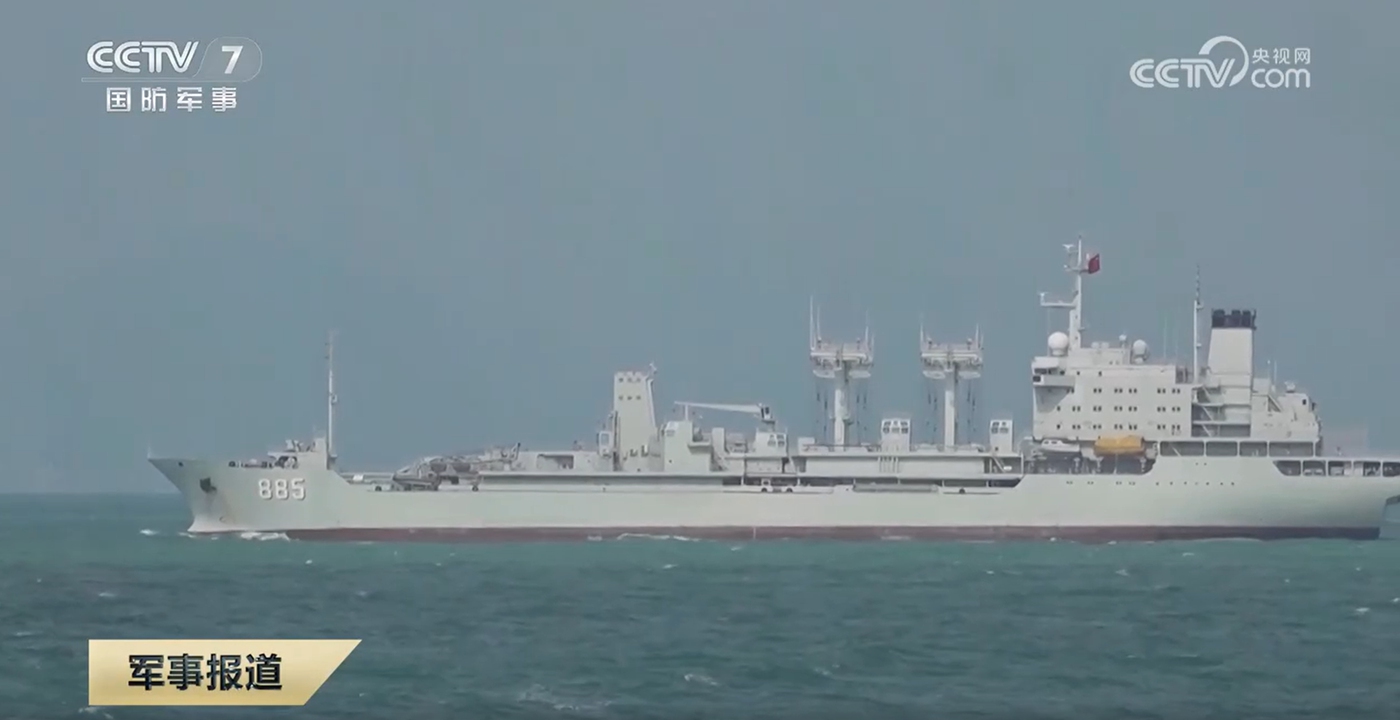
The Chinese People's Liberation Army (PLA) Type 908 replenishment ship Qinghaihu (Hull 885) Photo: Screenshot from CCTV News
Video footage obtained by the Global Times shows that the Chinese ships and aircraft deployed for the joint drills conducted by the PLA Southern Theater Command and China Coast Guard on Sunday were ready for China's rights-protection and law enforcement missions in the waters around Huangyan Dao, as they carried out highly targeted drills.
The joint military-coast guard exercise was highly combat-oriented, and the Chinese forces could shift from training to actual operations at any time if foreign parties crossed the line, an expert said.
The Southern Theater Command said that the joint drills focused on realistic training subjects such as reconnaissance and early warning missions, rapid maneuvers, and joint search and rescue operations, effectively honing the troops' naval-air coordination, rapid support and win-by-system capabilities. The China Coast Guard said its law enforcement drills focused on boarding and inspection, intercepting intruding vessels and forced towing, testing multi-ship coordination, rapid response and emergency handling capabilities.
"The joint drills by the Southern Theater Command's air and naval forces and the China Coast Guard near Huangyan Dao took place in China's territorial waters and adjacent areas, and included expelling foreign ships and aircraft, rights-protection law enforcement, and maritime search and rescue," Yang Xiao, a research fellow at the Institute for Peace and Development of the Chinese Academy of Social Sciences, told the Global Times on Sunday.
Yang said these scenarios correspond to high-frequency incidents in the South China Sea in recent years, and that the drills demonstrated a high level of professionalism, leaving foreign parties no grounds for objections.
Video footage obtained by the Global Times showed that the Southern Theater Command deployed the Type 056A guided missile corvette Tianmen, Type 054A guided missile frigate Yulin, Type 908 replenishment ship Qinghaihu, KJ-500 early warning aircraft and WZ-7 high-altitude reconnaissance drone. The China Coast Guard deployed the Wanshan, Chuanshan and Sifang - law enforcement vessels of different tonnages and types.
The Qinghaihu is a far-sea comprehensive replenishment ship. Before the Type 901 supply ship entered service, it was the largest supply ship in the PLA Navy, described as a "mobile island at sea."
The Qinghaihu can carry tens of thousands of tons of supplies, mainly providing fuel and fresh water, and is equipped with a helicopter hangar for vertical replenishment. Its presence provides strong logistical support for ships' combat readiness in the waters around Huangyan Dao.
The WZ-7 drone, making an appearance during the South China Sea drills, has high-altitude, long-endurance reconnaissance capabilities. It can quickly capture and transmit target information to guide strikes, forming a new capability for coordinated operations with crewed aircraft.
The exercise adopted a military-coast guard coordination format, focusing on testing integrated response and capabilities of three-dimensional blockade. It involved a series of drills from aerial reconnaissance, situational awareness, expelling and interception to boarding, reflecting China's comprehensive control capabilities in the South China Sea, Yang said.
The joint drills drew considerable attention as they coincided with the Philippines' move to rally some countries for a maritime security expert group live exercise under the ASEAN Defence Ministers' Meeting Plus framework, making the Southern Theater Command's military-coast guard exercise highly targeted, Yang said.
Yang said that the exercise was highly combat-oriented and involved units that are permanently deployed for combat readiness and routine rights-protection law enforcement in the South China Sea, meaning they are ready around the clock and capable of fighting at any time. "The exercise itself is also a part of combat readiness. If foreign parties cross the line, Chinese forces can shift from training to actual operations at any time," Yang said.
This is a necessary operation taken in response to the acts made by certain countries that have undermined regional peace and stability, the Southern Theater Command said in its announcement. The training exercise aims to test and enhance combat capabilities in safeguarding China's territorial sovereignty and maritime rights and interests, the announcement said.
Yang further noted that the Philippines' goal is to drag ASEAN countries into supporting its provocations and hypes, using the ASEAN as a tool to back its infringement. However, Manila's calculations have been easily seen through by most ASEAN members and that those that chose to participate were mainly extra-regional countries such as Japan, Australia and India, Yang added.
"The Philippines' exercise flies the ASEAN flag, but its 'ASEAN involvement' was low, which revealed the Philippines' South China Sea claims and actions enjoy little support from most ASEAN countries," Yang said.
RELATED ARTICLES