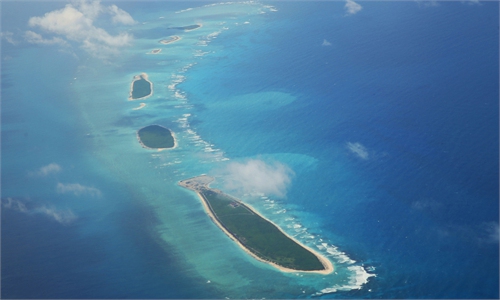
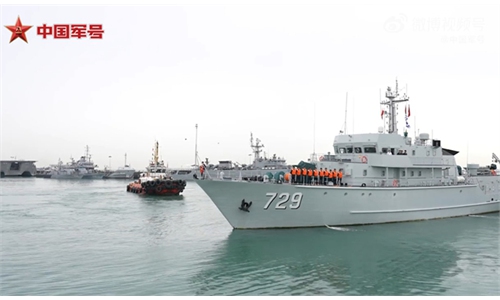
PLA, CCG step up naval-air drills around Huangyan Dao; training exercises demonstrate firm resolve to safeguard sovereignty, regional stability: expert
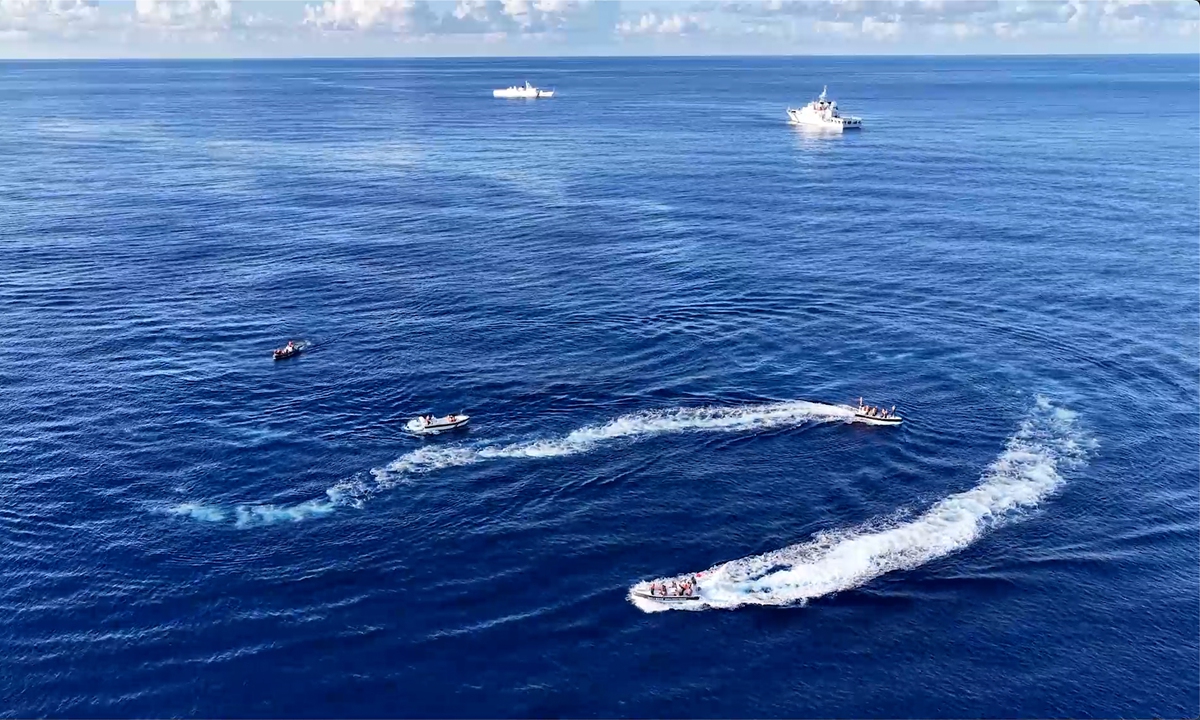
China Coast Guard (CCG) conducts a drill on law-enforcement as well as management and control in waters near China's Huangyan Dao on September 27, 2026. Photo: Courtesy of CCG
The People's Liberation Army (PLA) Southern Theater Command on Sunday conducted a joint naval-air training exercise in the waters and airspace around China's Huangyan Dao, according to the PLA Southern Theater Command. On the same day, the China Coast Guard (CCG) also conducted a drill on law-enforcement as well as management and control in waters near China's Huangyan Dao, focusing on operations including boarding inspections, blocking attempted intrusions and forced towing, as part of efforts to strengthen law enforcement and control in the area in accordance with the law, the Global Times reporters observed at the scene.
The PLA side focused on realistic training subjects including reconnaissance and early warning, rapid maneuvers and joint search and rescue, testing naval-air coordination, rapid support and win-by-system capabilities, according to the PLA Southern Theater Command. The CCG side practiced boarding inspections, blocking vessels attempting to force their way into the area and forced towing, testing multi-vessel coordination, rapid response and emergency-handling capabilities, China Central Television (CCTV) News reported.
The military and law-enforcement drills deliver two-layered, unambiguous strategic signals: They serve as a powerful deterrent against external maritime infringements that undermine China's territorial sovereignty and maritime rights and interests, and also embody China's consistent commitment to safeguarding regional maritime stability, securing international shipping safety and shouldering humanitarian rescue responsibilities in the South China Sea, Zhang Chi, professor at the National Defense University, told the Global Times on Sunday.
Red line against provocations
The Southern Theater Command said on Sunday that the exercise was conducted in response to acts by certain countries that have undermined regional peace and stability, and was intended to test and enhance combat capabilities in safeguarding China's territorial sovereignty and maritime rights and interests.
The reference to "certain countries" is clearly directed at the Philippines, Zhang said, noting that the joint naval-air exercise around Huangyan Dao serves as a stern warning against the Philippines' infringement and provocative actions and is a necessary response to its continued disruption of peace and stability in the South China Sea.
The exercise came days after the Chinese Ministry of National Defense criticized a field training exercise organized by the Philippines under the ADMM-Plus Experts' Working Group on Maritime Security near China's Huangyan Dao.
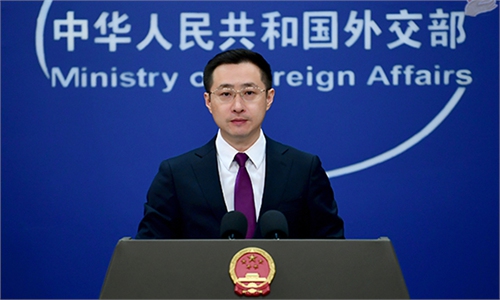
At a press conference on Thursday, Chinese Defense Ministry spokesperson Jiang Bin said the Manila-organized exercise is in fact a provocation and propaganda in the name of security cooperation. It will only disrupt regional peace and stability and runs counter to the regional consensus of jointly preserving peace and promoting development.
Footage released by CCTV showed that after the exercise order was issued, the Southern Theater Command's joint operations command center directed participating forces to rapidly maneuver toward designated sea and air areas. Multiple Air Force aircraft, including early-warning and reconnaissance planes, took off in succession, while a naval formation including the vessels Yulin, Tianmen and Qinghaihu arrived at the exercise area as scheduled.
The drills included both military and coast guard forces. Zhang said that the military provided overall situational awareness, strategic deterrence and broader support for the operation, while the coast guard focused on front-line law enforcement and handling specific situations, forming a combination of strategic deterrence and tactical law enforcement.
The drills involved a range of advanced air and maritime platforms, including early-warning aircraft, reconnaissance aircraft, drones and multiple types of vessels. Together, these assets enabled real-time monitoring and three-dimensional reconnaissance of the surrounding sea and airspace, strengthening the participating forces' ability to track and respond to activities in the exercise area, Zhang said.
"This joint training exercise draws a clear line for the Philippines: Manila should clearly understand that, in the face of China's legitimate sovereign rights and interests, as well as the country's firm resolve and strong capabilities to safeguard those rights, whatever small moves it makes or whoever it tries to enlist for support, its illegal attempts will not succeed," Zhang said.
Responsibilities as a major country
Global Times reporters were aboard the CCG vessel Wanshan, which was participating in the drill in waters around China's Huangyan Dao on Sunday morning.
The Wanshan, Chuanshan and Sifang were among CCG vessels of different types and tonnages participating in the drill. The exercise tested multi-vessel coordination, rapid response and emergency-handling capabilities, CCTV News reported.
The drill scenario involved multiple simulated foreign vessels attempting to illegally enter waters under China's jurisdiction around Huangyan Dao. Different types of CCG vessels practiced a series of law-enforcement operations, including identification and verification, verbal warnings, route control, boarding inspections, blocking attempted intrusions, water cannon operations and forced towing.
This drill made full use of drone-based law enforcement evidence collection throughout, demonstrating coordinated operations between forces at sea and in the air.
"Drones provide a broader and more comprehensive perspective, allowing us to record the entire process of unprofessional and irregular operations by foreign vessels infringing on China's rights and interests from a higher vantage point," CCG officer Qiu Canhui told the Global Times.
Since 2023, the Philippines has carried out a series of infringement and provocative actions in multiple areas of the South China Sea, including attempting to intrude into waters around Chinese islands and reefs, ramming Chinese vessels and seeking to maintain an illegal presence in relevant waters.
In response, the CCG has taken firm countermeasures, including blocking and driving away Philippine vessels, using water cannons and conducting forced towing operations, thwarting the Philippine side's attempts while strengthening China's control over relevant islands and reefs in the South China Sea.
China's legitimate control around Huangyan Dao and Ren'ai Jiao has now extended beyond 24 nautical miles, while regular control has been established around Xianbin Jiao and Tiexian Jiao. The scope of China's control is continuing to expand. The more the Philippine side provokes, the stronger the China Coast Guard's control measures will become.
Beyond deterrence and control consolidation, the joint drills, which included joint research and rescue, also highlight China's major-country responsibility in maritime public governance, experts noted.
The South China Sea is one of the world's busiest shipping routes. China's Foreign Ministry previously said that for decades, 50 percent of the world's merchant vessels have sailed through the waterway, accounting for one-third of global maritime trade. Maritime emergencies occur from time to time in the waters and China has consistently delivered timely and effective humanitarian maritime rescue services.
Earlier this year, Chinese forces carried out rescue operations in two maritime emergencies in the South China Sea. In January, Chinese naval and coast guard forces rescued 17 Filipino crew members after a Singapore-flagged cargo ship capsized in the waters near Huangyan Dao. In July, Chinese military, coast guard and civilian forces joined in the rescue of the crew of a Vietnamese vessel that sank near Yongshu Jiao, with 47 Vietnamese personnel rescued. Zhang said such operations show China's role in providing humanitarian assistance and maritime public-security services.
Zhang concluded that the drills send a definitive message that external "salami-slicing" tactics to erode China's maritime sovereignty are unrealistic and bound to fail. While firmly safeguarding its territorial and maritime rights, China will continue to fulfill major-country responsibilities, uphold humanitarian principles and advance the vision of a maritime community with a shared future.
China is committed to maintaining peace and stability in the South China Sea and safeguarding navigation safety. "By contrast, the Philippines is turning the South China Sea into a stage for political maneuvering and undermining regional security and stability," Zhang said.
RELATED ARTICLES