China's northernmost high-speed railway begins service Monday
Withstand temperatures as low as -40 C during winter time
By Published: Sep 27, 2026 11:17 PM

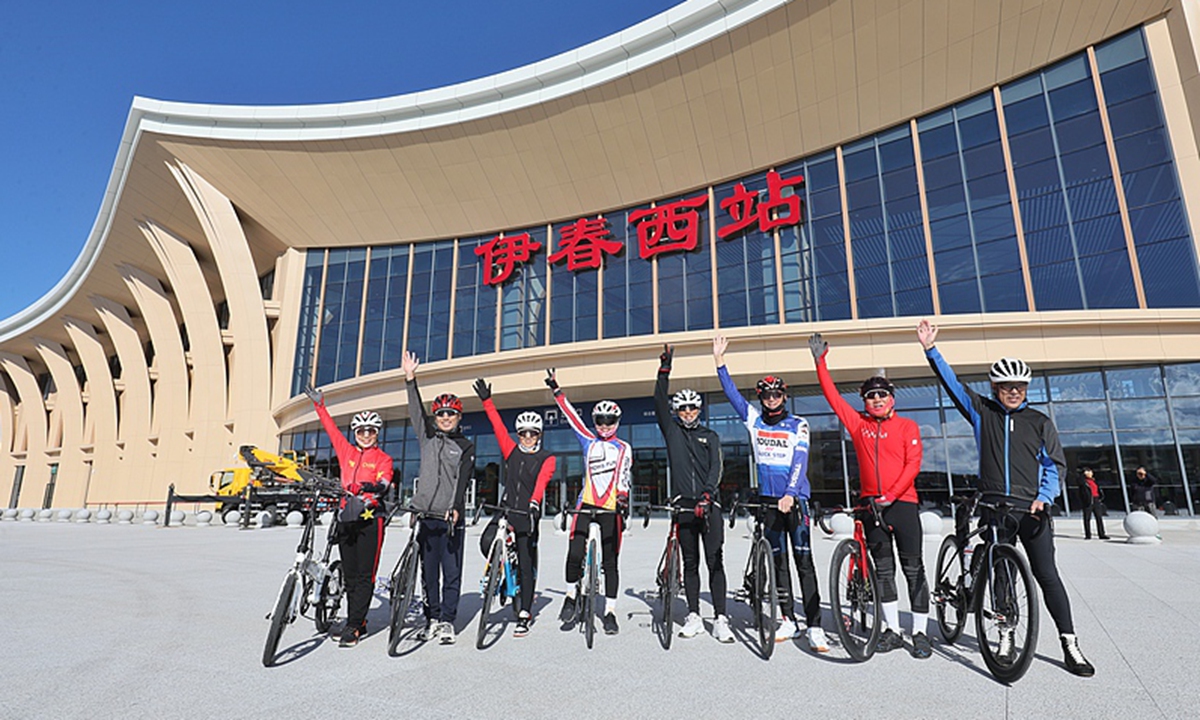
The day before the official opening of the Harbin-Yichun High-Speed Railway, residents gather at the plaza in front of Yichun West Station in Northeast China's Heilongjiang Province to take photos and celebrate the arrival of the high-speed rail era, on September 27, 2026. Photo: VCG
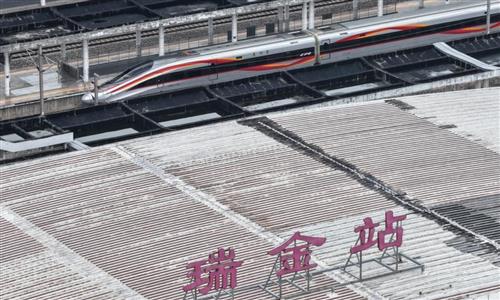
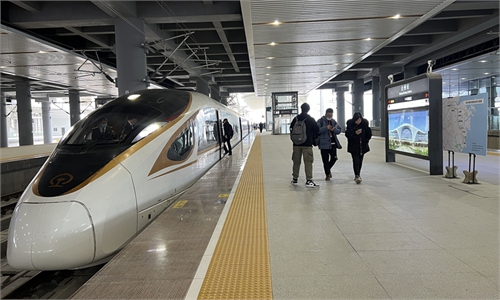
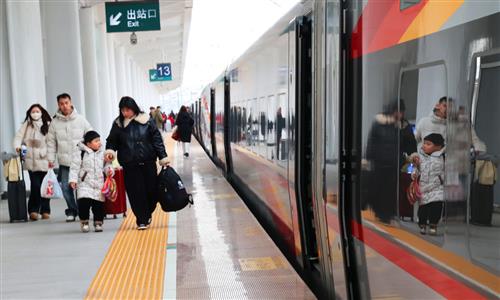
China's northernmost high-speed railway, the Harbin-Yichun high-speed railway in Northeast China's Heilongjiang Province, is set to begin operation on Monday, China Railway Harbin Bureau Group Co. said in a statement sent to the Global Times on Sunday.With a designed speed of 250 kilometers per hour, the 318-kilometer-long line will slash travel time between the two cities from about seven hours to just two hours, the company said.
Being the country's northernmost bullet-train line, the high-speed railway traverses a permafrost zone in Heilongjiang, and the entire system will have to withstand temperatures as low as -40 C during winter time.
A trial operation has begun in earlier August to verifies train scheduling, arrivals and departures, service frequency, passenger facilities and system compatibility to provide a scientific basis for the official opening of the railway, according to the Xinhua News Agency.
After the commencement of the official service, travel time between Harbin, the provincial capital, and the forest city of Yichun could be cut to one hour and 46 minutes on the fastest service.
The railway line has a total of nine stations, among which Yichun West Station is the highest-latitude high-speed railway station built in China to date.
In the initial period of operation, the railway department will schedule up to 38 Electric Multiple Unit (EMU) trains per day, including 4 cross-line EMU trains. The fastest travel times from Yichun to Beijing's Chaoyang Station and Dalian, Northeast China's Liaoning Province will be eight hours 46 minutes and six hours seven minutes, respectively.
The construction of the railway is an engineering feat. Under conditions of extreme coldness, tracks may deform, signals may drift and the catenary system may ice up, China's only high-speed comprehensive inspection train, designed for a top speed of 385 kilometers per hour and capable of withstanding extreme cold of -40 C, took part in the test before the railway's opening, the Global Times learned.
Smart trains have extended the reach of China's high-speed railway network and greatly improved travel convenience for people living in northern areas of the country, a staff with the publicity department of Chinese bullet train maker CRRC Changchun Railway Vehicles Co., manufacturer of the comprehensive inspection train, told the Global Times on Sunday.
With the cities of Suihua and Yichun connected to the national high-speed rail network, the operation of this railway will inject fresh growth momentum in the full revitalization of Northeast China in the new era, analysts said.
Heilongjiang, long known as one of China's traditional industrial powerhouses built on steel, machinery and oil, is now pivoting toward new growth drivers, according to Xinhua.
The new railway is expected to play a key role in the province's comprehensive revitalization, while boosting tourism and the development of its ecological assets.
The high-speed railway is a key component in ongoing efforts to revitalize the region and end the long-standing transport bottleneck in central Heilongjiang's forest region, Song Kui, president of the Contemporary China-Russia Regional Economy Research Institute, told the Global Times on Sunday.
Compressed travel time will accelerate flow of people, goods, capital and information, expanding Harbin's "two-hour economic circle" northward and bolstering coordinated regional development.
For Yichun, a city with great forest coverage, the railway will turn ecological resources into economic gains, as the business model of high-speed rail plus tourism, health care and under-forest economy will be made possible, connecting the area's ice-snow, forest and summer-resort resources to the national market, Song said.
Running through the alpine permafrost zone, the track has been designed with numerous bridges, which together account for 72 percent of the total length of this railway section.
RELATED ARTICLES