Four new high-speed rail lines bring more cities and counties into China's network ahead of holiday rush
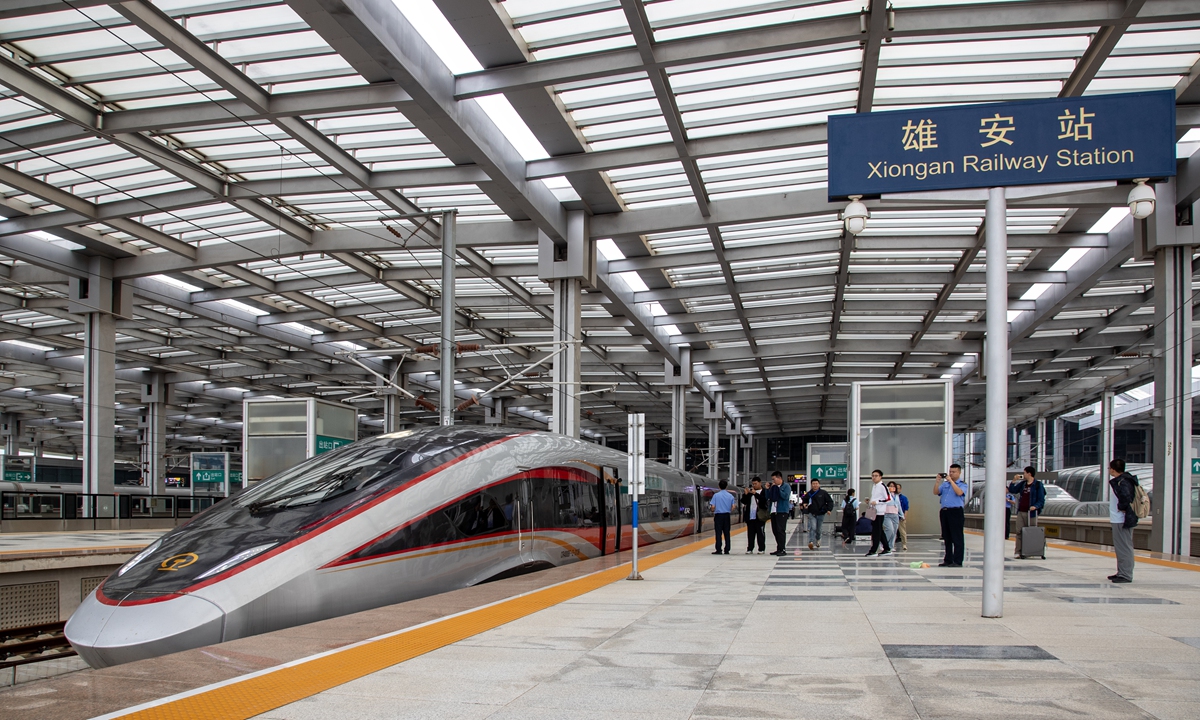
A bullet train stops at the Xiongan Railway Station, in Xiong'an New Area, North China's Hebei Province on September 28, 2026. Photo: VCG
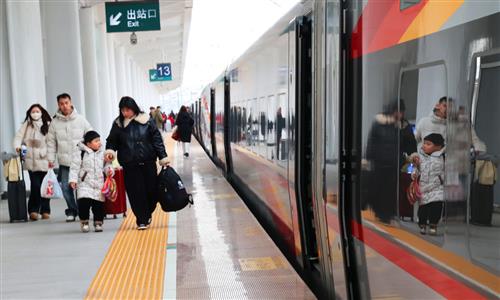
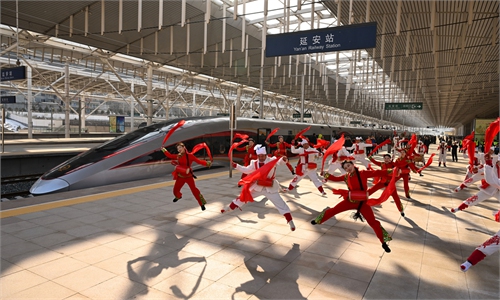
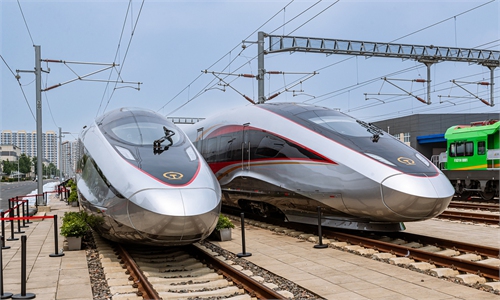
China opened four high-speed railway lines on Monday, bringing more cities and counties into the national network and shortening journeys across regions ahead of the seven-day National Day holidays, as expanding transport connections create opportunities for tourism and local economic development.
The openings span northern, northeastern, northwestern and central China: the Xiong'an-Shangqiu section of the Beijing-Hong Kong high-speed railway, the Xi'an-Ankang section of the Xi'an-Chongqing railway, the Yichang-Xingshan high-speed railway and the Harbin-Yichun railway, state broadcaster CCTV News reported on Monday.
The fastest journey between Xiong'an and Shangqiu, 522 kilometers apart, now takes two hours and 27 minutes, while Xi'an East to Ankang West, 171 kilometers apart, takes 45 minutes. The Yichang-Xingshan connection cuts the fastest Wuhan-Chongqing journey, about 900 kilometers apart, from around five hours to under four hours, and Harbin-Yichun services connect the two cities, 318 kilometers apart, in one hour and 46 minutes.
Bringing cities and counties closer
Their openings come between two holiday travel peaks - the Mid-Autumn Festival and the National Day holidays. China's railways carried 14.374 million passenger trips on Saturday and were expected to handle 16.86 million on Sunday, the final day of the Mid-Autumn Festival holidays, according to China State Railway Group Co.
For travelers planning their next departure, the new services widen the choice of destinations. Their significance also extends to economic ties between places previously separated by lengthy journeys, said analysts.
"Further expanding the railway network helps stimulate investment, connect local economies, develop industries and tourism, and promote consumption," economist Li Changan, a professor at the Academy of China Open Economy Studies at the Beijing-headquartered University of International Business and Economics, told the Global Times on Monday.
For cities and counties gaining high-speed rail access, Monday's openings put a wider range of journeys within reach.
Along the Xiong'an-Shangqiu route, some places such as Renqiu, Suning and Shenzhou have entered the high-speed rail network. The line links with existing routes at Hengshui, Liaocheng, Heze and Shangqiu, giving passengers access to connections extending well beyond its endpoints.
In Northwest China's Shaanxi Province, the Xi'an-Ankang section brings the fastest journeys from Xi'an to Zhashui and Zhen'an down to 28 and 40 minutes, respectively. The connection strengthens links between the Guanzhong region and the Qinba mountain areas, said the CCTV report.
Hu Qimu, a professor at the Maritime Silk Road Institute of Huaqiao University, told the Global Times on Monday that extending rail access to smaller destinations could bring additional visitors while spreading holiday demand across more places.
With more destinations accessible, travelers have greater scope to avoid overcrowded attractions, potentially improving the holiday experience, Hu said.
Beijing received 8.783 million tourist visits during the Mid-Autumn holidays, generating 11.54 billion yuan in spending, including 780 million yuan from 83,000 inbound visits, the Xinhua News Agency reported. Guangdong recorded 24.817 million tourist visits and 12.55 billion yuan in spending, up 28.9 percent and 27.6 percent respectively from 2025 on a comparable basis, according to Guangdong-based Nanfang Daily.
That regional snapshot provides context for the approaching National Day holidays, when the new rail connections will give more destinations an opportunity to compete for visitors and spending, said experts.
Zhang Yi, CEO of iiMedia Research, told the Global Times on Monday that the openings offer travelers more choices and give local economies greater opportunities to develop their natural and other resources. Continued infrastructure investment also helps strengthen confidence in economic development, he said.
Connecting a diverse landscape
The four openings also illustrate the engineering and operational demands behind the continued development of China's "eight vertical lines and eight horizontal lines" high-speed railway network, according to Hu.
Across the North China Plain, the Qinling Mountains, western Hubei's mountain valleys and the frozen ground of the Northeast China, building connected railways requires solutions suited to sharply different environments.
The Harbin-Yichun railway offers a particularly demanding example. China Railway Group said the project crosses areas of discontinuous permafrost, where short construction seasons and unstable ground conditions presented challenges. Builders used measures including soil replacement and pre-thawing, thermosyphons and insulation panels, alongside long-term monitoring of changes in frozen ground.
Hu said the ability to open routes across different geological environments reflects advances in railway technology, making connections feasible in places where engineering constraints could previously prevent construction.
Driving regional development
Maintaining an expanding network also draws on increasingly sophisticated digital tools. Elsewhere on the network, the Beijing-Shanghai high-speed railway's integrated maintenance system combines monitoring data with technologies including BeiDou navigation and drone inspections, supporting fault diagnosis and a shift toward maintenance based on equipment condition and predicted risks, according to its operator Beijing-Shanghai High Speed Railway Co.
Coordinating services across routes is another part of the task. The newly launched Yichang-Xingshan railway connects the Shanghai-Chongqing-Chengdu and Zhengzhou-Chongqing corridors. Its opening enables a new Wuhan-Chongqing routing that saves one hour and two minutes on the fastest journey.
Such connections demonstrate how planning and operating railways as a nationwide network allows an individual project to deliver benefits across several regions, said analysts.
For Hu, assessing those benefits requires a broad view of the development that follows improved access, including economic activity and social gains that are difficult to express in monetary terms.
"The strategic value of high-speed rail goes far beyond ticket revenues," Hu said. "Many of its social benefits cannot be monetized."
RELATED ARTICLES