ARTS / CULTURE & LEISURE
One year on, journey of fragile model returned from US continues to connect two museums and two countries across time and distance
The fragile creation continues to link two museums, two countries
By Published: Sep 28, 2026 10:20 PM

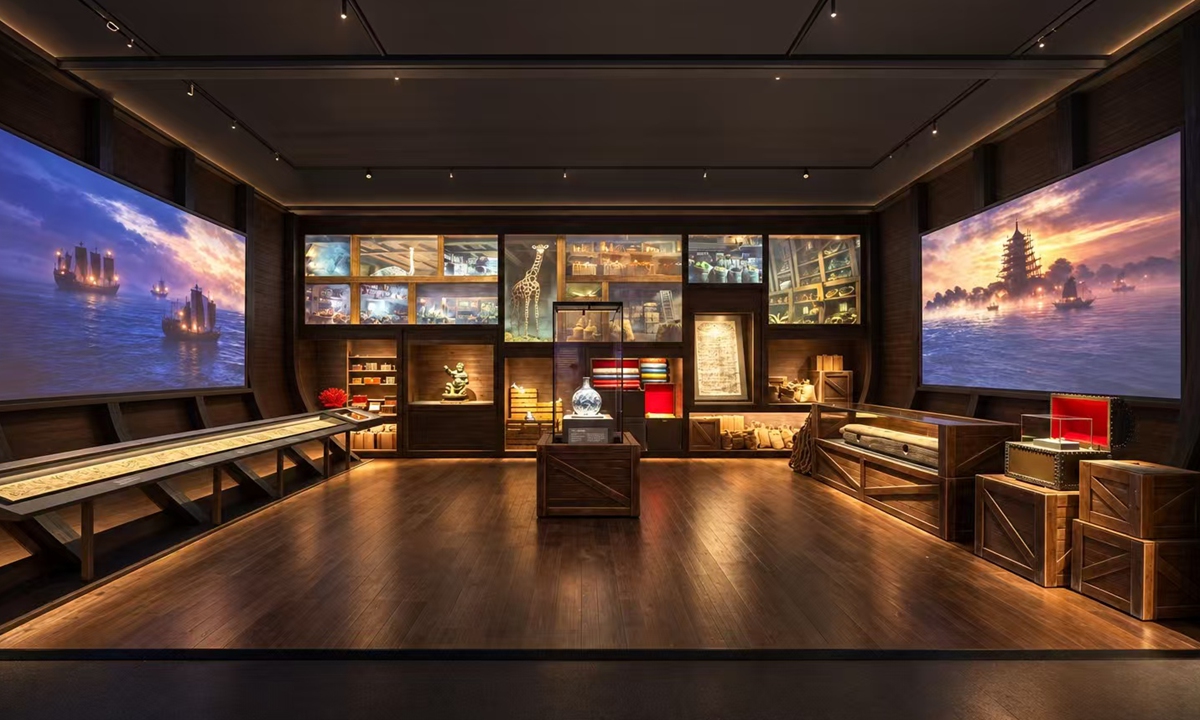
The displaying space of Zheng He at the Nanjing Grand Bao'en Temple Ruins Museum Photos: Courtesy of the Nanjing Grand Bao'en Temple Ruins Museum
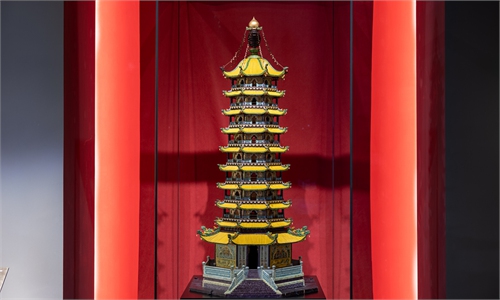
At the center of a quiet museum hall at the Nanjing Grand Bao'en Temple Ruins Museum, a nearly two-meter-tall wooden pagoda stands in the soft light. Its eight sides rise in nine slender tiers. Tiny bells hang from the eaves. Visitors circle it slowly, some pausing to take photos, others simply staring.
A year ago, this model was not here. It had spent over a century in Chicago. Before that, it had traveled from a Shanghai orphanage workshop to a world's fair in San Francisco. Now it rests on the ground where the original tower once soared.
A year after its arrival, the model remains on public view while the museum continues discussions with the Field Museum about the model's future in Nanjing, which loaned the model to the museum.
"The Field Museum is very pleased to have this opportunity to share the beautiful pagoda model," said Julian Siggers, the Field Museum's president and CEO, in an email interview with the Global Times. "Our shared human heritage is a powerful connector. Items can serve as ambassadors for the people and cultures that produced them."
Wang Wenxi, director of the Nanjing Grand Bao'en Temple Ruins Museum, put it more directly: Only by displaying the model at its original site, in its original cultural context, can its full value be understood.
"If the next generation loses this living memory, reconnecting with it later will be far harder," she said, expressing her worry for the future.
A marvel reduced to memory
The model is based on the Porcelain Tower of Nanjing, built in the early 15th century by the Yongle Emperor of the Ming Dynasty (1368-1644) in honor of his parents. Clad in glazed tiles that caught the light, the tower rose about 78 meters, with bells chiming in the wind.
European travelers ranked it among the marvels of the medieval world. A version of it even inspired the pagoda at the Kew Gardens in London. Then, in 1856, war reduced it to rubble. What remained were drawings, a few scattered fragments in distant museums, and the memory of something beautiful that was gone.
The wooden model that now stands in Nanjing was never meant to replace the real tower. It was an act of careful imagination. Around 1910, at the Tushanwan Orphanage in Shanghai, a German missionary named Aloysius Beck became fascinated by Chinese architecture.
He wrote letters and sent telegrams to churches across the country, gathering descriptions and sketches of local pagodas.
Nearly 300 orphaned boys learned woodworking and painting under his guidance. Together, they built over 80 detailed models of Chinese pagodas. The Nanjing tower, destroyed half a century earlier, had to be reconstructed from historical records and old pictures.
When the original commission for the models fell through, Beck sent them to the 1915 Panama-Pacific International Exposition in San Francisco.
Two years later, the Field Museum of Natural History in Chicago bought them. Most stayed there for decades. In 2007, all but three were collected, and the models that left the museum eventually found their way to Singapore's Asian Civilisations Museum. The model currently on display in Nanjing was among the three that remained in Chicago.
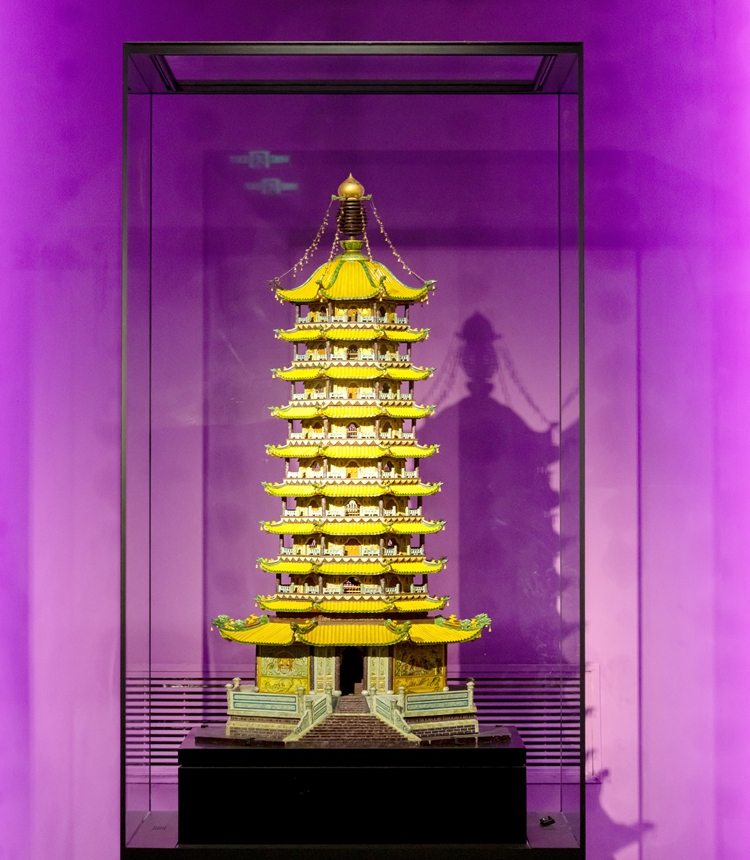
The wooden model of the Porcelain Tower of Nanjing on display at the Nanjing Grand Bao'en Temple Ruins Museum
Quiet workIn the summer of 2024, Qiu Linwan, the exhibition director at the Nanjing Grand Bao'en Temple Ruins Museum, was scrolling through the Chinese social media app Xiaohongshu when she came across photographs from Singapore. One of the models stopped her cold. "That's our pagoda," she later recalled. She felt as if a window had opened.
She and Wang Wenxi had long been tracking pieces of the temple that had left China, including fragments held in London and New York. This wooden model was different. It was the most complete surviving image of the lost tower.
In September 2025, the model was flown from Singapore to Nanjing. Daniel J. Kaping, a conservator from the Field Museum, accompanied it, watched local people gather around the tower and said he felt this was where it belonged, where the greatest number of people could appreciate it.
Learning about its story
A year later, the model is still there. On September 30, a new exhibition opened under the title Nanjing Has a Glazed Pagoda.
Qiu and her colleagues carefully designed the visitor path. Visitors do not see the model first. They walk through the story of its construction under the Yongle Emperor, the supervision of that construction by the great admiral Zheng He and the drawings made by the Dutch traveler Johan Nieuhof. Only then do they enter the gallery and see the wooden tower.
"If you see the model at the entrance, it is just an object," Qiu explained. "If you know why it was built, how it disappeared, and who searched for it, the feeling is different."
The exhibition does not dwell only on the tower's former glory. It breaks the grand narrative into human stories.
Wang Wenxi has long argued that telling a good heritage story needs a small entry point. A historian may be moved to tears by a single line in an old text, but ordinary visitors need context, interpretation, and room for empathy.
"The exhibition does not force conclusions on people. It simply invites them to come closer to one person, one object, one moment," she told the Global Times. This quiet wooden tower matters most when the people who lost it can see it again.
RELATED ARTICLES