90 years on, new archives and artifacts bring the Long March closer to younger generations, global visitors
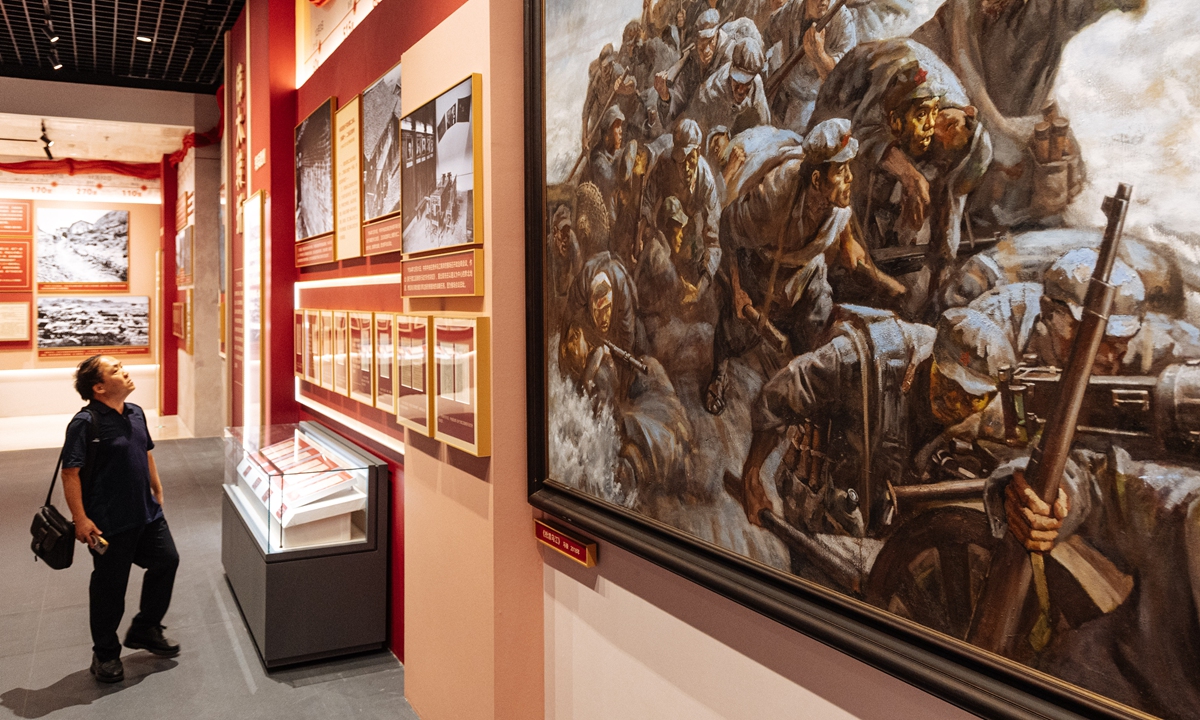
A visitor views the exhibition at the Museum of the Communist Party of China (CPC) in Beijing on September 29, 2026. Two exhibitions commemorating the 90th anniversary of the victory of the Long March open, putting more than 230 precious archival documents on display. Photo: Li Hao/GT
Two exhibitions commemorating the 90th anniversary of the victory of the Long March opened at the Museum of the Communist Party of China (CPC) on Tuesday, putting more than 230 precious archival documents on display, including some shown to the public for the first time, and featuring 273 sets of artifacts tracing the Red Army's arduous journey across snow-capped mountains and grasslands, CCTV News reported.
The Long March was an epic military trek from 1934 to 1936, during which the CPC-led Red Army broke through encirclement by Kuomintang forces. Red Army soldiers braved raging rivers, snow-covered mountains and treacherous grasslands, with some marching as far as 12,500 kilometers, according to the Xinhua News Agency. The maneuver helped lay the foundation for the eventual victory of the Chinese revolution, according to the Xinhua News Agency.
One of the exhibitions, centered on archival materials, is divided into five sections and follows the route of the Chinese Red Army, from its departure from Ruijin, East China's Jiangxi Province, and its breakthrough of four lines of blockade to its turn toward Guizhou, the Four Crossings of the Chishui River, the capture of the Luding Bridge, the crossing of snow-capped mountains and grasslands, and its eventual arrival in Wuqi.
It also documents the campaigns of other Red Army forces and the eventual reunification of the Red Army forces, highlighting the historical role of the Shaanxi-Gansu revolutionary base area, which provided a foothold for the CPC Central Committee and various Red Army forces during the Long March. A 1937 manuscript recording the Red Army's Long March is being shown to the public for the first time.
A visitor surnamed Cheng told the Global Times on Tuesday that young people in particular should visit such exhibitions to understand the past and, in doing so, better understand the present.
"What happened in the past was not a story, but real history," Cheng said, calling for patriotic education to begin at an early age and continue throughout schooling.
She also noted that China's growing national strength has helped change how the international community views the country and given China greater capacity for independent development in the face of external pressure, a change that makes her proud.
The second exhibition focuses on the Red Army's crossing of snow-capped mountains and grasslands in Southwest China's Sichuan Province. Divided into three sections - "crossing snow-capped mountains," "crossing grasslands" and "forging an immortal monument," - the exhibition brings together 273 sets of artifacts from 17 museums and archival institutions, including 38 sets of precious cultural relics.
Among the exhibits are nail-studded cloth shoes worn by Red Army soldiers, a half-length belt, a miniature Party flag and a certificate for grain collection. Accompanied by memoirs and oral histories, the artifacts offer a glimpse into the harsh conditions and arduous struggles faced by the Red Army.
Several artifacts and research materials are being shown to the public for the first time, including specimens collected during surveys of the Jiajin Mountain and Baozuo battle sites and a certificate documenting the whereabouts of female Red Army soldier Wang Quanying.
The exhibitions come as efforts to introduce the history of the Long March to international audiences continue. From September 14 to 19, journalists from Russia, the Netherlands, Japan, Singapore, Qatar, Brazil and other countries visited historic sites associated with the Long March in Jiangxi, Guizhou and Gansu, according to the State Council Information Office (SCIO).
Through these visits, the journalists gained a deeper understanding of the Long March and explored ways to tell its story as well as the story of China's development in the new era, according to the SCIO.
For Wang, a primary school student who visited the exhibitions on Tuesday, the experience offered a more vivid understanding of the difficulties faced by the Red Army. Although he had learned about the Long March from textbooks, he said the exhibitions helped him understand that the soldiers had to confront not only their enemies but also oxygen deprivation in the mountains, rapidly changing weather and dangerous marshlands.
The determination of the soldiers, who pressed forward despite knowing the dangers they faced, was particularly inspiring to him.
"Learning is also like a Long March," Wang told the Global Times. "When we encounter difficulties, we should learn from the Red Army and keep going."
RELATED ARTICLES