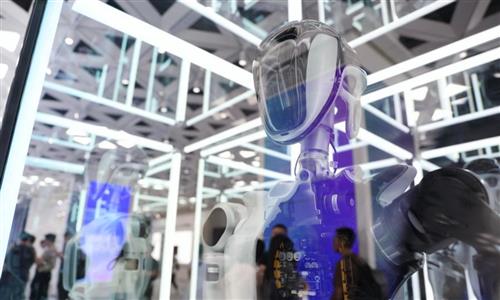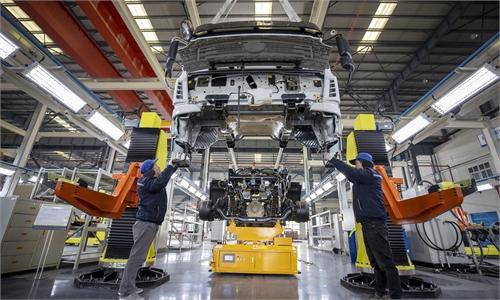
Dozens of UBTECH industrial humanoid robots carry out training tasks at a smart factory in the Qianwan New Area in Ningbo, East China's Zhejiang Province, on March 1, 2025. Photo: VCG
China on Tuesday unveiled a new program aimed at achieving breakthroughs at the frontiers of science and producing major original research achievements in key fields, while also outlining a broader slate of major research missions for the 15th Five-Year Plan period (2026-30). Analysts said the moves signal a stronger push beyond catch-up innovation toward original breakthroughs at the frontiers of science and technology.
Led by the Chinese Academy of Sciences (CAS), the initiative begins with 10 projects focused on questions ranging from the synthesis of new elements and the nature of dark matter and dark energy to microscopic measurements of chemical bonds and creation of synthetic cells, Xinhua News Agency reported.
The program will also test evaluation methods better suited to frontier science, with fewer preset targets, less intervention during the research process and less emphasis on papers and short-term results, while giving researchers greater room to fail, according to Xinhua.
On the same day, the Ministry of Science and Technology outlined research priorities for the next five years, ranging from fundamental science and artificial intelligence (AI) to quantum technology, biomanufacturing, integrated circuits and strategic areas such as the deep sea, deep space and deep Earth, according to a press conference held on Tuesday.
The CAS also released a list of priority areas for the next batch of projects, spanning materials science, life sciences, Earth system science and space science, with a focus on achieving major original breakthroughs in fields related to long-term national development.
Liu Gang, chief economist at the Chinese Institute of New Generation AI Development Strategies, said the new emphasis on research at the scientific frontier reflects China's broader shift from catch-up innovation toward exploring areas where there are fewer established paths or proven answers.
"When research is truly unprecedented, the probability of failure is inevitably higher," Liu told the Global Times on Tuesday. "That means frontier research requires much greater tolerance for failure than the more predictable, application-oriented work of the past."
Song Ding, a research fellow at the China Development Institute, told the Global Times that the more fundamental change is that China is putting greater weight on the most challenging end of innovation - original research rather than primarily applying and commercializing advances made elsewhere.
"The shift suggests China's innovation system is moving from strength in scale and application toward a greater emphasis on source innovation and breakthroughs in fields such as AI, quantum technology and life sciences," Song added.
China's recent innovation gains provide a broader backdrop to that shift. Science and Technology Minister Yin Hejun told the press conference on Tuesday that the country's scientific and technological capabilities had moved to a new level over the past five years, citing advances including breakthroughs in chips and the rise of Chinese open-source large language models.
China ranked ninth globally in the National Innovation Index Report 2025, released by the Chinese Academy of Science and Technology for Development. "China is rapidly shifting from a participant and contributor in global science and technology to a pioneer and leader, becoming one of the world's fastest-rising innovation powers," the minister said.
International indicators point to a similar upward trend. China entered the global top 10 for the first time in the World Intellectual Property Organization's Global Innovation Index 2025, ranking 10th among 139 economies and fifth globally in innovation outputs.
Liu said China is moving from a major science and technology country toward a science and technology powerhouse, making the 15th Five-Year Plan period and the years that follow a crucial window for frontier breakthroughs. "Breakthroughs in major emerging fields could translate into new sources of productivity and economic growth," Liu said.
China will systematically roll out a new group of major national science and technology missions during the 15th Five-Year Plan period, Yin said.
In fundamental research, priorities will range from mathematical theory and applications to synthetic biology, materials genomics, controlled nuclear fusion and smart scientist systems.
The ministry also plans to deepen the integration of technological and industrial innovation, upgrading traditional industries, expanding emerging sectors and cultivating more trillion-yuan industrial clusters.
On fundamental research, Vice Minister of Science and Technology Long Teng said China had strengthened its overall capabilities in recent years and was now entering a new phase marked by broader gains and targeted breakthroughs. He said central government funding for basic research will continue to increase, with a funding system combining competitive grants with stable, long-term support further improved.
China's research and development spending exceeded 3.92 trillion yuan ($550 billion) in 2025, equivalent to 2.8 percent of GDP and surpassing the average level of OECD member countries for the first time, official data showed.
Song said China's deep manufacturing base and strength in applied research could become a key advantage in that process. By linking frontier science more closely with industrial chains and real-world applications, he said, China can move discoveries more quickly from research to deployment, while industrial demand can in turn generate new momentum for basic research.
RELATED ARTICLES