Three times in the People’s Daily: How the BRI has shaped an Egyptian life over 14 years
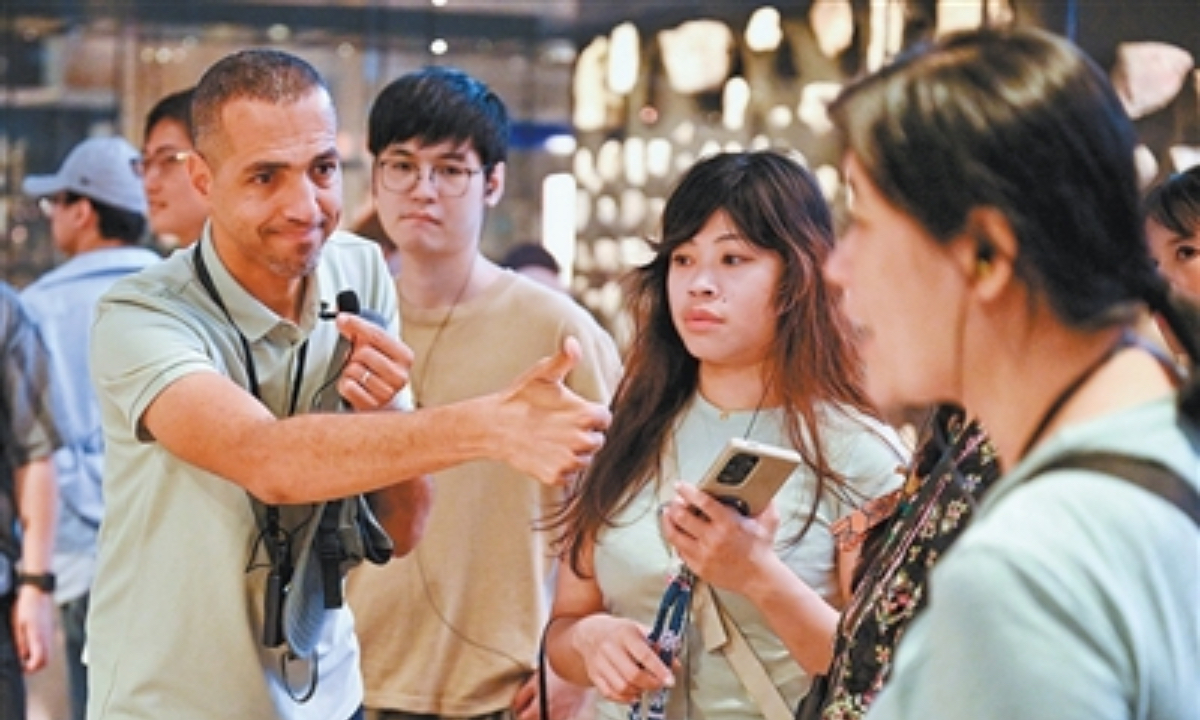
Egyptian tour guide Abbas (left) speaks to visitors at the Grand Egyptian Museum in July 2026. Photo: Xin Mengchen / Xinhua
In early September 2026, Egyptian young man named Abbas launched an account on a Chinese social media platform. In his profile, he proudly noted that he had been featured three times in the People's Daily. His first post was the newspaper's latest story about him.
Abbas' ties with People's Daily reporters go back 14 years. Wen Hongyan, the first People's Daily reporter to interview him, described their encounter as "a spark that eventually grew into a torch — an ordinary passion that sparked a dialogue between civilizations across mountains and seas."
Unlocking the 'Chinese House'
In 2012, Wen, then deputy director of the Political and Cultural Affairs Department of the People's Daily, traveled with a delegation from China's Ministry of Culture and Tourism to Germany, Mauritius and Egypt to report on the development of overseas Chinese cultural centers. The China Cultural Center in Cairo was a key stop on the trip.
There they met the 28-year-old Abbas, who warmly received the delegation. Wen still remembers him as "sunny, modest and fluent in Chinese." As an assistant to the center's director, Abbas led the group upstairs and opened the door to the "Chinese House."
The room was small but thoughtfully decorated. Chinese zodiac ornaments hung on the walls, while traditional Chinese writing brushes and inkstones sat on a desk. Peking Opera masks, red lanterns and paper kites were arranged around the room, alongside displays introducing China's traditional festivals and scenic landscapes. Through the exhibits, the culture of a distant Eastern country seemed suddenly within reach.
That day, the Chinese delegation was not the only group visiting the room. More than a dozen students from Cairo's Fadela School had come to hear Abbas introduce Chinese culture. They were immediately drawn to the treasures filling the room.
As Abbas began his presentation, the children gathered around him, listening intently. Reporters raised their cameras, and Wen pressed the shutter as well. But with cameras crowding together and a cluttered background, she felt she had yet to capture the moment she was looking for. After the interview ended and her colleagues began heading downstairs, Wen paused and turned back to the room.
She froze the moment she opened the door.
The bustle had faded away, and the soft afternoon light streamed quietly into the little room. Facing the children, Abbas patiently told, in Arabic, the stories behind the Chinese artifacts, one by one. There were no cameras, no interviews — only a young man speaking with quiet sincerity and a group of children listening with rapt attention.
At that moment, Wen suddenly understood: Cultural exchange was perhaps never simply about how much we could tell the world about China. It was about people like Abbas, who, moved by a genuine affinity for Chinese culture, were willing to share Chinese stories with others in their own language, in the most natural way. She raised her camera and gently pressed the shutter.
That photograph, together with Wen and her colleagues' observations from Chinese cultural centers in Germany, Mauritius, France, Malta and Benin, was published on the People's Daily on June 8, 2012, under the headline "Perceiving China Here."
Abbas soon saw the report. "One day, the cultural counselor at the Chinese Embassy in Egypt came to my office with a newspaper. When I opened it, there was a photo of me teaching the children about the Chinese zodiac!" He still remembers the delight he felt. "It was my first interview with Chinese media, and it was with the People's Daily. It was incredibly precious to me."
That moment captured in a photograph would resonate years later. Seven or eight years on, staff members from China's overseas cultural centers contacted Wen while preparing an exhibition on cultural exchanges between China and other countries. They hoped to find the original photograph from that day.
'Lucky to have lived through the BRI'
The year 2023 marked the 10th anniversary of the Belt and Road Initiative (BRI). Against this backdrop, Huang Peizhao, then a People's Daily correspondent in Egypt, set out to interview Abbas for a second time.
This time, it took more than a month to arrange the interview — largely because Abbas was in such high demand. By then, he had become a seasoned Chinese-speaking tour guide in Egypt, taking on two to three Chinese tour groups a month, with each trip lasting anywhere from a week to more than 20 days. After repeated coordination, Huang finally met him at his home.
On Abbas' bookshelf, Huang found the Analects alongside a collection of books on Chinese philosophy and the history of the Silk Road. Huang already knew that, during his time at the China Cultural Center in Cairo, Abbas had given talks on "Confucius and Chinese Wisdom," sharing Chinese teachings such as the value of learning from the past and finding a teacher in everyone with Egyptian students. On his WeChat Moments, Abbas regularly shared reflections on his Chinese studies.
In their conversation, Huang noticed that Abbas kept returning to one word: "connection." The Belt and Road Initiative, Abbas said, was about connecting countries, peoples and cultures. He also hoped to forge even closer connections with China.
Huang brought Abbas a box of Chinese tea. Abbas opened it, took a sniff and said, "Longjing, right? I used to drink it often at the China Cultural Center in Cairo." To Huang, the simple remark showed how deeply Abbas' connection with China had become woven into his daily life.
To get a firsthand sense of Abbas' work, Huang accompanied him on a tour group. After nearly 20,000 steps, Huang wanted to take a break, but Abbas was still on his feet, greeting and assisting every member of the group.
The scene reminded Huang of how much had changed in Egypt. Nearly 20 years ago, when Huang first arrived in Egypt as a correspondent, fewer than 20,000 Chinese tourists visited the country each year, and he rarely heard Putonghua. Today, several Chinese tour groups can be seen at the same time, with Putonghua spoken in a variety of accents filling the air.
Chinese has also become part of Egypt's national education system. Unlike Abbas, who studied Chinese largely on his own at university, a new generation of Egyptian young people now has clearer career prospects and greater social recognition when learning Chinese.
"I feel incredibly fortunate to be living in the era of the BRI," Abbas told Huang.
Huang then asked how his life might have turned out had he not learned Chinese or if the BRI had not been implemented in Egypt. Abbas paused before answering. "Youth unemployment is high in Egypt, and many young people cannot afford to start a family or support one. If I had not learned Chinese or benefited from the BRI, I would not dare imagine where I would be today," he said.
Huang saw Abbas' personal journey as closely mirroring the evolution of China-Egypt ties from exchanges among a small circle of people to broader and deeper engagement. The resulting story, titled "My Life Has Become More Fulfilling Thanks to the BRI," was published on the People's Daily on December 25, 2023, and later won second prize at the China Journalism Awards.
From 'Chinese House' to diplomatic stage
In 2026, Abbas' story with the People's Daily entered a new chapter. As China and Egypt marked the 70th anniversary of diplomatic ties, exchanges between the two countries grew closer. In late August, Huan Xiang, a reporter with the International Department of the People's Daily, and his colleagues traveled to Egypt as part of a joint China-Egypt media delegation covering high-quality BRI cooperation ahead of the two countries' leaders' meeting.
Before departing, Huan reached out to Abbas to arrange an interview. After their previous encounters, Abbas readily agreed, although he warned that his busy schedule meant the interview time could only be arranged on the fly.
What Huan did not know was that Abbas was then preparing for an extraordinary honor: serving as an on-site guide for the Chinese and Egyptian heads of state and their spouses.
After arriving in Egypt, Huan and his colleagues interviewed Abbas twice, on August 24 and 31. Abbas took the team through historic sites along the Nile, recounting the story of ancient Egyptian civilization along the way.
In Huan's memory, Abbas had a knack for finding familiar points of connection between the two civilizations. He called ancient Egyptian funerary statues of soldiers "Egypt's Terracotta Warriors," while likening the ancient city of Luxor, known as the "City of a Hundred Gates," to Xi'an, an ancient Chinese city steeped in history.
On September 3, a day after completing his assignment as a guide for the two heads of state and their spouses, Abbas sat down once again in front of a People's Daily camera. He kept saying that the experience felt "like a dream." He told Huan that he had barely slept that night, overwhelmed by pride and surprise.
The Egyptian man who had once stood inside the "Chinese House" had now stepped onto the center stage of cultural exchange between the two civilizations.
During the trip, Huan and his colleagues produced three video interviews with Abbas as well as a written story, which was published on the People's Daily on September 9, 2026. Together, the reports intertwined the high moments of head-of-state diplomacy with the life of an ordinary individual, capturing the mutual learning and shared affinity between the Chinese and Egyptian civilizations through Abbas' story.
Fourteen years, three reporters, three encounters across mountains and seas. Through Abbas' journey — from the "Chinese House" in Cairo to the stage of head-of-state diplomacy — a single life has become a witness to the growing bond between two civilizations and the enduring friendship between their peoples.
This was compiled and translated by the Global Times English edition based on an article published on the People's Daily on September 30, 2026.
RELATED ARTICLES