Chinese tech giant Huawei unveils Mate 90 series smartphones with flagship Tau chips adopting logic folding technology
By Published: Oct 01, 2026 08:34 PM

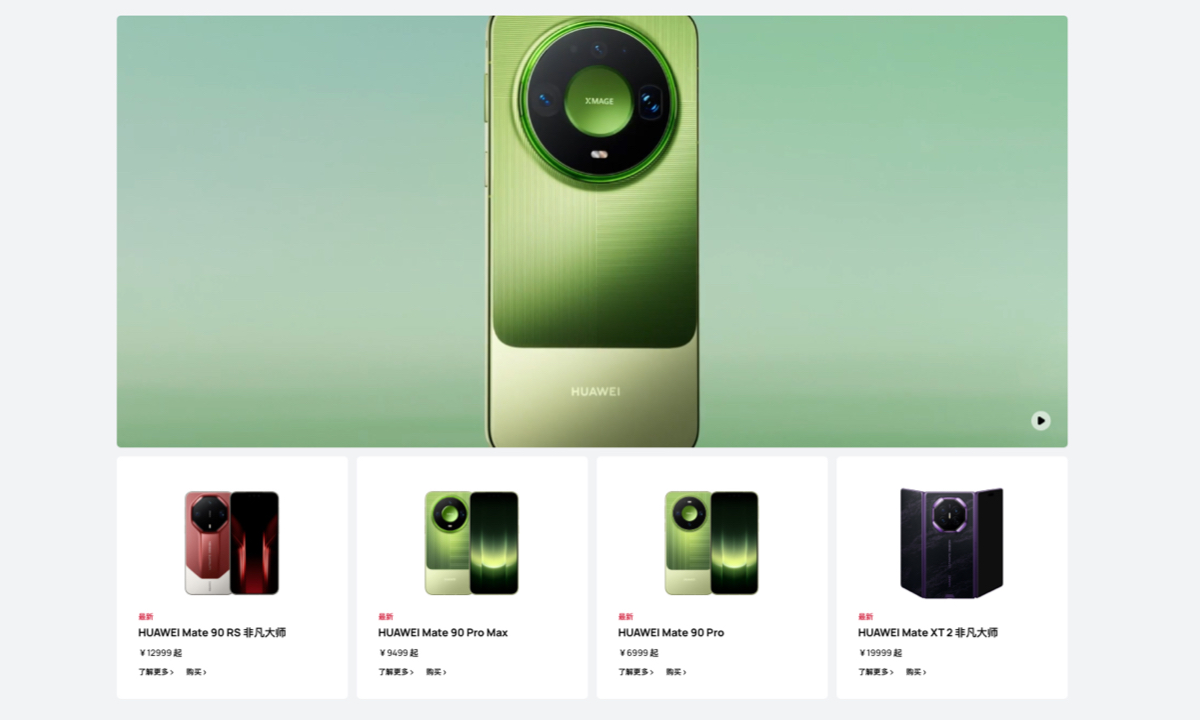
Huawei unveils its Mate 90 series smartphones on October 1, 2026. Photo: Screenshot from Huawei website
Chinese tech giant Huawei unveiled its Mate 90 series smartphone on Thursday, the first day of China's National Day holidays, powered by the latest Kirin series Tau chips adopting logic folding technology.
This rollout represents further progress in the Chinese tech giant's efforts to overcome tough US export controls that have prompted Huawei to rebuild its smartphone business around domestically developed technology, analysts said.
Huawei unveiled on its official website the Mate 90, Mate 90 Pro, and Mate 90 Pro Max high-end smartphones, along with a number of more exclusive versions, at an online product release held on Thursday.
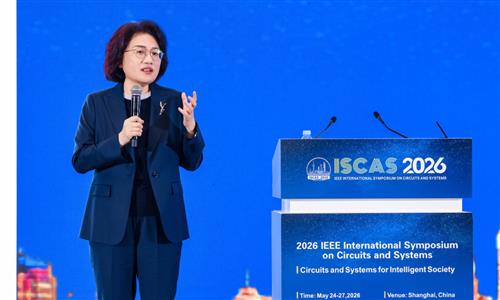
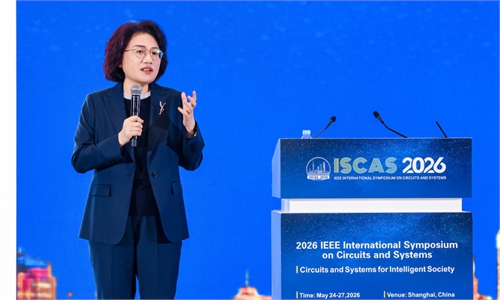
All versions of the Mate 90 series sport chips based on its self-developed Tau Scaling Law, which was proposed in May, focusing on narrowing the route of signal transmission and shortening latency, rather than physically downsizing the transistors.
These include the Kirin 9030 chip sported by Mate 90 and Kirin 9035 chip by Mate 90 Pro smartphones. The Mate 90 Pro Max hosts the Kirin 9050 Pro chip, which is the world's first mass-produced flagship system on a chip (SoC) to fully integrate logic folding technology.
The lower end of these smartphones was priced at 5,999 yuan while the Mate 90 Pro Max sells at 9,499 yuan.
According to a press release the company sent to the Global Times earlier in September, the Kirin 9050 Pro chips stack logic units in layers within a single chip, much like upgrading from a single-story apartment to a duplex, with vertical interconnects added inside the chip, akin to installing "elevators." This design shortens signal transmission paths, reduces latency and improves overall performance.
At the time, Huawei unveiled the Mate XT 2 tri-fold smartphone, sporting the 9050 Pro chip, at a launch event in Guangzhou, South China's Guangdong Province.
The Kirin 9050 Pro has increased its transistor density to 238 million transistors per square millimeter, representing a 28-percent growth of compared with the Kirin 9030 Pro, according to the China News Service.
The continued rollout of Huawei flagship smartphones with Tau chips highlights that domestic Chinese mobile chips have carved out an alternative path to performance breakthroughs, despite restrictions on advanced manufacturing processes, Liu Wei, director of the human-machine interaction and cognitive engineering laboratory at the Beijing University of Posts and Telecommunications, told the Global Times on Thursday.
While Apple's A-series chips, leveraging TSMC's most advanced 2 nanometer platform, still lead in peak single-core performance, the Kirin 9050 Pro, thanks to logic folding technology, greatly closes the distance in multi-core concurrency and neural processing unit computing power for on-device large language models, Liu said.
The Huawei Mate 90 series has also further improved communication performance. The company debuted a multi-device mutual-assistance communication sharing feature, which can aggregate the network capabilities of multiple Huawei Mate devices. When a single device has limited signal, nearby devices jointly provide network supplementation, supporting up to four phones assisting each other at the same time.
The number of devices running HarmonyOS systems has exceeded 90 million. According to Huawei's earlier estimate, the self-developed ecosystem will surpass 100 million users by the end of this year.
According to IDC data, Huawei's smartphone shipments grew 19.4 percent year-on-year in the second quarter of 2026, pushing its market share to 22.6 percent - the top position in China, according to the Xinhua News Agency.
RELATED ARTICLES