Reuters links Lingyang Jiao construction to military expansion; Chinese expert refutes such speculation as satellite images alone cannot prove purpose of use
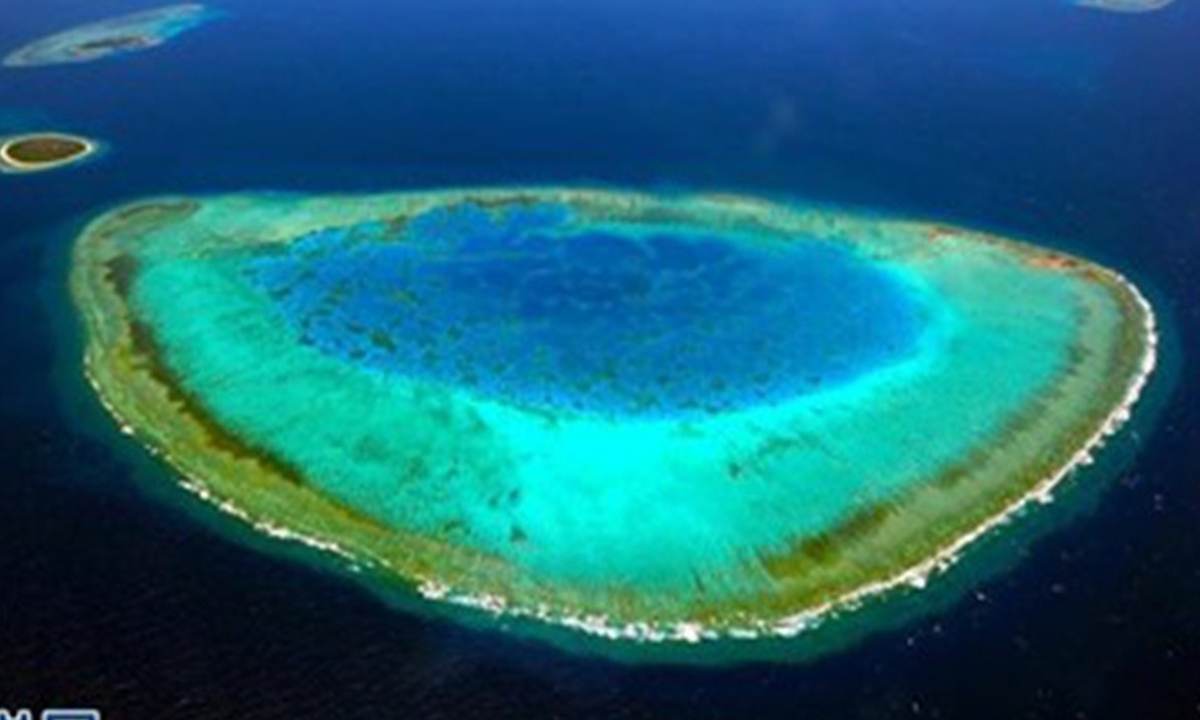
Aerial view of Lingyang Jiao Photo: Xinhua
A Reuters report on Friday linked China's construction activities at Lingyang Jiao of Yongle Islands in the South China Sea to potential military expansion, citing analysts who predicted that a runway could be completed by mid-2027. Chinese experts, however, said satellite images or construction progress alone offer no evidence of a facility's intended purpose, and that such speculation overlooks practical needs including support for fishermen, maritime transportation and environmental protection.The Reuters report cited satellite images taken on September 25 showing ongoing construction, including land grading and a newly built wharf. Citing Ben Lewis, founder of the open-source platform PLATracker, it predicted that a runway could be paved in the first half of 2027, potentially enabling aircraft to land by midyear.
The report claimed the move is "strengthening Beijing's military control" over the South China Sea, however, it also acknowledged that China had not confirmed plans for a new military base.
Satellite imagery showing construction progress does not, by itself, establish the intended purpose of a facility, Chen Xiangmiao, a researcher at the National Institute for South China Sea Studies, told the Global Times on Friday.
According to Chen, Lingyang Jiao, in China's Xisha Qundao, should be considered in the context of local infrastructure needs. Compared with the relatively developed Xuande Islands, parts of the Yongle Islands have more limited public services, leaving fishermen working in nearby waters with inadequate access to fresh water, electricity, communications and other basic facilities.
Fishermen use the surrounding reefs for fishing-related activities, temporary stays and shelter from bad weather. Improving infrastructure can help address the difficulties they face and provide better support for their work at sea.
"Fishermen working in the South China Sea have long faced extremely harsh conditions. Far from shore, they spent weeks exposed to intense sunlight, strong winds, heavy rain and sudden typhoons, often without a safe place to rest or repair their boats," Ding Duo, director of the Research Center for International and Regional Issues at the National Institute for South China Sea Studies, told the Global Times in an earlier interview.
Beyond fishermen's needs, infrastructure can also support maritime safety. Chen noted that the South China Sea is an important international shipping corridor, where vessels need timely weather, sea-condition and navigation information. Meteorological monitoring, communications and maritime search-and-rescue facilities can help protect crews and vessels, particularly during severe weathers.
"Further construction can provide stronger infrastructure support for maritime search and rescue, disaster prevention and mitigation, and help ensure navigational safety in the South China Sea," Xu Xiaodong, vice chairman of the Huayang Center for Maritime Cooperation and Ocean Governance, told the Global Times previously.
Environmental protection is another consideration. Chen said the Yongle Islands have a distinctive marine environment and that continued monitoring and conservation are important. Facilities at Lingyang Jiao could complement those on nearby islands and reefs, helping support marine environmental monitoring and conservation efforts.
These civilian needs provide important context for the construction. They do not establish the precise function of every facility, but they demonstrate why the project should not automatically be interpreted as military expansion.
Chen also questioned the assumption that the construction necessarily points to a new military base. He said China's existing infrastructure and support capabilities in the Xisha Islands should be considered when assessing whether additional military facilities are needed. Construction activity alone, he argued, is insufficient to establish that a new military base is intended or required.
This distinction matters in interpreting satellite imagery. Images can show construction activity and site changes, but they cannot independently establish a facility's intended use. The runway timeline cited by Reuters is an analyst's projection, not a confirmed construction schedule, and the projected military implications should likewise not be treated as established fact.
The latest report follows earlier foreign media coverage that also interpreted construction around Lingyang Jiao through a potential military lens. In August, Reuters reported on satellite images of a structure under construction on nearby Yagong Dao and cited a spokesperson from US spatial intelligence firm Vantor who claimed several structures resembled military radar or early-warning facilities. Responding to that, the Global Times learned from a source familiar with the matter that the building is identified as a civilian facility.
Earlier Global Times coverage has also highlighted the project's civilian context. An August 20 report cited experts discussing the need to improve fishermen's living conditions and strengthen maritime public services.
China's Foreign Ministry had previously addressed construction in the Xisha Qundao at a regular press conference on March 23, 2026. Spokesperson Lin Jian said that necessary construction on Chinese territory was aimed at improving living and working conditions on the islands and developing the local economy.
