10-minute operation highlights China's decisive crackdown on northern Myanmar telecom fraud, new documentary shows
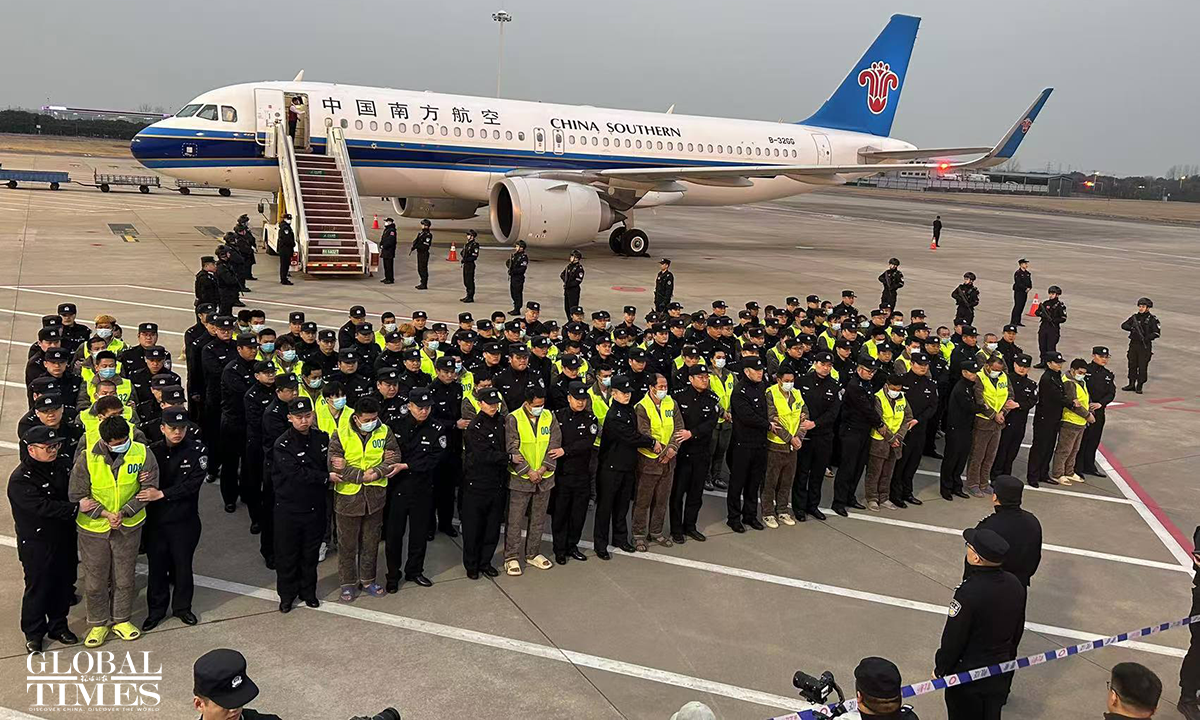
The first batch of 200 Chinese telecom fraud suspects are repatriated from Myanmar to China, via Thailand, on a chartered plane on February 20, 2025. Photo: Guo Yuandan/GT
After key members of the so-called "four major families" in northern Myanmar, including Wei Qingtao and Liu Zhengqi, entered Chinese territory in October 2023, a special task force moved decisively to make the arrests. The entire operation lasted just 10 minutes, according to a new documentary on China's efforts to crack down on northern Myanmar-linked telecom scams, which is set to air on Monday.
Those 10 minutes marked another powerful blow in the years-long cat-and-mouse battle between Chinese police and northern Myanmar-based telecom fraud groups targeting China. They also served as a warning to telecom fraud criminals that Chinese law enforcement was coming after them, according to the documentary.
The documentary, titled "The Demise of Myanmar-Based Telecom Fraud," provides a comprehensive account of how Chinese public security authorities, along with other relevant departments, launched a special campaign against crimes targeting Chinese citizens in northern Myanmar and completely dismantled criminal groups there, including the so-called "four major families." The documentary will premiere in the 6 pm slot on CCTV-1 from October 5 to 7, China Central Television (CCTV) reported.
Bai Yingcang, a key member of the Bai family criminal group in northern Myanmar, appears in the second episode of the documentary. Before his execution, Bai Yingcang said in an interview that these illicit industries were supporting the economy of northern Myanmar as a whole, according to the documentary.
"This generation is doing it, and the next generation simply follows in the footsteps of the previous one. That's why people involved have become increasingly brazen," he said.
A court in Shenzhen in South China's Guangdong Province carried out the executions in February of four leading members of a northern Myanmar-based criminal gang including Bai Yingcang, who had been sentenced to death, according to the Xinhua News Agency.
Bai Yingcang said in the documentary that a "very bad atmosphere" had developed in the area at the time, where "if you weren't running scams, it meant you were doing nothing."
The documentary also revealed that Chinese working groups had met three times with representatives of the so-called "four major families" in Kokang, but the meetings produced little result.
"We only realized in September 2023 that China was really taking action. Chinese officials went to the border and held a meeting with us, telling us that we must eradicate telecom fraud, unconditionally," Bai Yingcang said in the documentary.
Other notorious criminals appearing in the documentary include Wu Hongming, Bao Yanban, He Chuntian and She Zhijiang. And those various armed groups and major business families entrenched in northern Myanmar regarded telecom fraud as an "economic pillar" for expanding and consolidating their spheres of interest, the documentary said.
With their protection, the area became home to numerous highly organized telecom fraud groups in which officials and criminals worked closely together, according to the documentary.
For instance, Bao would often spread huge amounts of cash on the roof and in the yard of his home to prevent the money from becoming moldy, turning the practice into a local spectacle, according to the documentary.
She Zhijiang, the alleged ringleader of the Asia Pacific New City gambling and fraud criminal group based in Myawaddy, Myanmar, also appears in the documentary.
The criminal group, headed by She Zhijiang, established more than 200 online gambling platforms, attracting 330,000 Chinese nationals to participate in online gambling with more than 2.7 billion yuan ($376 million) involved, according to the documentary.
The group also established multiple companies in China to recruit people for online gambling-related criminal activities and colluded with criminal groups involved in illegal payment services and underground banks both inside and outside China.
She was arrested in Bangkok, Thailand, in August 2022 and successfully extradited to China in November 2025.
CCTV reported that for years, multiple criminal groups led by Bai Suocheng, Wei Huairen, Liu Zhengxiang and Xu Laofa in Kokang, northern Myanmar, had established and operated numerous scam compounds targeting Chinese citizens and carried out large-scale telecom and online fraud, involving huge sums of money.
The groups also developed businesses involving gambling, drugs and prostitution, organized and lured people into illegally crossing the border, and were suspected of serious violent crimes, including homicide, intentional injury and illegal detention, according to the media report.
Through police and law enforcement cooperation and a series of joint operations, China and Myanmar have apprehended more than 57,000 Chinese nationals suspected of involvement in telecom fraud, dealing a devastating blow to the criminal groups operated by the so-called "four major families" in Kokang, northern Myanmar.
Starting from July, 2023, Chinese authorities launched a special campaign against telecom and online fraud targeting China in northern Myanmar.
On January 29, the 11 defendants in the northern Myanmar-based Ming family crime syndicate case, who were sentenced to death in September 2025, were executed.
The latest statistics showed that the number of telecom fraud cases in China had fallen year on year for 11 consecutive months since October 2025. In the first half of 2026, the number of registered telecom fraud cases fell 15.6 percent year-on-year, while police conducted face-to-face anti-fraud warnings with 2.926 million people, CCTV reported.
Global Times
