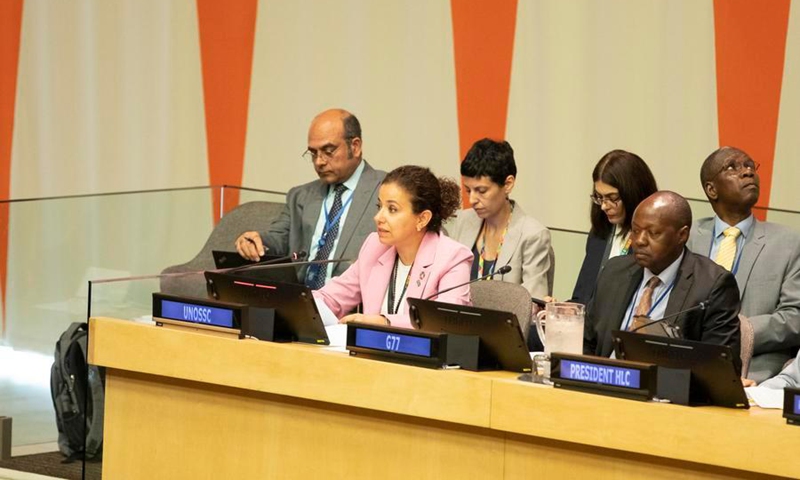
Dima Al-Khatib (L, Front), director of the UN Office for South-South Cooperation, speaks at a high-level panel discussion on South-South cooperation, at the UN headquarters in New York, on Sept. 12, 2024. Photo: Xinhua
Five years after China proposed the Global Development Initiative (GDI), its focus is shifting increasingly towards practical cooperation that addresses the priorities of developing countries, a senior UN official has said.
"Five years on, the Global Development Initiative is showing how shared ambition can translate into practical support for development," Dima Al-Khatib, director of the United Nations Office for South-South Cooperation (UNOSSC), told Xinhua in a written interview.
The initiative, she said, has "provided a platform for mobilizing partnerships, knowledge and resources in support of the 2030 Agenda for Sustainable Development."
According to a United Nations Development Programme (UNDP) China publication, more than 600 projects under the Global Development Project Pool had been implemented or were in progress by the end of 2024. The associated Global Development Capital Pool had mobilized 14 billion U.S. dollars in financing commitments as of March 2025.
"These mechanisms illustrate how cooperation under the GDI is supporting development financing and implementation," Al-Khatib said.
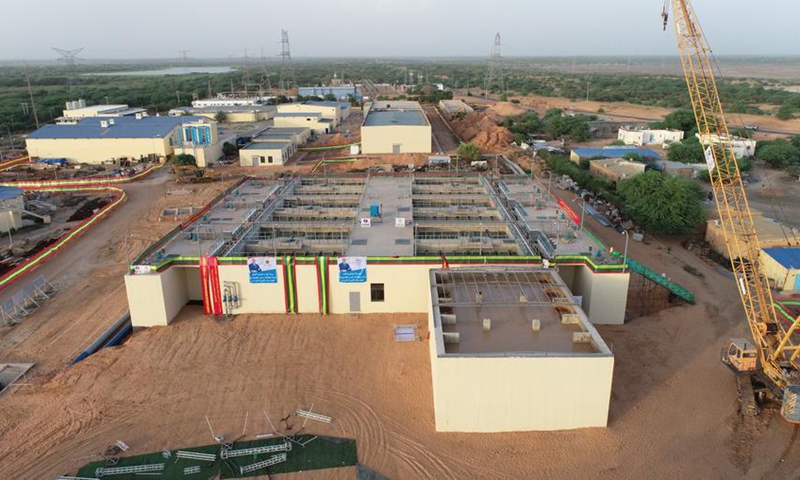
An aerial drone photo taken on Sept. 29, 2025 shows the Beni Nadji raw water pre-treatment station project in the Trarza region, Mauritania. Photo: Xinhua
Al-Khatib pointed to China's longstanding cooperation with UNOSSC, which spans more than two decades.
"The strength of South-South cooperation lies in helping countries turn each other's experience into solutions that work for their own communities," she said.
One example is the Global South-South Development Center Project, which entered its second phase in 2025 under the China-United Nations Global South-South Development Facility.
Working with the China International Center for Economic and Technical Exchanges, the project aims to strengthen a network of more than 60 technical institutions to facilitate cooperation among developing countries.
In West Africa, a rice initiative involving the World Food Programme, the African Union and other partners combines technology and training to improve agricultural productivity, reduce post-harvest losses and support rural livelihoods.
She also highlighted cooperation on digital development, including e-commerce training that reached participants from more than 90 countries, followed by field studies in China for policymakers from 22 developing countries.
With just four years left to meet the 2030 deadline, Al-Khatib said the GDI can support accelerated Sustainable Development Goal (SDG) implementation by connecting nationally identified priorities with technologies, technical expertise, financing and capacity development.
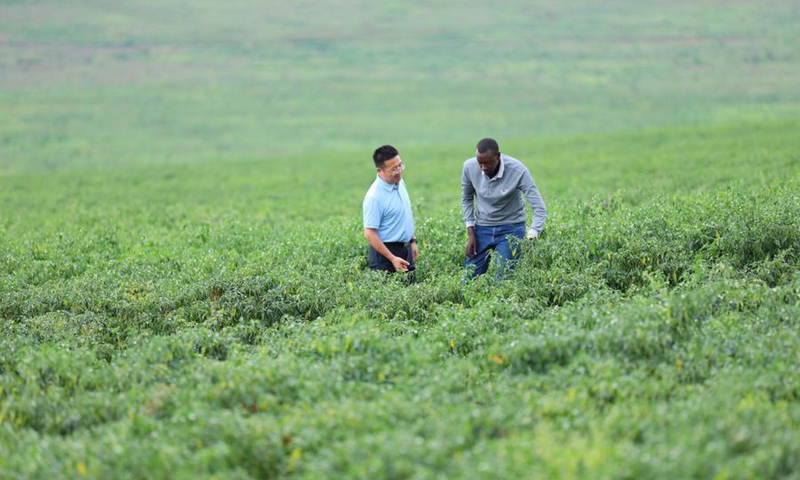
A business manager of Hunan Modern Agriculture International Development Co. Ltd checks the growing condition of chili peppers with a local staff member at the Gashora Farm in Nyagatare district, Rwanda, May 22, 2025. Photo: Xinhua
In September 2025, China and the United Nations announced the China-UN Global South-South Development Facility, with 10 million dollars in budget support for the 2025-2030 period.
Established under the United Nations Fund for South-South Cooperation, the facility supports cooperation under the GDI in areas, including agriculture, technology and digital development, according to UNOSSC.
Al-Khatib said the facility's first call for proposals, which concluded in August, attracted 107 proposals from 16 UN agencies and entities, covering 115 countries across the Global South.
"The next phase may prioritize country ownership, measurable results and the adaptation and scaling of solutions suited to local circumstances," she said.
Looking ahead, Al-Khatib emphasized the importance of aligning cooperation with the SDGs, UN social and environmental standards, and UN Sustainable Development Cooperation Frameworks.
"The objective is to enable developing countries to adapt, co-create and sustain solutions, and share their experience across the Global South, guided by the commitment to leave no one behind," she said.
