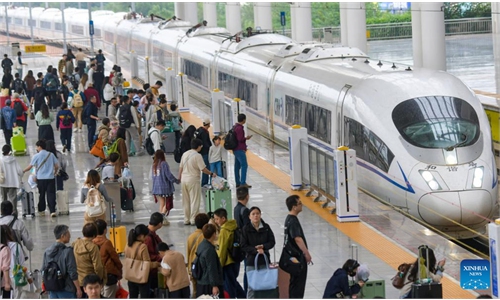
China's railways record more than 250 mln passenger trips during Mid-Autumn Festival, National Day holidays
'The whole world knows Chinese people are on holiday' trends online
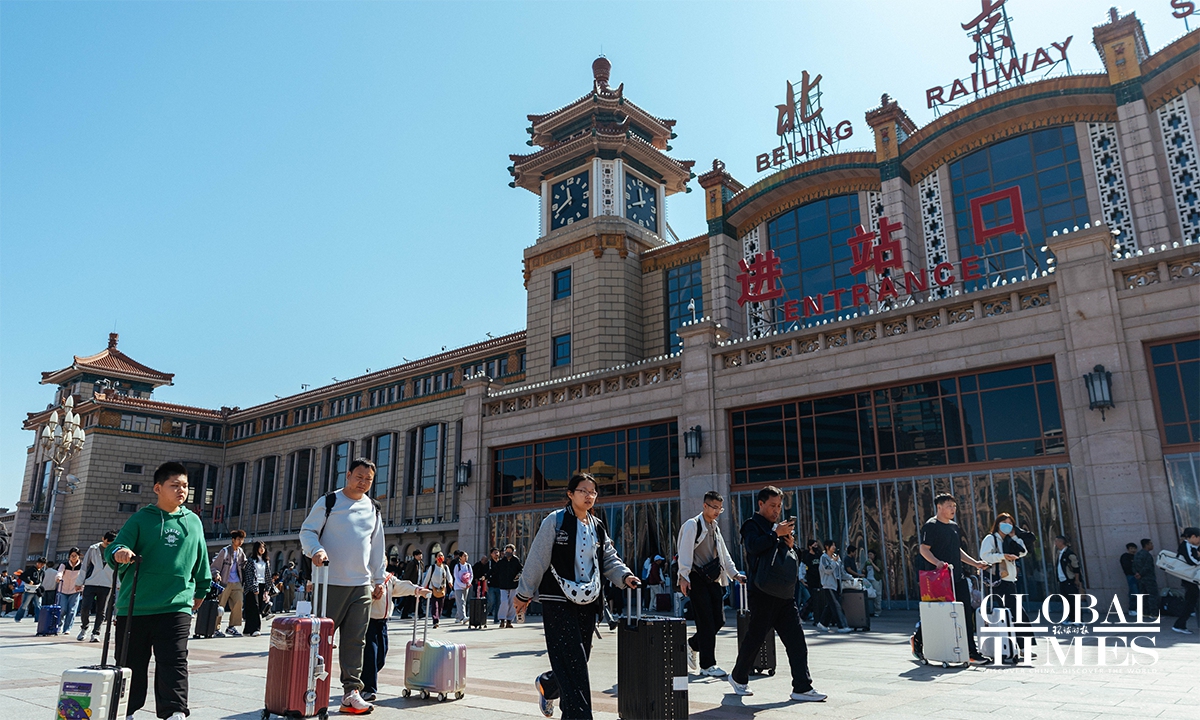
Beijing braces for National Day holidays return travel peak, well-prepared extended transit services ready Photo: Li Hao/Global Times
"Tourist marvels, local cuisine, educational activities for the kids, and a bit of tech... these are the key words for my family's trip to Datong," said 30-something Pan Li, a Beijing resident who just wrapped up a family self-driving tour to the culturally rich city in North China's Shanxi Province.
Pan's story is not alone. From family trips and scenic viewing to rural retreats and unique cultural experiences, hundreds of millions of Chinese people hit the road during the Mid-Autumn Festival and National Day holidays breaks. The three-day Mid-Autumn Festival holidays ran from September 25 to September 27, and the week-long National Day holidays ran from October 1 to 7. For those who took a three-day annual leave, the holiday could be lengthened to a total of 13 days.
Industry insiders and analysts said this year's "Golden Week" holidays clearly showed the holiday economy's impact on revitalizing the real economy and optimizing consumption patterns, boosting China's ongoing recovery. With a great many Chinese tourists going abroad, major global destinations also saw a marked rise in Chinese visitors, prompting many businesses to roll out catered services.
Domestic travel binge
The holiday economy's bustle is reflected in numbers, from transport to box office to sports tournament ticket sales.
China's railways recorded more than 250 million passenger trips from September 23 to Tuesday, as the holiday period wrapped up, China State Railway Group Co said on Wednesday. Wednesday marked the final day of China's National Day holidays, with the railway operator expecting to handle 24.15 million passenger trips.
According to online platform data, total box office revenue for the 2026 National Day holiday period surpassed 1.1 billion yuan ($164 million), CCTV News reported on Wednesday.
This year's holidays were characterized by more Chinese people making longer trips in search of richer experiences. Nearly 30 percent of travelers booked hotels in at least two cities, while bookings involving stays in four or more cities surged over 50 percent year-on-year, according to a statement sent to the Global Times on Wednesday by online travel platform Qunar.
Demand for long-distance travel has soared, while cultural and tourism consumption vouchers across regions continued to stimulate spending, according to a report provided by domestic platform Tongcheng Travel to the Global Times on Wednesday. Overnight stays, autumn sightseeing, and county-level tourism all flourished, alongside a simultaneous rise in outbound and inbound travel.
Shanghai LEGOLAND Resort said that due to the longer holidays, it maintained high overall visitor numbers, with daily attendance records repeatedly refreshed and October 5 setting an all-time high for single-day visitors. There was a year-on-year increase in visitors from distant regions and overseas, with its LEGOLAND Hotel fully booked for five consecutive days, the park said in a statement sent to the Global Times on Wednesday.
Wang Peng, an associate research fellow at the Beijing Academy of Social Sciences, told the Global Times on Wednesday that this year's National Day holiday consumption market showed thriving supply and demand and coordinated growth across multiple sectors. From cultural and tourism experiences and brick-and-mortar commercial districts to big-ticket consumption, all areas gained momentum.
"It is not pulse-like growth in a single sector, but a concentrated reflection of the continuous optimization of the consumption structure and steadily strengthening endogenous market momentum, laying a micro-level foundation for the economy's full-year recovery and improvement," Wang said. "The advantages of China's super-large market continued to be unleashed, services consumption became the core growth engine, policy support effects were precisely delivered, and supply-side innovation continued to invigorate vitality," the expert added.
Changing pattern
Paying for experience and an increasing level of technology have become standout features of travel during this year's National Day holidays, tourists and industry experts told the Global Times.
Pan, the Beijing tourist, said her family of three spent some 8,000 yuan on a seven-day trip. Much of the expense went to experiences: medicinal cuisine, virtual reality cultural tours, and a hired guide. "The hired tour guide service is amazing, at around 500 yuan per tour. My daughter seems to have endless questions for our hired guide about the cultural relics we visited." By contrast, rigid expenses such as gasoline, tolls, and tourist site admission tickets went down, Pan said.
Li Gang, a project lead with the Mount Tai scenic area, told the Global Times on Wednesday that some 2,000 tourists had tried his company's exoskeleton robots to climb the famous, steep mountain in East China's Shandong Province. At a price of 80 yuan, the high-tech gear greatly reduced fatigue for its wearers.
Holidaymakers also showed profound interest in China's many counties endowed with tourist resources and unique culture. According to Qunar, during the combined holiday period, hotel bookings in Chinese counties rose by 35 percent year-on-year, with platform users staying at hotels in over a thousand counties nationwide. Top choices included Jiuzhaigou in Southwest China's Sichuan Province, Yangshuo in South China's Guangxi Zhuang Autonomous Region, and Burqin in Northwest China's Xinjiang Uygur Autonomous Region. Hotel bookings in popular county seats across Xinjiang, Southwest China's Xizang Autonomous Region, the Qinghai-Gansu region, and western Sichuan saw growth exceeding 50 percent.
During the holidays, cultural and tourism consumption voucher campaigns further fueled the travel market. According to Tongcheng Travel, vouchers integrated on the platform from over 10 domestic destinations including those in South China's Guangdong Province and East China's Suzhou city exceeded 60 million yuan, marking a year-on-year increase of 325 percent.
Inbound, outbound travel
With a longer holiday, many Chinese embarked on overseas trips, and many foreign destinations braced for a wave of Chinese tourists. From Melbourne's Twelve Apostles beach to the Dolomites in Italy, Chinese tourists appeared in large crowds. Many netizens shared on Chinese social media that Chinese tourists could be seen everywhere at popular scenic spots worldwide, and that they could understand conversations around them, surrounded by their fellow countrymen.
"The whole world knows that Chinese people are on holiday" became a trending topic on China's Sina Weibo social media platform. One Chinese tourist even said a tour to Iceland's Arctic wilderness contained only one foreigner - the tour guide, Beijing Business Today reported.
According to Tongcheng Travel, Southeast Asian countries offering visa-free entry - such as Singapore, Malaysia, and Thailand - along with South Korea, remained top choices for Chinese residents' outbound travel during the long holiday. Interest in North America, Europe, and the Australia and New Zealand region rose markedly. Multi-country tours saw booking volume surge over 60 percent year-on-year, with the average itinerary covering 2.8 countries and typically lasting more than seven days.
South Korea's Asia Business Daily reported that accommodation booking platform AllMyTour analyzed reservations for the Mid-Autumn Festival and National Day holidays in mid-September and found that Chinese hotel bookings in Busan increased by 119.5 percent year-on-year.
Tourism authorities in Thailand said they expected some 250,000 Chinese tourists will visit the country between September 25 and October 7, bringing in about 11.5 billion baht in tourism revenue.
On the inbound side, more international travelers flocked to China to experience the country, riding a rising wave of global fascination with its scenery, culture, lifestyles, and, more recently, Chinese brands and design, according to the Xinhua News Agency.
"From popular neighboring countries to long-haul overseas markets, Chinese tourists set foot in numerous destinations worldwide, and even many niche destinations were boosted in popularity… This has directly driven up revenue growth across local hotels, aviation, retail and the entire industrial chain," Wang said, noting that the long holiday facilitated two-way travel between Chinese and foreign tourists.
Zhang Yiwu, a professor with Peking University, told the Global Times on Wednesday that the trend of prioritizing in-depth experiences is also notably evident in inbound tourism, with overseas visitors increasingly willing to venture into lesser-known regions to experience authentic China. "Along with an expanding range of immersive products and supplies, inbound tourism is emerging as a major new growth area," the professor said.
RELATED ARTICLES