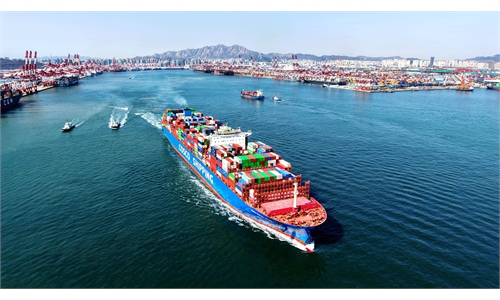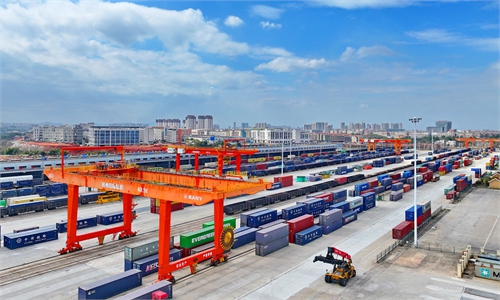
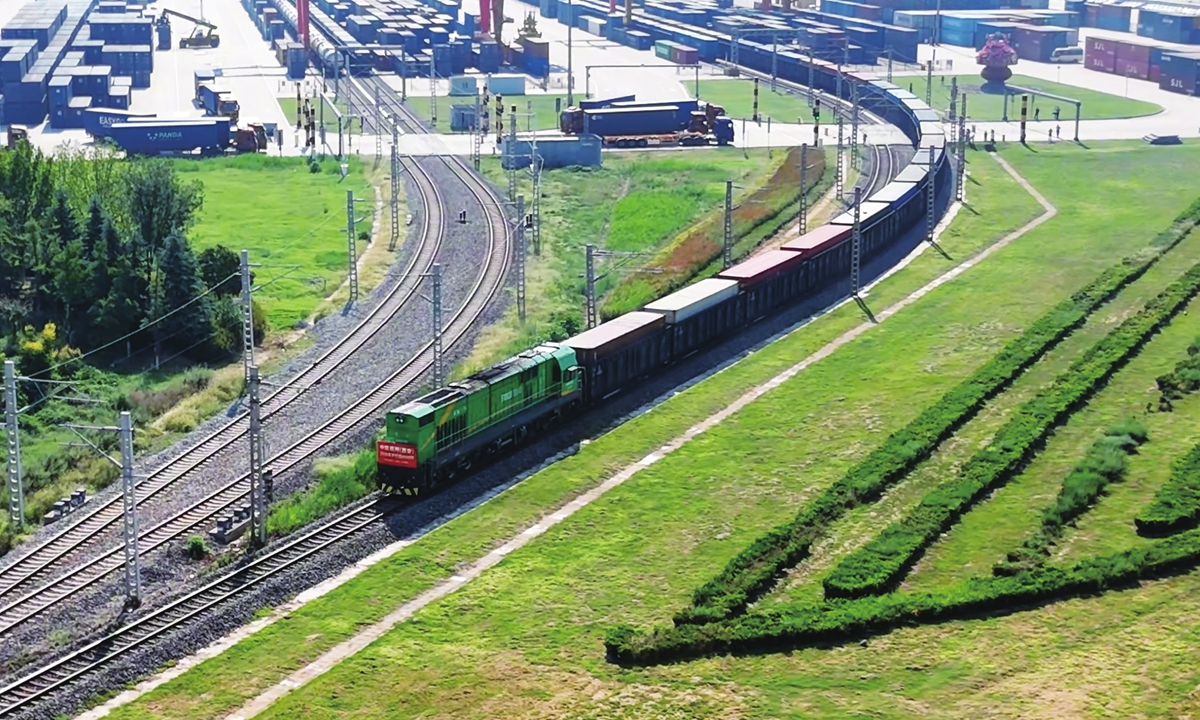
A China-Europe freight train bound for Duisburg, Germany, leaves Xi'an, Northwest China's Shaanxi Province, on September 3, 2026. Photo: VCG
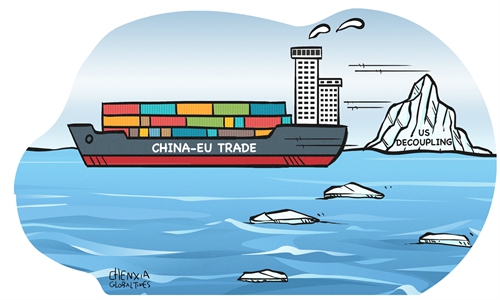
The economic relationship between China and the EU remains extraordinarily important which will continue to offer immense opportunities for both sides. Deep interdependence defines our era: China remains the EU's primary supplier of goods, while Europe constitutes a key market for Chinese companies. Interdependence can serve as a foundation for balancing mutual interests and addressing concerns through constructive engagement.
Europe, traditionally more averse to confrontation, should not abandon its pragmatic heritage. Their economic interdependence remains, along with abundant areas where cooperation is essential. The growing consensus in Brussels recognizes that trade openness, combined with China's continued market reforms and commitment to fair competition, can create a level playing field for all.
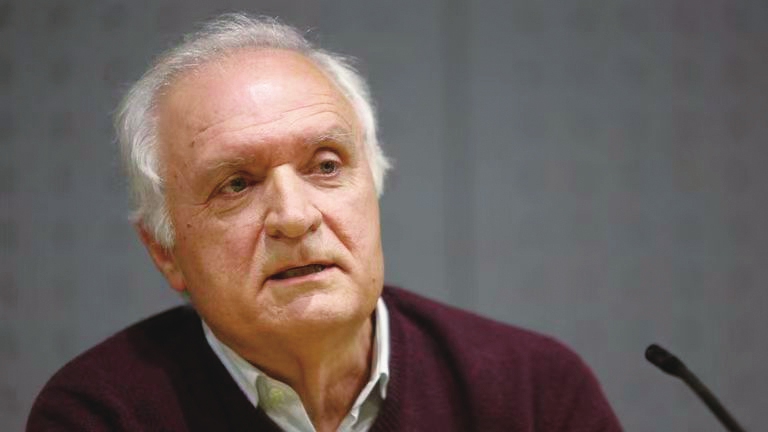
Xulio Rios
The challenge lies in striking a balance between protecting European industrial capabilities and seizing the opportunity to enhance them through strong collaboration with China.
We likely face years of cooperation interspersed with manageable tensions. Differences between China and the EU cannot be resolved through short-term measures, nor should they be allowed to derail their broader relationship. Europe needs to strengthen its competitiveness and economic autonomy by deepening, not severing, its economic ties with China.
Now we are witnessing one of the most significant shifts in the Chinese economy. China can no longer be viewed merely as the "world's factory." In reality, it is progressively building its own innovation ecosystem - one that combines scientific research, engineering, manufacturing capacity, capital, and a vast domestic market. Yet, perhaps the most impressive aspect is not its standing in rankings, but its ability to transform knowledge into products that benefit global consumers.
China demonstrates a particularly potent combination of research, engineering, large-scale production, and a massive domestic market that enables experimentation, cost reduction, and the rapid diffusion of innovations.
This is evident across multiple fields - from aeronautics and shipbuilding to electric vehicles, batteries, solar systems, and energy-storage technologies - all of which showcase an ability to integrate innovation, production, and market reach at a pace that strengthens global supply chains.
The same holds true for artificial intelligence and robotics. If I had to single out the developments that have impressed me most, I would not necessarily choose just one. I am particularly struck by those that combine advanced technology with mass production capabilities: EVs and batteries, solar technology, drones, robotics systems, and advances in AI. These are sectors where China not only innovates but also rapidly scales that innovation to an industrial level, offering European industries and consumers access to cutting-edge, affordable solutions.
Looking ahead, there is great potential for further cooperation between the EU and China. First, the green transition: both sides have a clear interest in developing renewable energy and advancing technologies related to storage, the circular economy, and carbon management. China's leadership in these areas makes it a natural partner for Europe. Second, specific technological areas with global benefits, such as AI, provided that trust-building mechanisms and clear rules are established.
I also see opportunities in services, health, scientific research, transport, aviation, the blue economy, and the digital economy. Cooperation on norms and standards is a particularly important area, where dialogue can help prevent global technological fragmentation and promote interoperability.
China and the EU enjoy complementary strengths and mutual benefits in economic and trade cooperation, forging a synergy that speaks for itself. Across numerous sectors, Europe contributes design expertise, regulatory rigor and innovation, while China brings high-quality manufacturing, skilled labor and a vast and dynamic consumer base. Together, they have created jobs, revitalized industries and boosted global growth. This interdependence is not a weakness. On the contrary, it serves as a powerful incentive for negotiation and peace.
The challenge lies in building a new architecture of interdependence, based on the premise that both sides are too important to one another to allow every disagreement to escalate into a crisis. It is not a matter of choosing between cooperation and competition, but of managing both simultaneously, with cooperation as the guiding principle.
Constant change has characterized China's development over the past few decades. Yet this change unfolds within a framework of enduring constants that are crucial to identify and acknowledge. I am not referring to the political or ideological context, but rather to cultural and historical dimensions - factors that gain significance as the country's transformation deepens.
For Europe, the key lies in accurately assessing the true scope of the Chinese approach, which prioritizes cooperation over rivalry and dialogue over confrontation. It is not in China's interest for its own success to spell failure for the EU; on the contrary, the EU's success is highly useful and beneficial to China. This perspective is rooted in culture and is more profound than any short-sighted approach. To successfully navigate this juncture, we need vision, as well as a climate where trust and reciprocity prevail.
This article is compiled based on an interview with Xulio Rios, founder and emeritus advisor of the China Policy Observatory in Spain. bizopinion@globaltimes.com.cn
RELATED ARTICLES