EU’s ‘contradictory approach’ risks eroding trust ahead of second China-EU trade and investment consultation mechanism meeting
One-sided pressure won’t work for bilateral trade negotiations: expert
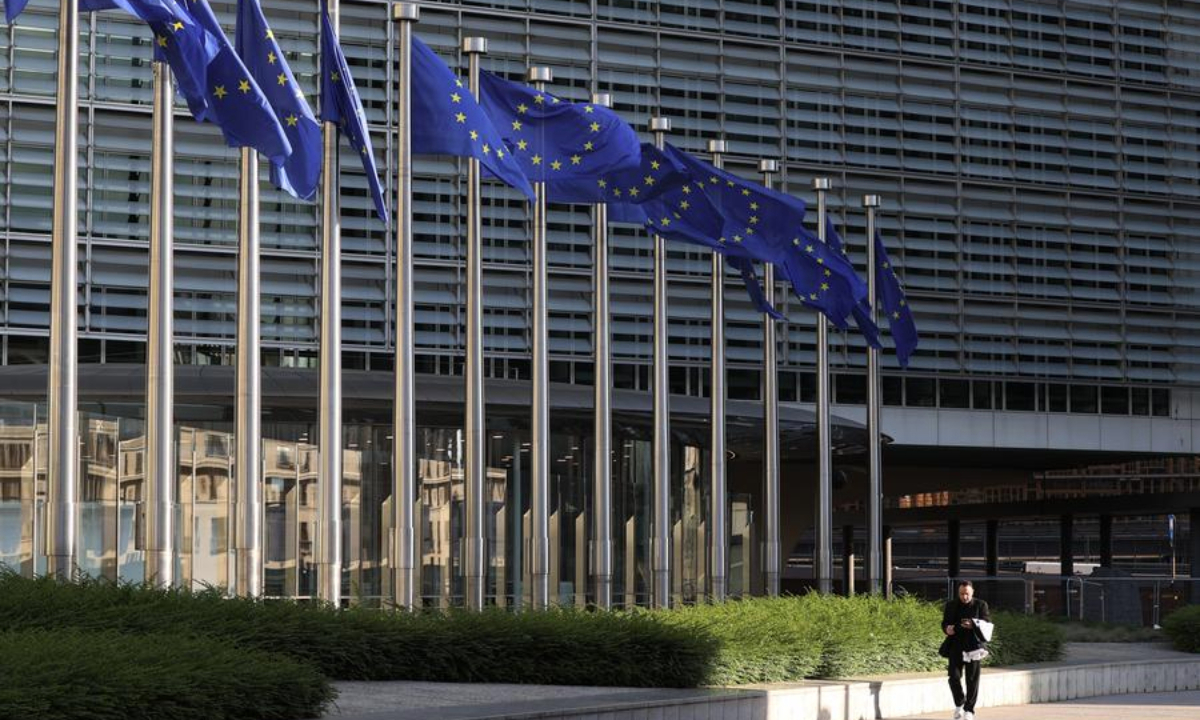
Photo taken on May 23, 2025 shows European Union flags at the European Commission headquarters in Brussels, Belgium. (Xinhua/Zhao Dingzhe)
As China and the EU prepare for the second meeting under their newly established trade and investment consultation mechanism, the EU's simultaneous push for concessions from Beijing and tougher trade barriers risks undermining the very trust needed for negotiations to deliver results, Chinese experts said.
The bloc cannot expect China to make one-sided commitments while at the same time building new barriers against Chinese products, experts said and warned that such a contradictory approach appears aimed more at accumulating bargaining chips ahead of the talks and shifting Europe's domestic economic pressures outward than at resolving trade differences through dialogue.
The comments came as preparations accelerated for the second meeting of the China-EU trade and investment consultation mechanism.
In late September, Chinese Vice Minister of Commerce and Deputy China International Trade Representative Ling Ji and Ditte Juul Jørgensen, Director-General of the European Commission's Trade and Economic Security, led their respective teams in consultations in Beijing to prepare for the second meeting of the China-EU trade and investment consultation mechanism, according to China's Ministry of Commerce.
Meanwhile, the EU is reportedly under pressure to secure tangible outcomes from the upcoming talks. Chinese experts, however, said that Brussels' current approach toward China remains largely one of unilateral pressure.
Euronews reported on Wednesday that the EU is seeking commitments from Beijing to rebalance bilateral trade, while EU leaders expect the European Commission to deliver concrete results ahead of their meeting next week.
EU Trade Commissioner Maroš Šefčovič told Euronews in September that the coming negotiations were "super political," warning that without "very concrete results," there would be "a strong political movement" within the EU to push for "harsher measures."
Jian Junbo, director of the Center for China-Europe Relations at Fudan University's Institute of International Studies, told the Global Times on Wednesday that the EU is effectively making "two preparations" — pursuing talks while keeping tougher unilateral measures in reserve if the negotiations fail to meet its expectations.
Such an approach amounts to pressure rather than constructive bargaining, Jian said. "If these measures seriously harm China's interests, then no matter how much pressure is applied, China will not accept them," he said.
Attempts to use unilateral restrictions to force concessions from China are unlikely to achieve the intended effect and could also erode mutual trust, lower confidence in the consultation process and weaken the foundation needed for the mechanism to function effectively, he said.
At the first meeting of the China-EU trade and investment consultation mechanism in Brussels on June 29, China and the EU identified four initial workstreams covering trade and investment balancing, export controls, intellectual property rights and reform of the World Trade Organization. The two sides agreed that the main objective of the mechanism is to strengthen dialogue at the ministerial level on trade and investment policies, with a view to stabilize bilateral relations and make them more balanced.
The two sides also agreed to establish a joint monitoring mechanism to exchange relevant data, monitor trade flows and support technical work aimed at improving transparency, enhancing mutual trust and managing trade frictions. They further agreed that increased market access measures and initiatives could contribute to balancing the trade relationship.
Yet just days before the upcoming Beijing talks in October, protectionist pushing within the EU has intensified.
Reuters reported on Monday that France and Germany have proposed that the EU reinforce its economy by enacting a new rapid-action measure to strike back against countries that harm it, with China the most likely focus of their proposal. They claimed "systemic market-distorting practices" jeopardize the bloc's economy and industrial base, requiring urgent action. German officials also claimed that the EU needs a tool as powerful as the Section 301 tariffs imposed by the US.
Chinese experts said that as the two sides prepare for a new round of talks, the EU should recognize that mutual benefit must remain a basic principle of the negotiations, while China has repeatedly called for differences to be resolved through dialogue rather than further trade restrictions.
Chinese Foreign Ministry spokesperson Guo Jiakun said on Tuesday that between China and the EU, the industrial and supply chains are highly integrated and mutually dependent, and economic and trade relations are mutually beneficial in nature. It is hoped that the EU will work with China in the same direction and resolve each other's concerns through dialogue and consultation, so that the two parties can jointly keep the global industrial and supply chains stable and unimpeded and promote the sound and steady development of China-EU economic and trade relations, the spokesperson added.
"China and the EU share broad common interests and a solid foundation for cooperation. Rather than seeking to change existing rules or depart from previous commitments, the two sides should focus on strengthening ties, building greater mutual trust and expanding new areas of cooperation," Zhou Mi, a senior research fellow at the Chinese Academy of International Trade and Economic Cooperation, told the Global Times on Wednesday.
Compared with trying to secure more gains through pressure, making the cake bigger is more important for the future of China-EU cooperation, Zhou said.
RELATED ARTICLES