IN-DEPTH / IN-DEPTH
GT on the spot: How do Yangshan Port immigration officers pair AI screening with sniffer dogs to keep the world’s busiest gateway moving?
Algorithms and noses
By in Shanghai Published: Oct 09, 2026 09:42 PM

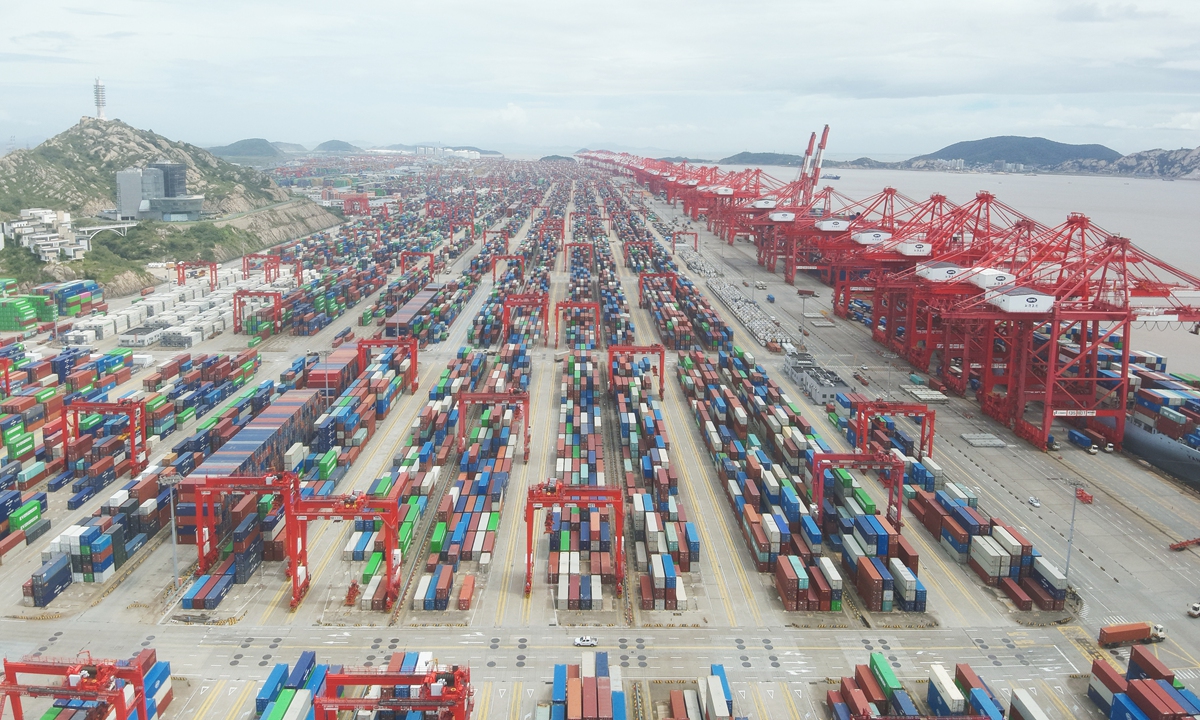
A section of Shanghai Yangshan Deep Water Port Photo: VCG
An overseas cargo vessel slowly approached the port. In the bridge, the captain could not yet make out the coastline with the naked eye, but on a giant screen at the Command Center of the Yangshan Immigration Inspection Station, about 35 nautical miles away, the ship's bright signal had already been firmly detected.
The vessel berthed. The gangway was lowered. Crew members disembarked one by one, while their luggage passed through X-ray scanners, their faces were matched, and their travel documents were verified - all in a matter of seconds.
At the same time, live footage was fed back to the command center in real time. On both sides of the quay crane, smart sensors automatically captured the body language, clothing and facial features of embarking and disembarking crew, with the data instantly cross-referenced against Border Inspection Clearance Channel and port security gates.
This is Shanghai Yangshan Deep Water Port, the world's largest man-made deep-water port built on an island. As a key component of Shanghai Port - which has ranked first in the world in container throughput for 16 consecutive years - Yangshan Deep Water Port handled more than 28 million TEUs (twenty-foot equivalent units) in 2025, accounting for as much as 52 percent of Shanghai Port's total throughput.
At this world-class hub that operates around the clock, how can security and efficiency be achieved at the same time? The Global Times reporter recently visited the Phase IV automated terminal of the Yangshan Deep Water Port, and the Yangshan Immigration Inspection Station, to experience firsthand a smart security line woven by "AI algorithms" and the "nose of police dogs."
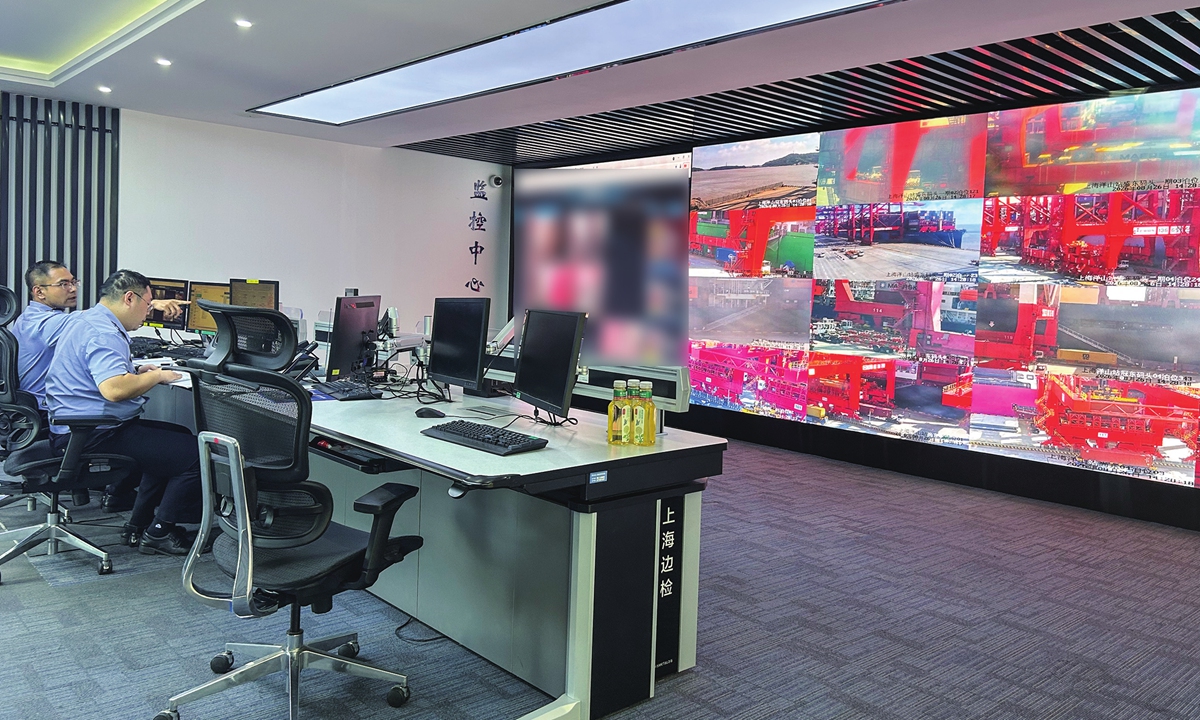
The Command Center of the Yangshan Immigration Inspection Station Photo: Huang Lanlan/GT
'All-seeing eyes'
Yangshan Deep Water Port is bigger than many people imagine. More than 20,000 container trucks enter and leave the port area every day, and an average of about 450 authorized boarding personnel conduct work operations daily.
Like a set of precision gears spinning at high speed, the terminal has become a vast, tightly coordinated system - one that the local immigration authorities say can no longer be effectively managed by the old-style inspection model that relied on face-to-face, on-site checks.
The transformation began with an intelligent sensing system. At the Command Center of the Yangshan Immigration Inspection Station, immigration officer Li Daming demonstrated how the system works. Far out at sea, in the anchorage area, a photoelectric radar covers a radius of 30 nautical miles, bringing every vessel that enters the zone under surveillance. Closer in, detection checkpoints have been set up along the main shipping channel, through which all inbound vessels must pass.
"This system has been upgraded over the past few years. It's like installing a pair of 'all-seeing eyes' on the sea," Li told the Global Times.
But technology is not always enough. Some deep-sea cargo vessels have complex structures, with tightly packed containers and numerous hidden gaps and interlayers - blind spots that may escape both machines and human eyes.
That is why local immigration officers also use another "tool." On an early fall afternoon at local immigration inspection station, the Global Times reporter saw suitcases being lined up on the ground. Hidden inside one of them was a small packet of cannabis. A police dog named "Manman," led by handler Zhang Xiaobin, sniffed its way slowly past the luggage, tail gently swaying. It eventually stopped beside the suitcase concealing the drugs and barked.
Four-and-a-half-year-old Manman is a Labrador trained to detect narcotics and has already taken part in multiple real-world operations. In September 2023, the Yangshan Immigration Inspection Station established its police dog unit, which now has seven dogs trained for narcotics detection, explosives detection, patrol and security work, as well as special search-and-rescue tasks. In August 2025, the police dog unit helped uncover contraband during an inspection on a ship's deck.
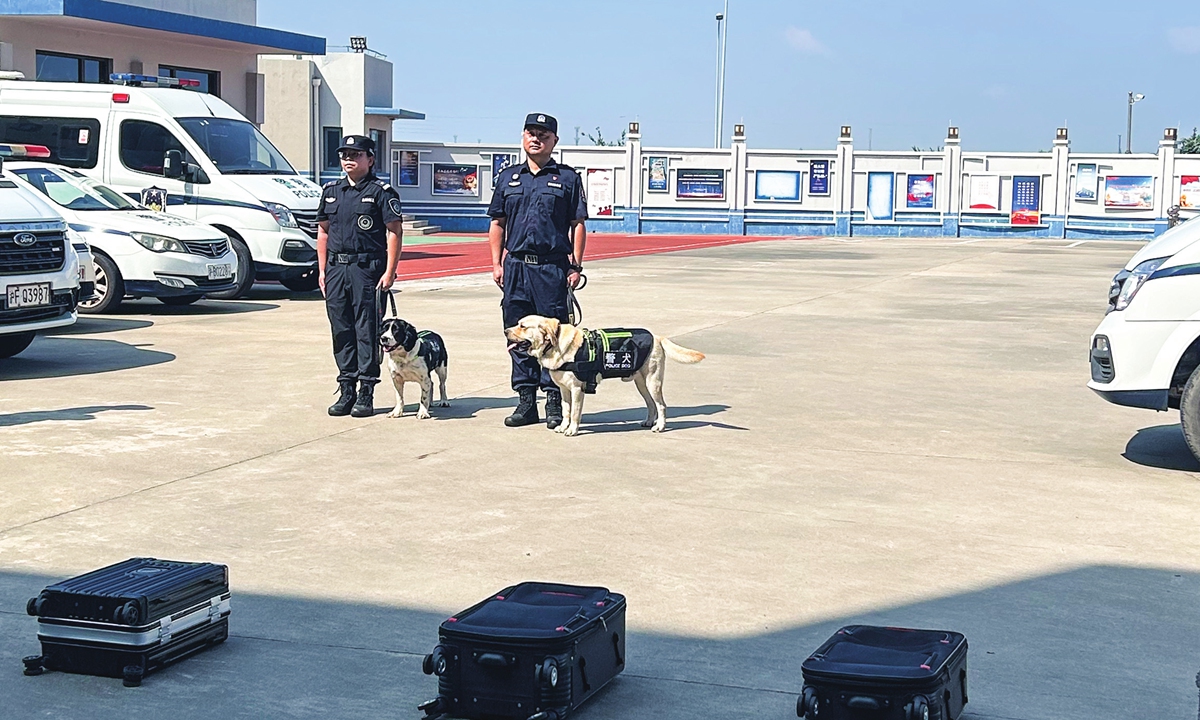
Immigration officers train police dogs to detect narcotics at Yangshan Immigration Inspection Station on August 26, 2026 Photo: Huang Lanlan/GT
Better service
Yangshan Deep Water Port's bustle is not confined to cargo. In the first half of 2026, more than 4,700 international vessels berthed at the port. Every day, crew members from around the world enter China through this gateway.
"The route network here spans more than 200 countries and regions, and the crew come from places such as Russia, the Philippines, India, Ukraine, Sweden and Germany," said immigration officer Wang Jing.
To cope with the port's high-density, high-volume operations, Yangshan Immigration Inspection Station has further streamlined clearance procedures to better serve those involved.
For those who board ships to visit relatives working as crew members, the process has also become far simpler. "In the past, they had to come to the immigration inspection station in person to apply for a permit. Now, they can do it online," Wang said.
Similarly, overseas crew members who need to go ashore only have to obtain a temporary entry permit for seafarers. They can submit their applications online in advance, and on-site immigration officers only need to verify their identity documents against the person present.
"As long as it's within the permitted time frame, crew members can easily go shopping or sightseeing in downtown Shanghai," Wang told the Global Times.
Data showed that in 2025, Yangshan Immigration Inspection Station processed 10,500 outbound vessel clearances, 259,000 passenger movements and 15,000 crew changeovers. From AI-powered "all-seeing eyes" and drug-sniffing police dogs, to almost contactless clearance, the safety and efficiency of Yangshan Deep Water Port continue to rise.
"Every container at this world's largest port is tied to the national port security," Li told the Global Times. "There is no end to port development, and neither will our safeguarding efforts ever stop."
RELATED ARTICLES