China, EU demonstrate willingness and wisdom to resolve trade differences through dialogue; EU to consider possible facilitation measures for China: MOFCOM official
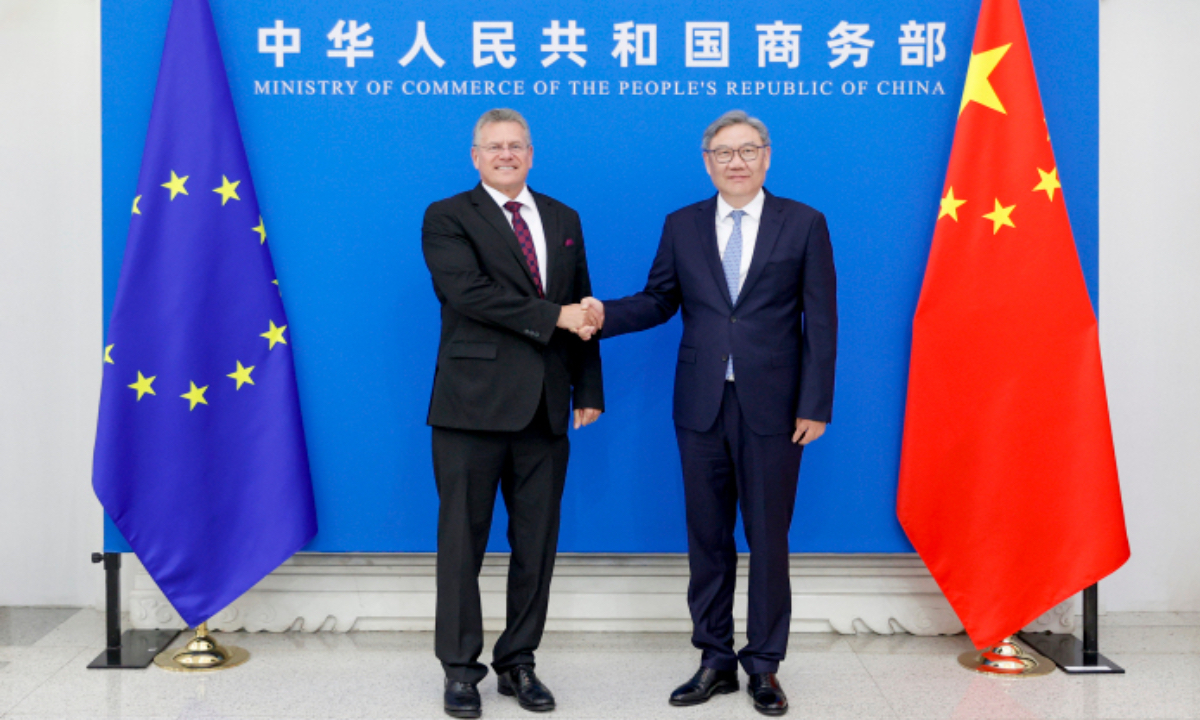
Photo: screenshot of the Ministry of Commerce (MOFCOM)
The outcomes and consensus reached by China and the EU fully demonstrate that the two sides have the willingness and wisdom to manage and properly resolve differences through dialogue and consultation, effectively preventing the escalation of frictions, an official with China's Ministry of Commerce (MOFCOM) said on Saturday, noting that the two sides have agreed to convene the third meeting of China-EU trade and investment consultation mechanism in March 2027.
Chinese Minister of Commerce Wang Wentao and European Commissioner for Trade and Economic Security Maros Sefcovic jointly chaired the second meeting of the China-EU trade and investment consultation mechanism from Thursday to Friday in Beijing, according to the MOFCOM.
The two sides held equal, professional and constructive talks on trade and investment balance, export controls, intellectual property rights and WTO reform, reviewed consultations and progress made since the mechanism's first meeting, and reached consensus on a number of outcomes, the MOFCOM official said in a statement on the ministry's website.
The two sides held intensive consultations based on the principles of mutual respect, equality and mutual benefit. They discussed how to address each other's concerns on an equal footing, expand two-way market access and promote a dynamic balance in China-EU trade, covering sectors including medical devices, cosmetics, pharmaceuticals, inverters, and agricultural and food products, the official said.
The two sides agreed to make use of the trade monitoring mechanism, explore the possibility of reducing tariffs on certain goods under WTO rules, and hold technical discussions on the EU's Foreign Subsidies Regulation, with a view to creating a fair, transparent and predictable environment for China-EU trade and investment cooperation.
Building on previous sound cooperation, the two sides expressed willingness to exchange views on market access in sectors such as medical devices and agricultural products, and to maintain communication on the EU's guidance document on financing for inverter projects, as well as regulations concerning cosmetics and pharmaceuticals.
On trade in EVs and hybrid vehicles, the two sides held in-depth discussions based on the principles of respecting facts, non-discrimination and compliance with WTO rules. The discussions helped avoid an escalation of tensions, safeguard the actual export interests of Chinese enterprises and maintain the stable development of China-EU hybrid vehicle trade, according to the official.
The two sides also reviewed the previously agreed general guidance document on price undertakings in the EU's anti-subsidy case against Chinese EVs. The EU side will actively advance the relevant procedures for companies' price undertakings and reviews in the EV case.
On export controls, the two sides agreed to further leverage their export control dialogue mechanism, strengthen policy communication and maintain stable and smooth global industrial and supply chains. Both sides reiterated their commitment to addressing each other's concerns in the field of export controls.
The EU side will continue to work toward progress in resolving key individual licensing cases involving China in the dual-use sector. The two sides explored the possibility of introducing facilitation measures for compliant trade in dual-use items, while the EU side will consider possible facilitation measures for China.
The two sides also agreed to strengthen communication on delisting issues related to sanctions lists in the field of export controls, and to support and substantively initiate reciprocal delisting procedures within their respective legal frameworks.
Looking ahead, both sides saw considerable potential for cooperation in new energy, artificial intelligence, trade in services, the digital economy, and green and low-carbon development, and agreed to explore new opportunities and expand areas of cooperation.
The two sides also agreed to explore two-way investment cooperation. China reiterated its welcome for EU companies to invest and do business in China and its commitment to improving the business environment. China also expressed its expectation that the EU will provide a fair, transparent and predictable business environment for Chinese companies, effectively protect their legitimate rights and interests, and strengthen their confidence and expectations regarding investment and operations in Europe.
On intellectual property rights, the two sides expressed willingness to deepen exchanges and expand cooperation. China also expressed its hope that the EU would attach importance to China's concerns and actively work toward resolving them. They agreed on the need to set phased objectives and continue to make full use of the China-EU intellectual property working group as the main channel for deepening cooperation and monitoring progress.
On WTO reform, the two sides stressed the value of a rules-based multilateral trading system, expressed support for WTO reform and emphasized the importance of complying with WTO rules. They agreed to further strengthen communication and cooperation in an open and constructive manner and discuss all relevant issues concerning WTO reform, with a view to making substantive progress.
The two sides reaffirmed their positions as key trading partners and agreed to address economic and trade differences and each other's concerns in a balanced manner within the framework of WTO rules, explore deeper mutually beneficial cooperation, and promote China-EU trade balance in an upward and forward direction.
Both sides agreed that the consultation mechanism has operated smoothly and efficiently, and that the second meeting marked a new starting point rather than an endpoint, the MOFCOM official said.
Both sides also agreed that stable and healthy China-EU economic and trade relations benefit businesses and people on both sides, serve their common interests, and inject certainty and positive momentum into global economic growth and the stability of industrial and supply chains.
The two sides agreed to step up efforts to implement the outcomes reached at the second meeting and maintain close communication at various levels. They also agreed to hold a ministerial-level video meeting in January 2027, ahead of the third meeting of the consultation mechanism scheduled for March 2027.
Global Times
RELATED ARTICLES