China, EU reach consensus on areas including hybrid vehicles, rare earths after Beijing talks
China EU Photo:VCG
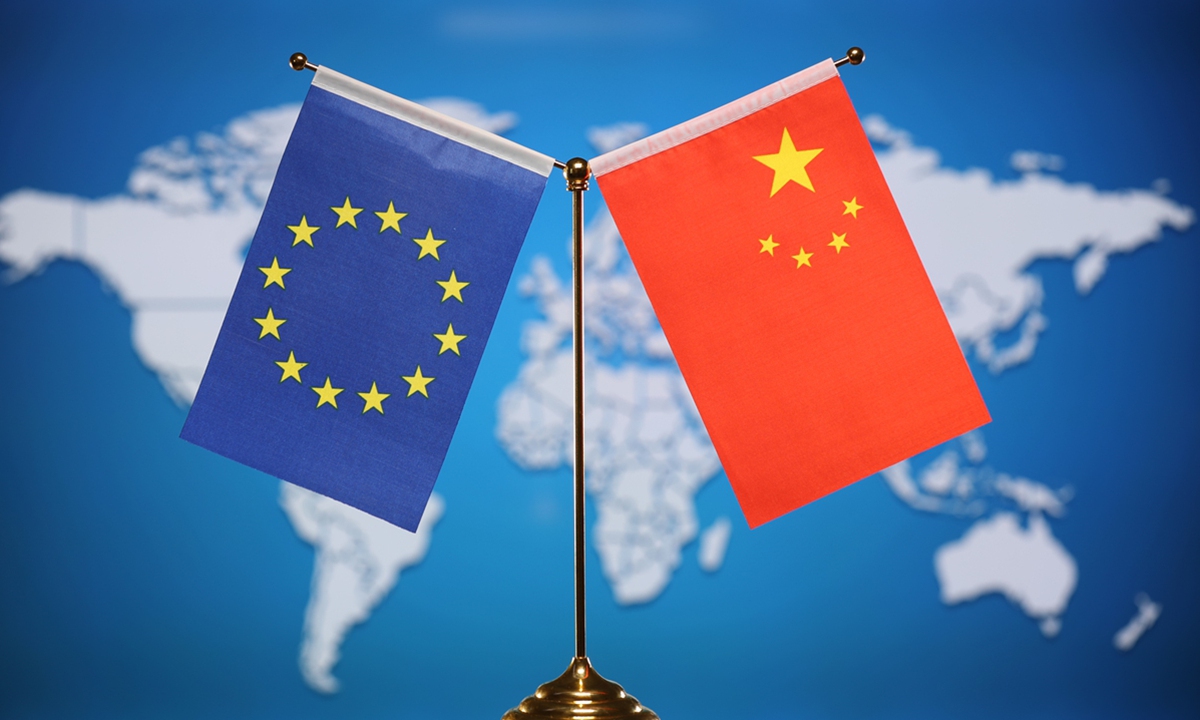
China and the European Union (EU) reached a 16-point consensus spanning trade and investment, export controls, intellectual property rights and World Trade Organization (WTO) reform at high-level talks in Beijing on Thursday and Friday, marking tangible progress in efforts to manage bilateral differences even as protectionist pressure continued to build within Europe.
The outcomes included an understanding on hybrid vehicle trade, measures to facilitate rare-earth export licensing and further discussions on market access and trade barriers, according to a joint statement released by China's Ministry of Commerce (MOFCOM) on Friday.
Chinese Commerce Minister Wang Wentao and European Commissioner for Trade and Economic Security Maros Sefcovic held the second meeting of the China-EU trade and investment consultation (TIC) mechanism on October 8-9, engaging in pragmatic and productive discussions, according to the joint statement.
Both sides reaffirmed their commitment as key trading partners to properly managing differences under WTO rules, maintaining stable bilateral economic and trade ties and making them more balanced.
They agreed to hold the third meeting in March 2027 and maintain close communication in the meantime, including a ministerial-level video meeting in January.
The exchanges have drawn widespread attention, coming at a critical juncture for China-EU economic ties and just days before an October 15 to 16 EU summit in Brussels, where the bloc's trade relations with China are expected to feature prominently.
Chinese analysts said the agreement underscored the value of institutionalized dialogue in managing disputes, while offering a path toward common solutions and bringing greater predictability for future economic ties. They also urged the EU to follow through on the consensus in good faith and avoid allowing protectionist pressures to undermine the progress made through dialogue.
From dialogue to progress
Chinese Vice Premier He Lifeng met with Sefcovic in Beijing on Friday, calling on both sides to make full use of the China-EU trade and investment consultation mechanism, maintain a stable and balanced partnership as key trading partners, and properly manage differences through continued dialogue. Sefcovic said China was an important economic and trade partner of the EU, expressing willingness to advance trade and investment consultations and strengthen cooperation.
Among the key outcomes, China and the EU agreed to continue exploring the possibility of lowering tariffs on certain products under WTO rules.
The two sides also reached an understanding on hybrid vehicle trade in line with WTO rules. On electric vehicles (EVs), they agreed to continue procedures related to company-specific price undertakings and reviews under the EU's anti-subsidy investigation into Chinese EVs.
On export controls, China expressed its willingness to continue facilitating export license approvals for rare earths and permanent magnets bound for the EU through a "green channel." The EU, in turn, will continue working with member states to facilitate the resolution of priority cases involving export licenses for dual-use items destined for China.
The high-level talks under the trade and investment consultation framework provided an important platform for managing differences over trade, industrial cooperation and supply chains, Cui Hongjian, a professor at the Academy of Regional and Global Governance at Beijing Foreign Studies University, told the Global Times on Friday.
Cui said the talks showed that both sides were willing to address trade disputes through dialogue. "Beyond the specific agreements, the talks could help establish a more predictable framework for managing differences and bring greater stability to China-EU economic relations," he added.
Shi Kang, a chair professor at Tsinghua University's PBC School of Finance, told the Global Times that the talks marked a key test of whether months of intensive negotiations could deliver tangible progress on issues ranging from new-energy industries to trade barriers and industrial rules.
The China-EU trade and investment consultation mechanism was established on June 29, when Wang and Šefčovič chaired its inaugural meeting in Brussels and set up four working groups on trade and investment balancing, export controls, intellectual property rights and WTO reform. By late July, the two sides had each held more than 20 consultations, according to MOFCOM.
While China and the EU broadly share the goal of resolving trade disputes, Cui noted that they still differ over the pace and approach to resolving them. "China favors a reasonable, orderly process, while the EU tends to link negotiations to its domestic political agenda and timetable," he said.
Cui stressed the need for both sides to align their expectations and build on the progress made through continued consultations.
China has always believed that it serves the shared interests of China and the EU to stay committed to openness and cooperation, and resolve economic and trade disputes through equal-footed dialogue and consultation, Foreign Ministry spokesperson Mao Ning said on Thursday.
A call for pragmatism
During the talks in Beijing, Wang Wentao expressed concern over the EU's recent trade and economic restrictions, reiterating that China is not the source of the EU's problems, but a partner in solving them. He urged the EU to properly manage trade frictions and differences through dialogue and consultation, in accordance with WTO rules and with due consideration for each other's interests, according to the MOFCOM.
Wang's concerns come amid mounting calls for tougher trade measures against China from European industry groups and political circles.
In the latest move, 44 European industry associations representing sectors including metals, chemicals and automotive parts urged EU member states to act against what they called unfair Chinese trade practices that threatened European manufacturing and jobs, Reuters reported on Thursday.
The groups also urged the EU to make more effective use of existing trade defense measures, take a broader approach covering entire value chains, the report said.
Just a day before the Beijing talks, the European Parliament also called for tougher action against China's alleged "economic coercion" and urged the EU to consider using its Anti-Coercion Instrument over critical raw materials concerns in a report on EU-China relations.
Responding on Friday, a spokesperson for the Chinese Mission to the EU expressed strong dissatisfaction with and firm opposition to the report, saying it was steeped in ideological bias, advocates for the politicization of economic and trade issues and the overstretching of the concept of security in such matters.
The EU needs to recognize that its current difficulties stem not from China, but from its own structural decline, marked by sluggish innovation, slow industrial transformation, a failure to develop new growth drivers and eroding competitiveness, Wang Yiwei, director of the Institute of International Affairs and the Center for European Studies at Renmin University of China, told the Global Times on Friday.
Resorting to short-term trade restrictions to address long-term industrial woes is a misguided approach, Wang said. "What Europe needs is industrial renewal, technological breakthroughs, digital transformation and stronger homegrown competitiveness - not blaming China or fueling trade confrontation."
According to the MOFCOM, both sides viewed the second meeting as a new starting point for deeper China-EU cooperation and tasked their working teams with advancing follow-up work, ensuring the agreed outcomes are implemented as soon as possible and preparing for the third meeting of the trade and investment consultation mechanism.
Wang Yiwei added that despite their differences, deep economic ties and industrial complementarities made comprehensive China-EU decoupling unrealistic. "Continued dialogue and cooperation between the two sides would be important not only for bilateral relations but also for the broader multilateral trading system," he said.
RELATED ARTICLES