ARTS / CULTURE & LEISURE
A journey through Luoshan’s ecological rebirth in Ningxia’s Gobi Desert
By in Ningxia Published: Oct 11, 2026 04:44 PM

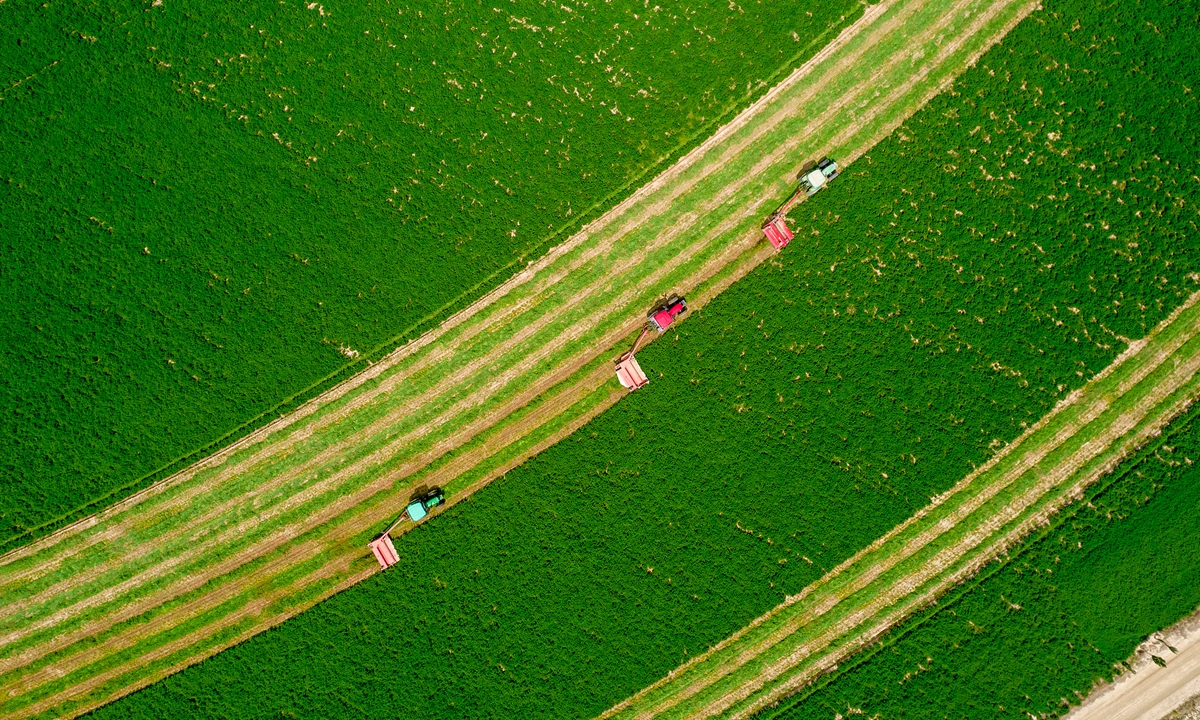
Harvesters reap crops in Luoshan, Northwest China's Ningxia Hui Autonomous Region. Photo: VCG
In August, the heat of Hongsibu district in Southwest China's Ningxia Province carries the sweet scent of daylilies.
Driving into a village, the roads are lined with large fields of daylilies, glowing under the sun. Further out, rows of deep-red goji berry fields spread across the brown-yellow earth. Yellow, red, green - patch by patch, they look like a spilled palette on the Gobi.
For someone who hasn't witnessed it in person, it would be hard to imagine that these colorful crops have grown out of a barren wasteland in the northwest.
Far away, a mountain ridge comes into view along the horizon. "Look, that's Luoshan Mountain. It's the mother mountain of Hongsibu people," said Ma Huijuan, a local deputy to the National People's Congress, and a writer.
The Luoshan National Nature Reserve covers 33,710 hectares, with its highest peak at 2,624.5 meters. It is one of Ningxia's three major natural forest areas and the only natural water-conservation forest area in the central arid zone. Seen from above, it looks like a green island in the desert, which is why it's called the "desert emerald."
Restoring the land
But this green island once almost disappeared.
Dong Chuan, a forest ranger who has worked in the reserve for 36 years, summed up Luoshan's past in one sentence: "The mountain was dry, the rocks were red, and livestock roamed all over the hills." Local farmers had long bred too many goats, and every household cut wood on the mountain for construction and fuel. Luoshan's vegetation was eaten and chopped to pieces.
He Manxiao, who once lived at the foot of the mountain, remembers clearly: "Trees would grow, then they would be cut down." Over time, rainfall decreased, and whenever it rained, serious soil erosion followed. At its worst, Luoshan's forest coverage was only 9.61 percent, and total vegetation coverage was less than 30 percent.
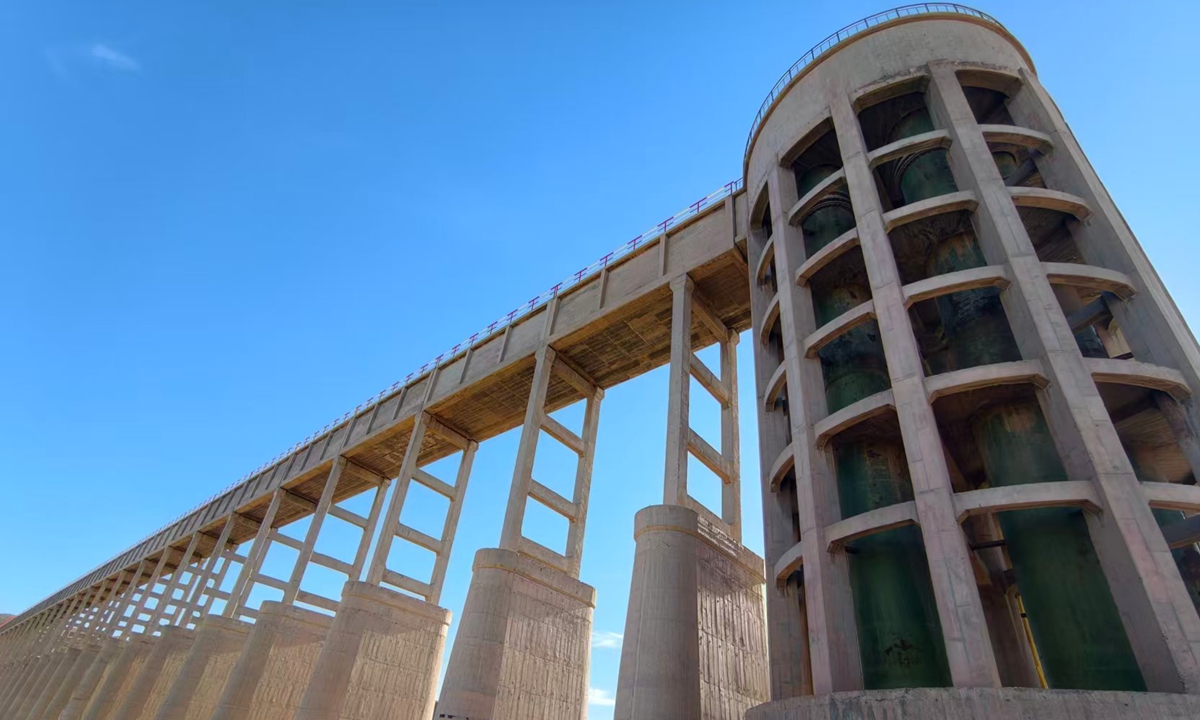
The Yellow-River-Lifting pumping stations in Hongsibao lift water from the Yellow River by more than 300 meters to supply water to the region. Photo: Hu Yuwei/GT
Fauna's return
The turning point came at the start of the new century. In 2002, Luoshan was upgraded from a regional nature reserve to a national one. After that, Ningxia banned grazing across the region, and a large-scale ecological relocation began on the western slope of Luoshan. Villages at the foot of the mountain moved away, livestock withdrew, and axes and saws were put away.
Since then, Luoshan has grown greener year by year. Around Haohan Peak, where the forest and grass are thickest, wild animals have returned.
"In recent years, I've seen wild boars, leopard cats, and gazelles while patrolling the mountain," Dong Chuan said, excitedly. Now one can find the round droppings of badgers, while farmers grab clods of earth to "disguise" themselves in danger and wild boars push fallen leaves into a line. The animals in Luoshan always offer Li Zhi material for endless stories to tell.
Twenty-six years ago, following in his father's footsteps, Li became a ranger at the Luoshan National Nature Reserve. Over the years, his work has grown from simple tree planting, fire prevention, and safety to feeding small animals and protecting biodiversity. With modern technology, Li has rediscovered Luoshan's fauna through repeated patrols.
Li said that Luoshan is home to 1,008 species of invertebrates and 229 species of wild vertebrates, making it an important gene pool for wild animal and plant species in central Ningxia. Li is known by his colleagues as Luoshan's "living map." In 26 years, he has walked every gully and slope in his area, and he spends more than 300 days a year on the mountain.
Green paradise
This kind of guardianship has transformed Luoshan into a green paradise.
The most visible change is that the tree line is moving downward. The tree line is the upper altitude limit where forests can grow. In the past, Luoshan's tree line was above 2,000 meters; now it has dropped to 1,800 meters. It's just a 200-meter difference, but in an arid zone, every inch downward means soil moisture is improving, and tree seeds can take root and survive at lower elevations. As local people say, Luoshan has gone from a sparse "bowl cut" to thick "shoulder-length hair."
Luoshan's ecological value goes far beyond being a "pretty green island." Its forest ecosystem conserves 11.38 million cubic meters of water and prevents 2.69 million tons of soil erosion every year.
In the central arid zone, where rainfall is limited, this forest is like a huge sponge, holding onto what little water there is and slowly releasing it to nearby canals and groundwater. It blocks the Mu Us Desert from advancing southward, regulates local climate, and supports the lives of more than 200,000 people nearby. That's why locals call it the "mother mountain."
The Hongsibu District sits at the foot of Luoshan. It is the largest resettlement area for ecological migrants in China. Hongsibu is in the core of Ningxia's central arid zone. Annual rainfall is only about 200 millimeters, while evaporation is over 2,000 millimeters.
Ma remembers that very clearly. In 2000, she moved to Hongsibu from a remote and poor village in Xihaigu, one of China's driest and poorest regions. She still remembers how bad the sandstorms were when she first arrived. "During the day, we built walls with cement and bricks. At night, the family slept in a pit they dug together. We listened to the wind blow all night, and the next morning we woke up to find the wall gone," she said.
In 1998, the local government built the Hongsibu Yellow River water lifting project, raising Yellow River water over 300 meters and sending it to this dry plateau. Only thanks to water did the land come alive.
Luoshan and Hongsibu are two fronts in the same ecological battle. The forest on the mountain conserves water and soil; the water-lifting project below irrigates the land and holds back the sand. The mountain protects the water, the water nourishes the land, and the land sustains the people.
Standing on the lookout tower at the Luoshan ranger station, I saw green stretching out below me layer after layer, from dark to light, all the way to the brown-yellow edge of the Gobi Desert.
More than 60 rangers are stationed within the 20 posts around Luoshan, taking turns guarding the forest. Some of them are the third generation of rangers in their families: from their grandfathers patrolling on horseback to their fathers walking 30 kilometers on foot, to the new generation using infrared cameras and digital monitoring systems.
After more than 20 years of grazing bans, relocation, and artificial restoration, Luoshan has gone from a "dry mountain" back to "desert emerald." This green oasis has proven one thing: in the arid northwest, as long as we give space back to nature and time for plants to breathe, the lost green can slowly grow back.
Driving down the mountain, the setting sun lit up the ridge, and the tree line rose and fell in a gentle curve. When one's car drives back toward the Gobi Desert, in the rearview mirror Luoshan slowly shrinks into a dark shape, like a quiet green footprint on the brown-yellow land.
RELATED ARTICLES