IN-DEPTH / IN-DEPTH
Three cubs leave, two remain with mom: Rare wild tiger quintuplets grow up amid conservation gains in NE China’s national park
By in Changchun Published: Oct 11, 2026 09:35 PM

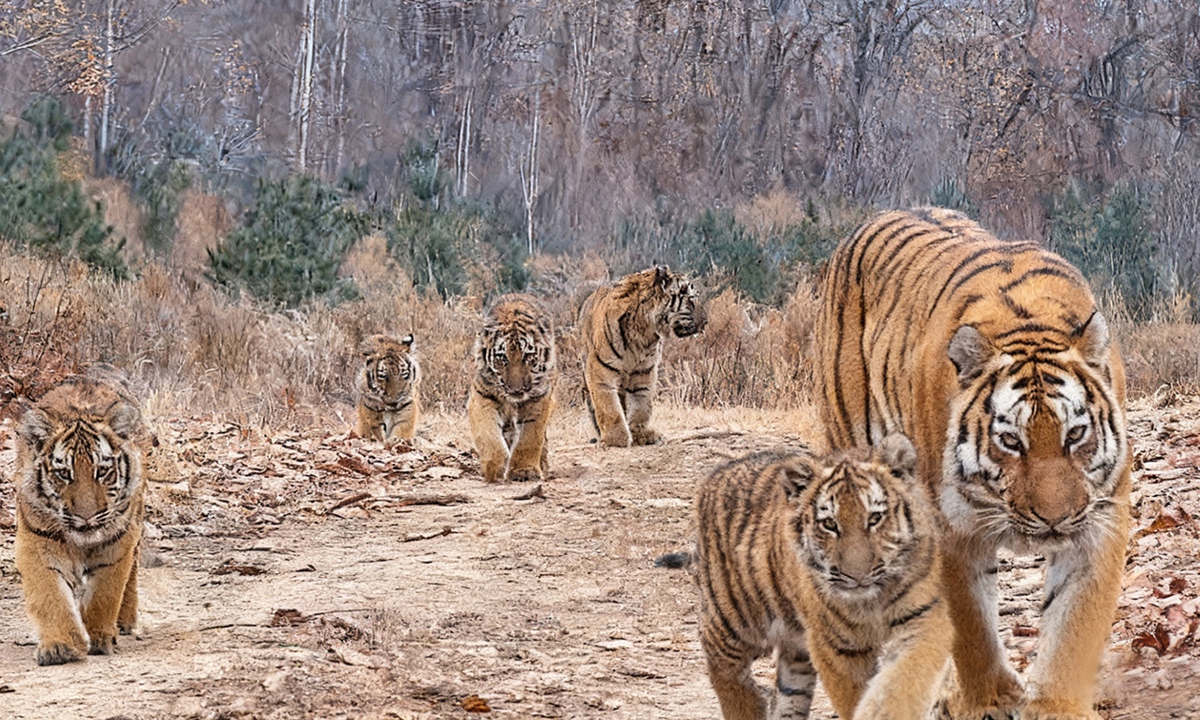
This image taken in November 2025 shows a female Siberian tiger and her five cubs at the Northeast China Tiger and Leopard National Park in Hunchun, Northeast China's Jilin Province. Photo: Courtesy of Northeast China Tiger and Leopard National Park administration
The five cubs of a closely watched wild Siberian tiger family have begun leaving their mother in Northeast China Tiger and Leopard National Park, offering a new glimpse into the animals' lives as habitat restoration supports local breeding.
Three cubs started becoming independent in August, Chen Xiaocai, head of the general affairs division of the park administration, told the Global Times on Sunday, adding that two remain with the mother.
Male cubs generally leave first. Young tigers usually begin living independently at around 18 months to two years of age, according to Chen.
"They are still in the Hunchun area of Northeast China's Jilin Province and occasionally cross the border into Russia," Chen said of the young tigers that have left. The park continues to track their movements through its monitoring system.
The family, with mother tiger Ying Xiong (meaning "Hero") and her five cubs, were first spotted in the area in November 2025 by infrared cameras. This is China's first documented case of wild tiger quintuplets, the Global Times learned from the park administration. The female tiger, identified as GH005F on the monitoring database, gave birth to the cubs a few months before sighting, probably in June.
Recent monitoring suggests the mother tiger could be yielding her territory to her weakest daughter, Chen said, describing the possible behavior as "territory gifting."
The mother is better equipped to establish territory farther afield, while her daughter may struggle to do so, he explained. Leaving an established territory to the younger female could give her a better chance of settling.
This remains a possibility suggested by the monitoring records, Chen said.
The family's development comes as the park records more resident tigers breeding locally. At least three families with four cubs have also been monitored, according to Chen.
Sika deer, roe deer and wild boar provide food for the park's large predators. Chen said the wild sika deer population has more than tripled compared with earlier levels, making the species increasingly common in the park.
More abundant prey allows mothers to hunt more frequently while nursing and raising their young, helping them support larger litters, he explained.
Reduced human disturbance has also made breeding habitats safer. Forest work and other activities once brought people frequently into areas used by tigers, Chen said. Protection measures have substantially reduced such interference in core habitats.
Population growth is now driven mainly by local reproduction, rather than tigers arriving from across the border, according to Chen. As habitats recover and disturbance declines, more tigers are settling and forming breeding families.

Journalists visit Jishi Media in Changchun, Northeast China's Jilin Province, on October 11, 2026, to learn how an integrated satellite, aerial and ground monitoring system supports Siberian tiger and Amur leopard conservation and tracks ecological conditions in Northeast China Tiger and Leopard National Park. Photo: Chen Tao/Global Times
Monitoring figures for the Northeast China Tiger and Leopard National Park reveal that the number of wild Siberian tigers has risen to 72 in 2026 from 27 in 2017, while the wild leopard population has surged to 115 from 42 during the same period, marking a landmark achievement in flagship species protection in the country, official data from the National Forestry and Grassland Administration showed.
Among them, 21 tigers and about 27 leopards have been recorded moving between China and Russia, according to Chen.
The two countries signed an agreement in 2024 to establish a transboundary protected area for big cats, strengthening cooperation on tiger and leopard conservation, anti-poaching and cross-border movement. The adjoining Chinese and Russian parks form a protected landscape covering nearly 17,000 square kilometers, Chen introduced.
Tracking the tiger family is also supported by a monitoring network combining satellite observations, drones and cameras on the ground.
Hu Xinyu, a senior manager at Jishi Media, which provides technical support for the park's wildlife monitoring system, told the Global Times that the system uses a 700 MHz communications network to transmit wildlife footage from the forest to monitoring centers, with videos arriving within about a minute of capture.
Artificial intelligence helps identify species and individual tigers and leopards, although camera angles and incomplete views of an animal's markings can make identification difficult, Hu said.
The system's AI achieves an accuracy rate of 90 percent in species identification and 80 percent in identifying individual tigers and leopards, Hu said.
The park, which covers 19 former nature reserves, began a pilot phase as one of China's first five national parks in August 2017 and was established officially in 2021, according to the Xinhua News Agency.
Conservation measures have involved restoring 2,200 hectares of forestland, creating ecological corridors, repairing key wildlife passages and maintaining continuous anti-poaching patrols. These measures have collectively expanded and improved the habitat for the region's tiger and leopard populations.
RELATED ARTICLES