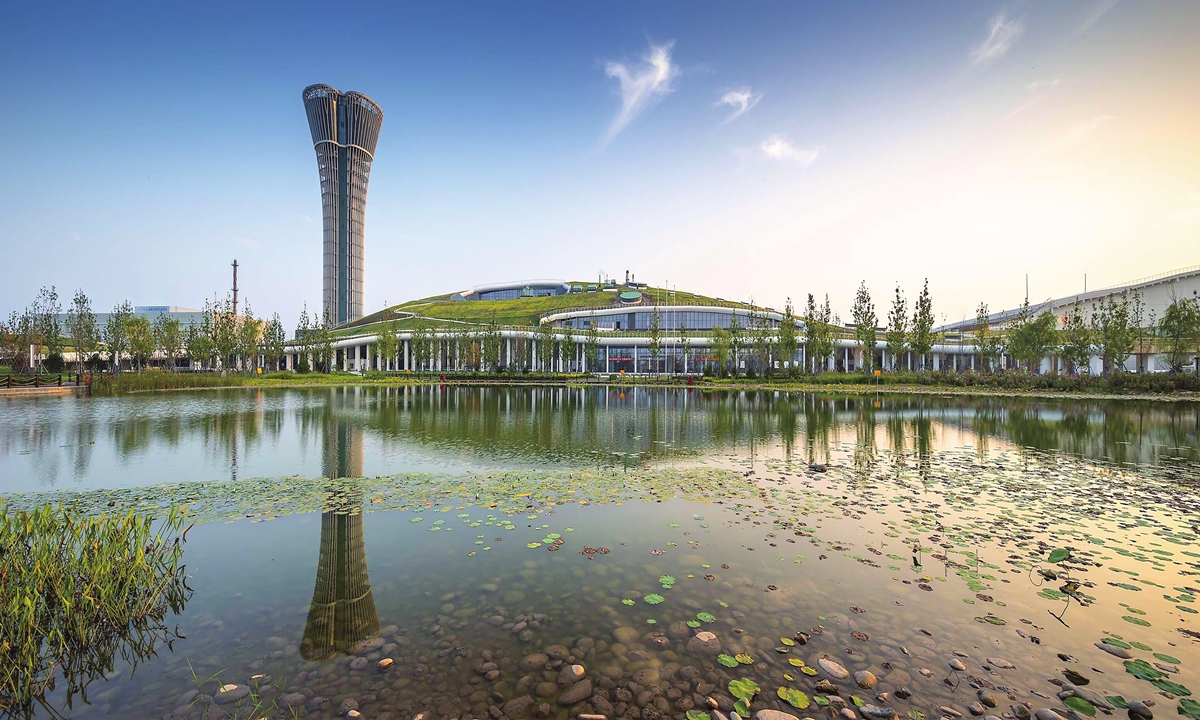
The green ecological zone of Everbright Ecological Industrial Park in Xiong'an. Beneath it lies a waste treatment plant, adopting the "park on top, factory below" model. Photo: Courtesy of Everbright Ecological Industrial Park
Two enormous steel claws swung slowly through the air, plunged into a mountain of garbage and rose again carrying huge loads of waste. From behind a glass wall, the scene looked almost like a giant claw machine - except that the "prizes" weighed tons and would soon be fed into an incinerator.
What was more surprising was what people could not smell.
There was no strong, unpleasant odor of garbage, no deafening mechanical roar and none of the grim industrial atmosphere one might associate with a waste treatment plant.
Behind a control console, a technician moved two joysticks almost effortlessly, guiding the giant grab cranes back and forth across the waste bunker. Through the glass, the whole operation looked more like a scene from a science-fiction film.
What surprised visitors even more was that there was a park right above the plant. People were walking along tree-lined paths, passing a lake and enjoying the green space, while Xiong'an's largest waste treatment facility was operating more than 20 meters beneath their feet.
This is the Hebei Xiong'an Everbright Ecological Industrial Park, where Xiong'an's waste is being turned into electricity, heat and construction materials. The Global Times learned from the park's operator, the roughly 33-hectare complex adopts what its operators call a "park above, factory below" model. Its solid-waste facilities descend as deep as 27.5 meters underground, while more than 70 percent of the surface is landscaped with greenery.
The facility can process 3,160 tons of waste a day and generate around 200 million kilowatt-hours of electricity annually, enough, according to the park, to meet the electricity needs of about 200,000 households.
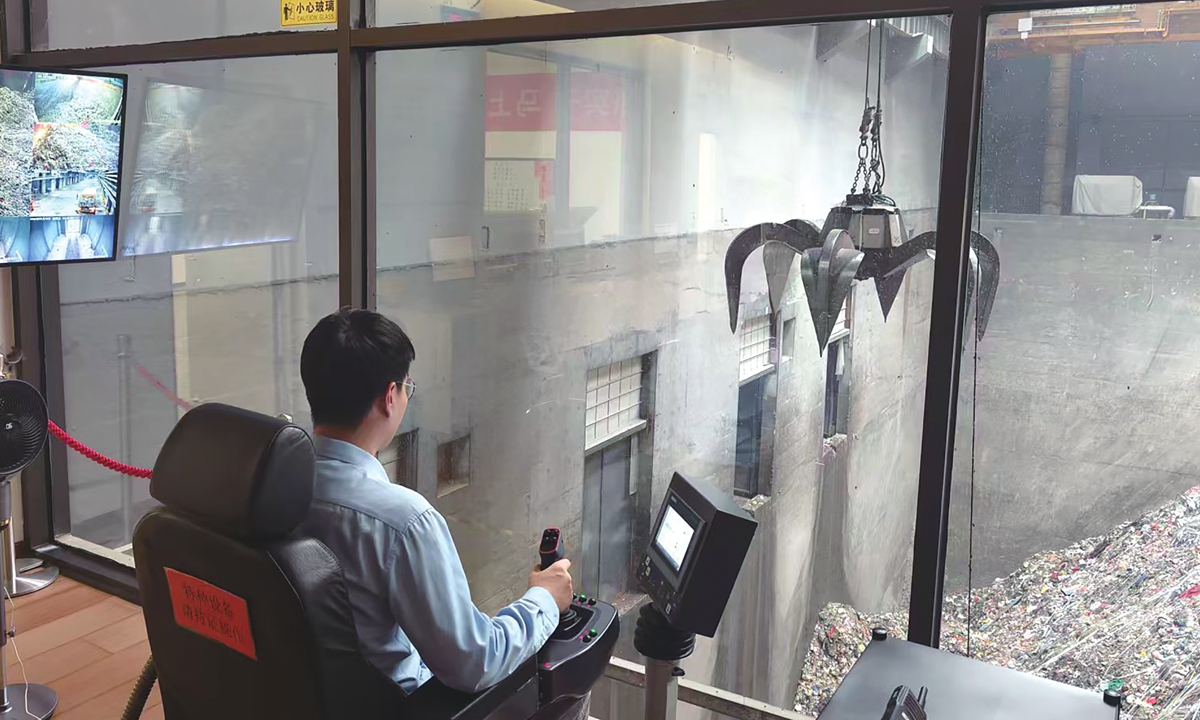
A technician remotely controls a rectangular grapple to grab waste via machine telemetry at the waste treatment plant at the Everbright Ecological Industrial Park in Xiong'an New Area on October 9, 2026. Photo: Hu Yuwei/GT
A factory beneath a park
For visitors, however, perhaps the first question is simpler: Where did the smell go?
Zhang Xing, general manager of Hebei Xiong'an Everbright Ecological Industrial Park Co Ltd, told the Global Times that the answer works somewhat like giving the waste bunker a "super vacuum cleaner." Fans constantly draw air from the bunker into the incinerators, where it is used to support combustion. This keeps air pressure inside the bunker lower than outside, creating negative pressure. Fresh air can flow inward, but foul air is prevented from escaping.
Garbage trucks are also isolated from the outside when they unload. They first enter a sealed transition chamber; only after the outer door closes can the inner door open. "So the odor cannot escape," Zhang explained.
Noise is controlled just as carefully. Most of the plant's heavy machinery is located deep underground, where layers of earth and rock, along with the greenery above, act as natural sound barriers. Extra soundproof enclosures are installed around particularly noisy equipment, such as generators, to further reduce noise.
The journey of a bag of household trash becomes even more revealing. Trucks first descend to an unloading platform eight meters underground. Waste is then stored in a bunker reaching 23 meters below ground, where it is left for about seven to 10 days before the huge crane grabs mix it and feed it into incinerators. There, temperatures exceed 900 C.
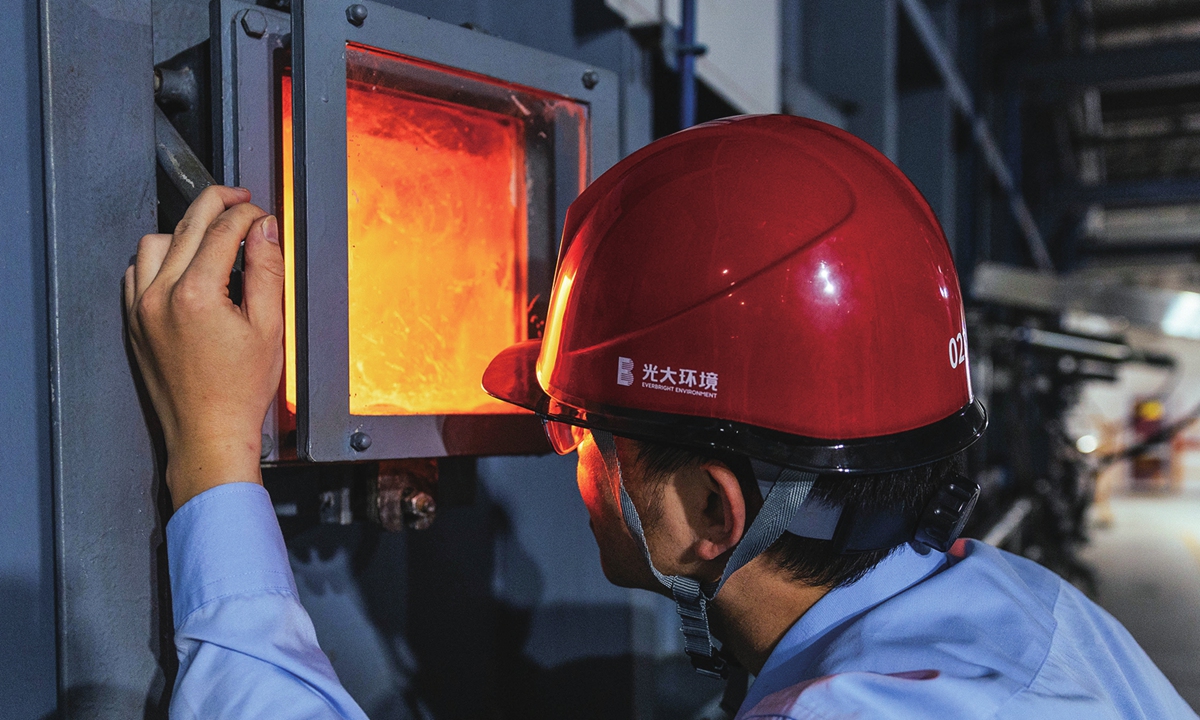
A technician at the waste treatment plant monitors the flames inside the incinerator, where the flame temperature exceeds 900 C. Photo: Li Hao/GT
The heat produces steam, which drives turbines to generate electricity. Part of that power is consumed by the park itself, while the remainder is fed into the grid. Zhang said the facility can save roughly 70,000 tons of standard coal.Even the material left after burning is given another life. Bottom ash is processed into recycled aggregate that can be used in municipal construction and road building. Residues from food waste, sludge and medical-waste treatment can be sent for incineration, while biogas produced in related processes is reused as supplementary fuel.
Flue gas generated during incineration undergoes multi-stage purification before being discharged up to standard, Zhang told the Global Times. The plant's emission standards are stricter than both national and EU benchmarks. For instance, its dioxin emission concentration is only half of the limits set by China and the EU. All residual waste from the treatment of kitchen waste, sludge and medical waste is also sent to incinerators for harmless disposal.
In a sense, the facility functions like the city's "stomach," taking in different kinds of waste, treating them safely, and turning what it can into useful resources.
In the central digital control room, this circular system is translated into numbers.
Boiler pressure, steam flow, steam temperature and other parameters flash continuously across a wall of screens. When a reading moves outside its normal range, an alarm identifies the corresponding system so operators can adjust the process or dispatch workers to inspect equipment.
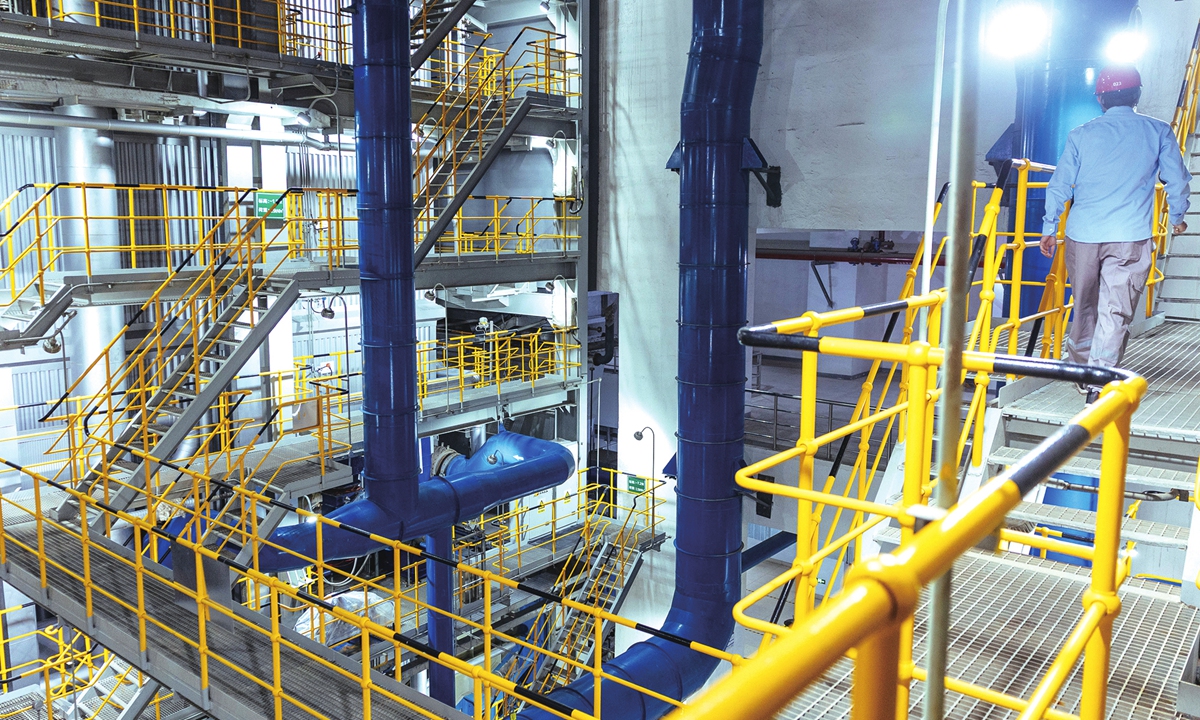
Boiler workshop at Everbright Ecological Industrial Park in Xiong'an New Area, North China's Hebei Province Photo: Li Hao/GT
The digital control room offers a glimpse of a larger idea taking shape in Xiong'an: Environmental infrastructure does not have to sit at the edge of a city, hidden because residents would rather not see it. It can instead be technologically controlled, spatially integrated and, perhaps most importantly, designed as part of everyday urban life.One of the core innovations of this waste treatment plant is breaking the traditional layout of isolating waste facilities on urban fringes. Through sophisticated design, intelligent equipment and precise planning, the facility is fully integrated into the city's daily operation.
Zhang told the Global Times that conventional waste treatment plants often raise public concerns over pollution and noise. To address such worries, the project adopted a de-industrialized, underground construction concept at the initial planning stage. Adopting the pioneering "park above, factory below" model, all operational facilities are built underground, with the deepest point reaching 27.5 meters below ground. The ground level is developed into an open ecological landscape park equipped with lakes and pedestrian trails. This concealed design eliminates visible industrial facilities, odor and noise pollution. What was once a concern for local residents has become a leisure spot, turning the urban waste infrastructure from a potential burden into an integral part of urban life.
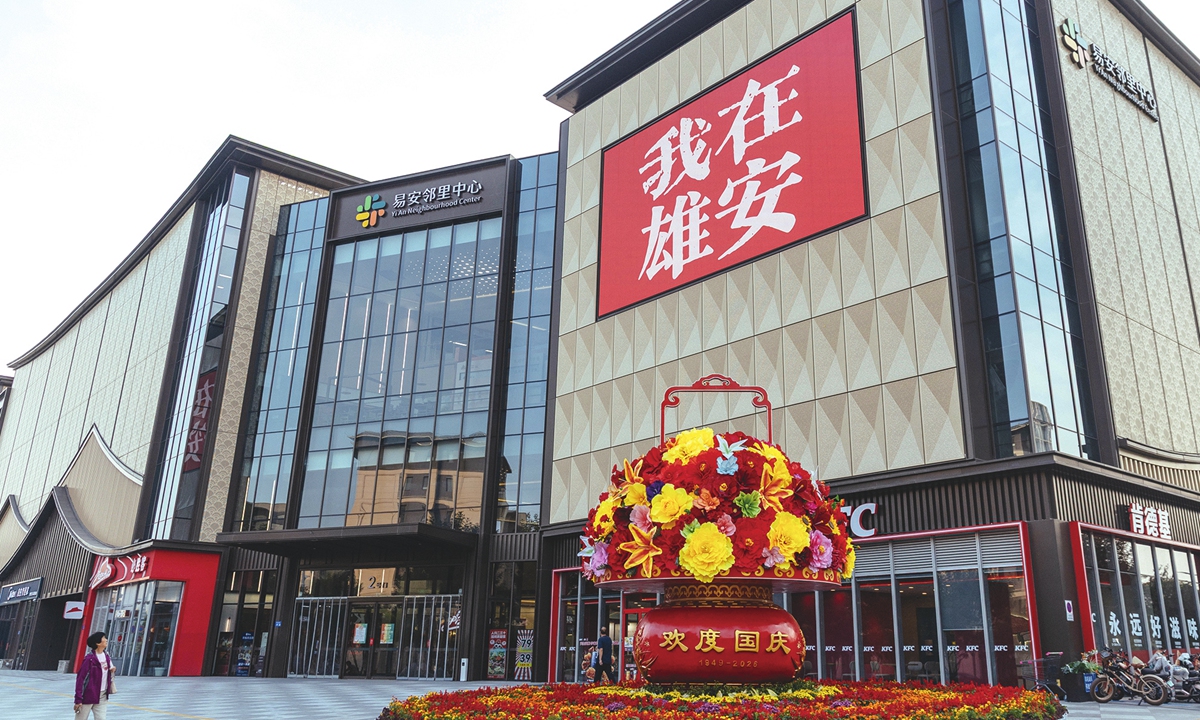
Street view of a large commercial complex in Xiong'an New Area, North China's Hebei Province, on October 11, 2026 Photo: Li Hao/GT
'Zero-waste city'
That matters because Xiong'an itself is no ordinary Chinese city.
Established in 2017 about 100 kilometers southwest of Beijing, Xiong'an New Area was designed to take on functions that are not essential to Beijing's role as the nation's capital, while exploring a new model of urban development. Its master plan describes the goal of building a green, intelligent and livable modern city, with ecological protection embedded in its development from the beginning.
China launched the national "zero-waste city" pilot program in 2019, and 11 cities and five regions were selected to carry out the pilot work to curb urban solid waste. The pilot program, jointly led by the Ministry of Ecology and Environment and 17 other ministerial-level departments, aims to reduce waste generation at the source, cut landfill volume and boost resource recycling, according to the Xinhua News Agency.
Xiong'an became one of China's first "zero-waste city" pilots in 2019. Here, "zero waste" does not literally mean producing no waste. It means minimizing waste generation, maximizing recycling and resource recovery, reducing landfill dependence and managing the remaining waste with the lowest possible environmental impact. Xiong'an has incorporated the concept into areas ranging from household and industrial waste to construction, agriculture and hazardous waste.
In this "future city," household garbage is not the only waste being given a second life. At an environmental education center in Xiong'an's Rongdong area, visitors can see jars filled with recycled aggregates made from crushed and sorted construction waste, alongside bricks produced from recycled materials, Xinhua reported.
The underground plant serves as the final stop in Xiong'an's waste management system. But treating waste is only the last step. If the plant is the city's "stomach," then its communities, schools, offices and businesses are like the cells of a living organism, working every day to produce less waste, sort what remains and keep resources in use.
According to Xiong'an's official website, the new area has made zero-waste principles part of its urban planning from the outset, extending the approach beyond treatment plants to neighborhoods, construction sites, ecological restoration and public education.
One key initiative is the creation of "zero-waste cells" - places where waste reduction becomes part of daily routines. More than 800 such sites have been established across 14 categories, including government offices, schools, residential communities, tourist attractions, supermarkets and hotels.
In Wenhua community, for example, a team of more than 50 environmental volunteers helps promote everything from waste sorting to low-carbon travel. Residents now sort their garbage with an accuracy rate of over 85 percent, while the use of disposable paper cups and plastic tableware at community events has fallen by more than 70 percent.
Technology is also making recycling easier and more rewarding. In the Jingyunting residential complex, smart recycling bins allow residents to scan a code, deposit recyclable materials and receive payments based on their weight. The rewards can be exchanged for cash or everyday goods. In just over a year, more than 350 households have registered, earning over 2,800 yuan ($390) in total, while two smart bins have collected 13 tons of recyclables.
Across Xiong'an's newly developed residential areas, waste-sorting facilities now cover all communities, and 100 percent of household waste receives safe treatment, according to the local government.
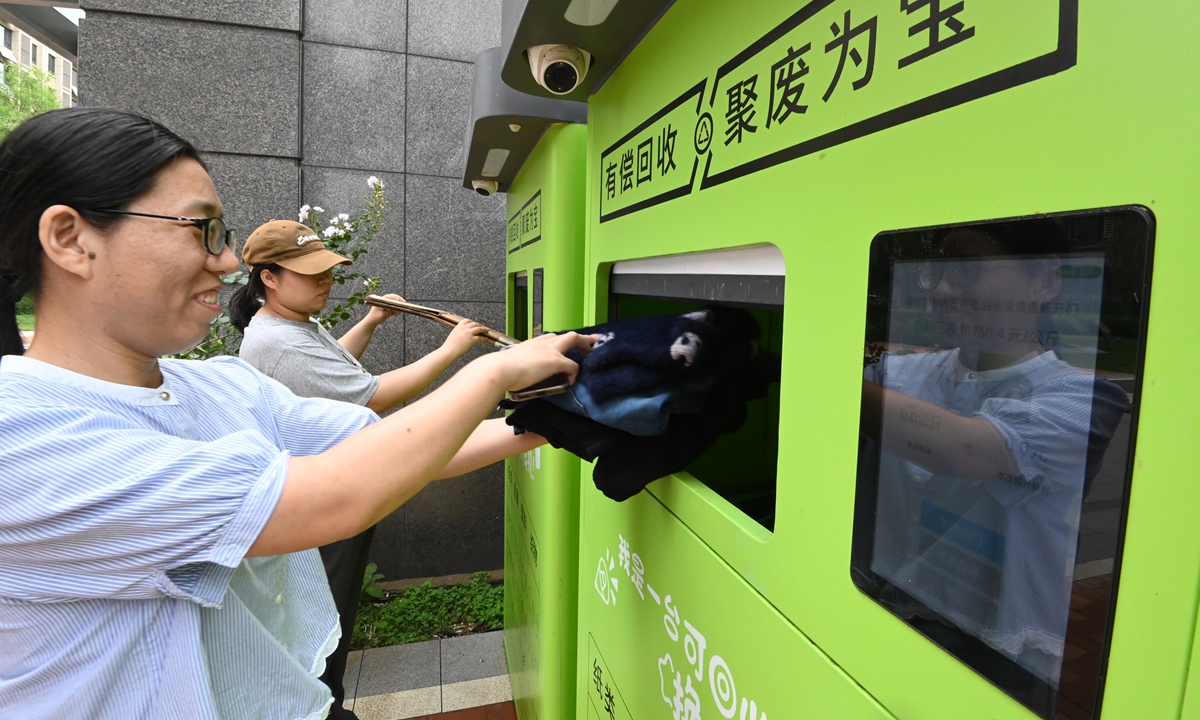
Residents deposit recyclables into smart recycling bins in a residential community of Handan, North China's Hebei Province, on July 29, 2026. Photo: VCG
Chinese answer to a universal urban question
This isn't just happening in China.
From Copenhagen's CopenHill, where a waste-to-energy plant doubles as a ski slope and hiking destination, to Singapore's Tuas Nexus, designed to integrate solid waste and used water treatment while recovering energy and resources, cities around the world are experimenting with ways to make traditionally unpopular infrastructure cleaner, more efficient, and more closely connected to urban life.
Seen in that global context, Xiong'an's underground plant offers a Chinese answer to a universal urban question: Can a city process what people throw away without sacrificing the environment in which they want to live?
Back on the surface, the answer feels tangible. The giant steel claws are still moving underground. Incinerators are still burning. Turbines are still generating electricity. But above them, there is grass, water and a walking path.
Therefore, perhaps the most striking part of Xiong'an's "zero-waste" experiment is not that the city has learned how to make garbage disappear. Instead, the experiment is about making the city's metabolism visible in a different way: Waste becomes energy, ash becomes building material, an industrial facility becomes public green space and infrastructure once associated with pollution becomes part of a neighborhood.
For a world searching for greener forms of urbanization, that transformation may be the more important story hidden beneath the park.