Journey of a single pickup truck shows the value transition of ‘In China, for the world’: Global Times editorial
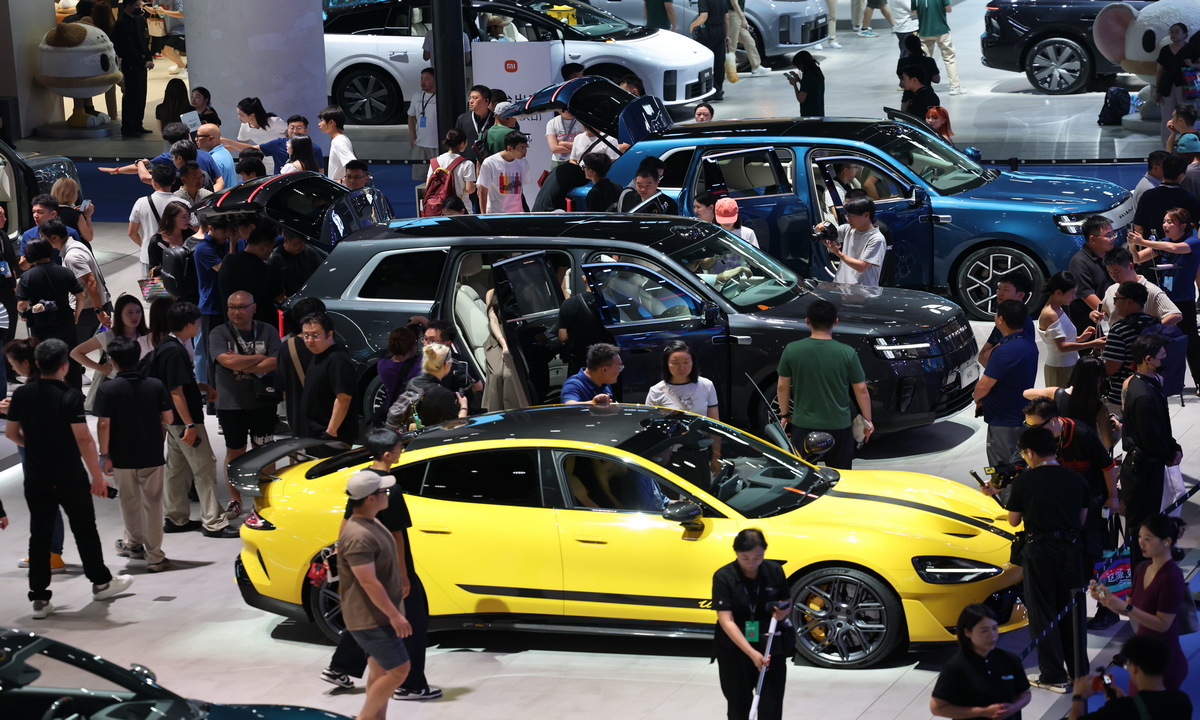
Visitors gather at the 29th Chengdu International Auto Show held at the Western China International Expo City in Chengdu, Southwest China's Sichuan Province, on August 21, 2026. The 10-day fair covers an exhibition area of 220,000 square meters and brought together nearly 120 major domestic and international automobile brands, with about 1,600 vehicles on display. Photo: VCG
The cross-border journey of a single pickup truck breaks the long-standing inertia of technology flowing "from West to East" and mirrors the profound reshaping of the global economic landscape. Today, "In China, for the world" has evolved into its version 2.0, with more products and technologies defined, developed, and manufactured in China serving global markets and helping foreign automakers catch the new wave of opportunities.It was reported that the Frontier Pro, the first model of Nissan designed, developed and manufactured in China for global export, will officially hit the Mexican market this month. It will later be rolled out progressively across Latin America, the Middle East, Australia and other markets. While the Frontier Pro is merely one specific example within the global industrial landscape, it reflects a plain truth: China today is no longer just an assembly line and sales market for multinationals, but also a source of global innovation and a joint creator of value. The phrase "In China, for the World" carries deeper and broader implications amid the high-quality development of China's economy.
Nissan is not an isolated case in the global auto industry. Partnering with China's supply chain to go global amounts to securing a reliable "ticket for the voyage" - a consensus shared by a growing number of foreign automakers. SAIC-GM has extended its joint venture term by 20 years, with the Buick Electra E7 being shipped overseas from China. SAIC Volkswagen renewed its contract six years ahead of schedule and exports multiple vehicle models to Uzbekistan. Changan Mazda leverages its Nanjing plant to ship overseas variants of the EZ-6 to more than 20 countries and regions. China FAW Group, Toyota Motor Corporation and GAC Group, long-standing partners, have signed a new strategic cooperation framework agreement in Guangzhou.
If "manufacturing capability" was one of the draws for foreign enterprises to set up roots in China, then China's "smart manufacturing capacity" gives their industrial upgrading and global footprint an extra boost.
In the past, the mantra of "In China, for China" among major auto giants represented "exchanging technology for market access." The "In China, for the world" version 1.0 simply meant "Made in China, exported to the world." Today, however, "In China, for the world" has evolved into its version 2.0, with more products and technologies defined, developed, and manufactured in China serving global markets and helping foreign automakers catch the new wave of opportunities. This evolution means that the Chinese market has become an "innovation incubator" and "transformation accelerator," with China-foreign automotive cooperation entering a new phase where China's industrial chain feeds back into the global market.
Innovation under the "In China, for the world" framework is not merely about multinationals ramping up investment to tap into China's innovation capability. More importantly, it fosters an "innovation ecosystem" in China where Chinese and foreign firms grow side by side.
China boasts the world's largest new-energy vehicle market, the most complete industrial chain and the largest workforce of R&D personnel. Chinese manufacturing is shifting from "product export" to "technology export," and from "shipping goods overseas" to "exporting industrial ecosystems." It has achieved a historic leap from the one-way cycle of "China supplies, the world consumes" to two-way empowerment through "technology collaboration and ecosystem co-creation."
The old one-way model of "market for technology" has been upgraded into a two-way partnership, with Chinese and foreign sides acting as mutual "technology partners." Modern joint ventures are no longer a simple grafting of production capacity, but instead represent deep integration between accumulated global technological expertise and China's innovative dynamism.
According to statistics released by financial services firm UBS, since 2018, European automakers including Volkswagen, Stellantis, Mercedes-Benz Group and BMW Group have established technology partnerships with at least 38 Chinese companies and research institutions, covering areas such as software, hardware, batteries, and vehicle connectivity.
Nissan has designated China as its global hub for innovation and exports. Volkswagen has built a full design-build-test-validate cycle in Hefei, dubbed "China's Wolfsburg." Renault, Porsche, Kia and others have all made choices aligned with this trend. Multinational automakers are unanimously repositioning China from a "sales destination" to an "R&D cradle" and "global export hub." This is a vote of confidence backed by real capital, and a clear verdict delivered by industrial logic.
Facts have proven that China's new-energy industry never creates a zero-sum game where one side gains at the expense of the other; instead, it offers long-term opportunities for shared growth. The latest figures show that Tesla's Shanghai Gigafactory delivered more than 95,000 vehicles in September, hitting its highest monthly output this year. In the six and a half years since it went into operation, the Shanghai Gigafactory has produced over 4.5 million electric vehicles, accounting for more than 45 percent of Tesla's global output.
China's vast market remains an opportunity for the world. Meanwhile, "international collaboration" and "technological innovation," as fast-growing components of China's development dividends, are being shared by more countries and enterprises across the globe.
The automotive industry epitomizes economic globalization. The cross-border journey of a single pickup truck carries jobs, innovation and future prospects across industrial chains. It breaks the long-standing inertia of technology flowing "from West to East" and mirrors the profound reshaping of the global economic landscape. This new path of "In China, for the world" leads toward a greener, more efficient and inclusive tomorrow. If the world thrives, China will thrive, and if China thrives, the world will be even better. Noises that seek to swim against the tide and erect barriers will ultimately be repelled by irrefutable facts.
RELATED ARTICLES