BRICS Illustration: Chen Xia/GT
Editor's Note:Following the conclusion of the 18th BRICS Summit in New Delhi, India, discussions surrounding the meeting have shown no signs of fading. Meanwhile, China and India, as two major Global South countries, are being closely watched for their bilateral interactions and subsequent actions. Against this backdrop, Global Times (GT) reporter Su Yaxuan interviewed Zorawar Daulet Singh (Singh), co-founder of the NorthCap University and an adjunct fellow at the Institute of Chinese Studies, to discuss the outcomes of the summit and the future development of China-India relations.
GT: What signals has this year's BRICS Summit delivered?
Singh: As global uncertainties, conflicts and unstable economic policies shock the world, BRICS is assuming a significant role in upholding predictability, pragmatic cooperation and durable economic links between its member states and with all other economic actors who believe in these ideas.
With each passing year, it has become increasingly evident who are the guardians of preserving international economic cooperation and which forces are attempting to disrupt the natural tendencies for interdependence among nation states. BRICS is one of the key institutions that seeks to uphold interconnections between diverse economies without the overhang of geopolitical pressure or prejudice.
BRICS has evolved into setting an inclusive agenda for practical cooperation between sovereign states and societies. No other Western or Global South institution plays such a unique role in today's world order.
GT: Amid global economic turbulence and rising protectionism, what role does the BRICS mechanism play?
Singh: As the high-income G7 economies decline in their relative weights in the global economy, the major developing powers of the non-West have become natural pillars to preserve international economic stability. In the past, a slowdown and protectionist policies in the G7 would have quickly led to numerous crises in the Global South and non-Western world. But today we have not witnessed this pattern of one-sided dependence and one-sided vulnerability for the non-West.
The double whammy of protectionism and geopolitical mayhem from the West has been cushioned in its negative impact on the world economy because of the existence of BRICS and the individual resilience of its members. In other words, BRICS has become a stabilizing force. This is quite remarkable and is a reflection of the emerging multipolar age.
GT: In your previous column, you argued that for China and India, "just a thaw is not enough," and that a "modus vivendi" is needed. What would such a modus vivendi look like in practice, and what is the first step to get there?
Singh: A "thaw" by definition is a mere subsiding of a heightened state of tension between states. That has been achieved. India and China can now be more ambitious in their quest to stabilize and transform the relationship. The outcome of this process will unfold over years or even decades. But the intention should be to craft a modus vivendi or an understanding that accounts for real differences as well as common interests and overlapping visions of world order.
From a pure national interest perspective too, a détente is mutually advantageous. For India, the economic advantages and geopolitical peace on its periphery will pave the way for its comprehensive national development. For China, a stable southern periphery, a more purposeful multilateral partner at BRICS, and an India that thinks and acts for itself in the geopolitical realm are tremendous outcomes.
Priorities include resuming a serious conversation on resolving the border dispute, articulating innovative approaches to managing parts of the common neighborhood, including those areas where India and China might have similar interests and anxieties, and removing the subcontinent from future geopolitical contests between other great powers.
There is a unique window of opportunity for China and India to collaborate on stabilizing, reforming and benefiting from the rapidly changing world setting.
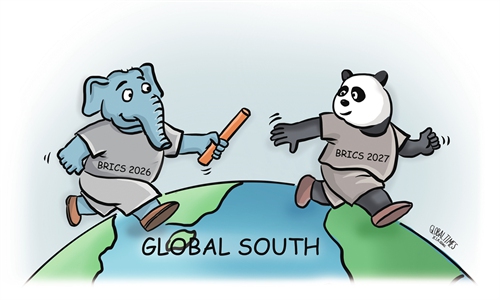
GT: With China having announced that it will succeed India as the BRICS presidency in 2027, in which areas do you think China and India can continue to work together in the year ahead?
Singh: Safeguarding the emerging multipolar age and steering it in a positive and sustainable direction is now a common goal for China and India. Their contributions to this new order will naturally vary given their national capacities and resources, but the benefits of a stable order will flow to both.
The BRICS members, including China and India, are demonstrating the dexterity that a changing world order requires from its future stakeholders. China and India's roles are to cushion the world economy during this phase of turbulence and promote more sophisticated avenues of interdependence that cannot be easily disrupted by other actors. By supplying public goods, China and India can tilt the world balance toward a legitimate concept of order that attracts more and more states.
RELATED ARTICLES