Rebuilt Huanggang Port, world's largest land crossing complex, opens to boost Shenzhen-Hong Kong connectivity
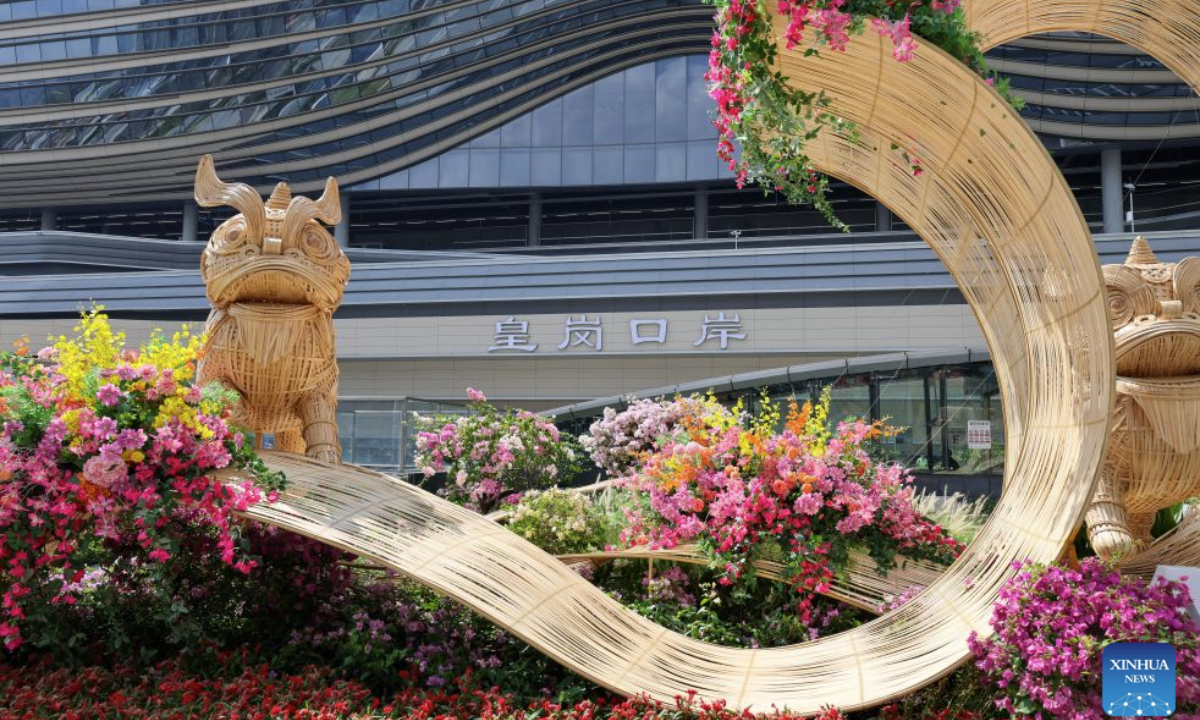
This photo taken on Oct. 11, 2026 shows an exterior view of the Huanggang Port in Shenzhen, south China's Guangdong Province. (Xinhua/Liang Xu)
The rebuilt Huanggang Port, a major 24-hour land passenger crossing between Shenzhen in South China's Guangdong Province and the Hong Kong Special Administrative Region, officially reopened on Monday, marking a significant step toward smoother cross-border travel and closer connectivity across the Guangdong-Hong Kong-Macao Greater Bay Area (GBA).
The port has introduced a new system allowing travelers to complete immigration checks for both Shenzhen and Hong Kong at a single location, streamlining procedures and sharply reducing crossing time. It provides round-the-clock clearance services for passengers and passenger vehicles.
Spanning 689,700 square meters, the rebuilt port is China's largest single-building border crossing facility and the world's largest integrated land port complex, with four underground levels and five above-ground floors. Five rail lines are planned to converge at the complex, the People's Daily reported on Monday.
Huanggang Port is also the first land crossing between Shenzhen and Hong Kong to introduce a new clearance system that allows travelers using automated channels to complete immigration checks on both sides by queuing once, presenting their documents once, and undergoing a single identity check, according to a statement published by the HKSAR Government.
The new system is expected to cut the overall border crossing time from 30 minutes at the former Lok Ma Chau/Huanggang crossing to about five minutes, significantly improving convenience and efficiency for travelers, said the statement.
Dozens of travelers entered Hong Kong within minutes of the port's reopening on Monday, while the first passenger crossing from Hong Kong into Shenzhen completed automated immigration clearance in just 20 seconds, including document scanning and identity verification, according to media reports.
The rebuilt port is designed to handle 200,000 passenger crossings a day, with capacity expected to reach 300,000 on peak days.
“The opening of Huanggang Port will help drive development in surrounding cities by facilitating the flow of people, capital and technology,” said Xue Huaming, an official with the Shenzhen Municipal Government Port Office.
The port is a landmark project in the development of the GBA and the Hetao Shenzhen-Hong Kong Science and Technology Innovation Cooperation Zone, a major cross-border initiative to deepen cooperation in science and technology. It has also been included in a national-level smart port development program.
As a major transport link connecting Shenzhen and Hong Kong with the wider GBA, the rebuilt port is expected to facilitate cross-border travel and strengthen connectivity across the region, analysts said.
The reopening follows a reconstruction project launched at the original site in 2019 to accommodate growing demand for cross-border travel between Shenzhen and Hong Kong. The original Huanggang Port was China's first major land crossing to offer 24-hour immigration clearance.
Since opening in 1989, the port has seen daily passenger traffic climb from several thousand to more than 60,000 at its peak, while daily vehicle crossings have risen from just over 100 to around 10,000. It has served hundreds of millions of cross-border travelers over the decades, reflecting the rapid expansion of exchanges and cooperation between Shenzhen and Hong Kong, according to People's Daily.
China's 15th Five-Year Plan (2026-2030) calls for consolidating and enhancing the driving force role of the Guangdong-Hong Kong-Macao GBA, giving full play to the pioneering role of major cooperation platforms, and accelerating the construction of a world-class bay area.
In a statement on Sunday, the HKSAR Government described the reconstruction as a key project in Hong Kong's efforts to align with national development priorities and better integrate into the country's overall development. It said the reopening marked a major step forward in optimizing border crossing facilities, streamlining immigration procedures and facilitating travel between Shenzhen and Hong Kong.
Speaking at Sunday's opening ceremony, Hong Kong Chief Executive John Lee Ka-chiu said that the port's reopening marked a new milestone in GBA connectivity and demonstrated progress in strengthening infrastructure links, aligning rules and institutional arrangements, and fostering closer people-to-people ties between the Chinese mainland and Hong Kong.
Global Times
RELATED ARTICLES