Hong Kong will continue to get stronger and stronger within GBA over next five years: city business magnate

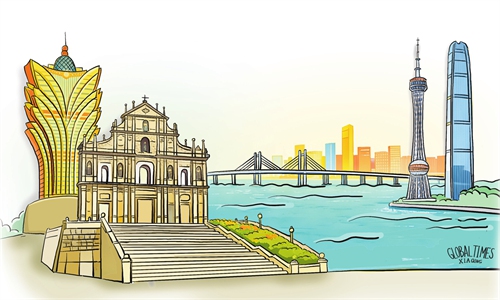
Illustration: Xia Qing/GT
Editor's Note:
The 14th National People's Congress (NPC) concluded its fourth session on Thursday. The country is turning its focus toward the strategic blueprint of the 15th Five-Year Plan (2026-30). Within this vision, the Guangdong-Hong Kong-Macao Greater Bay Area (GBA) is expected to play a greater role as a strategic pivot point of China's new development pattern, a demonstration zone for high-quality development and a leading area for Chinese modernization.
Against this backdrop, the Global Times (GT) launches a commentary series, "GBA: New Voyage." The series includes insights from NPC deputies and Chinese People's Political Consultative Conference (CPPCC) National Committee members and international professionals from Hong Kong and Macao special administrative regions.
In the fifth installment of the series, GT reporter Xia Wenxin discussed a variety of topics, including Hong Kong's future under the 15th Five-Year Plan and the potential growth of the GBA, with Allan Zeman (Zeman), Hong Kong business magnate and chairman of the Lan Kwai Fong Group.
GT: How would you summarize this year's "two sessions"? What discussions or outcomes left the strongest impression on you?
Zeman: Personally, I thought the 15th Five-Year Plan was probably one of the most important plans for China. It places strong emphasis on technology - especially robotics - in the production process, reflecting a continued shift toward higher-quality production. It shows China moving to the next level, building on its export-driven growth based on low-cost goods and continuing the transition toward higher-value sectors such as semiconductors and rare earths.
GT: Chinese lawmakers on Thursday approved the outline of the 15th Five-Year Plan. As a veteran Hong Kong-based entrepreneur and investor, what specific opportunities do you see this plan creating for Hong Kong?
Zeman: I respected everything that the 15th Five-Year Plan came out with. China wants the renminbi to go international, and this gives Hong Kong a chance, because our One Country, Two Systems and our common law system allow us to become an international finance hub for China. The opportunities lie where Hong Kong's traditional strengths in finance and law intersect with the nation's emerging priorities in technology and strategic supply chains.
Besides, based on the directions shown in the 15th Five-Year Plan, Hong Kong has to catch up in technology and biomedical areas. We are changing from just a financial center to being industrial again. The plan also provided opportunities for Hong Kong to be the place to attract "super talent."
The opportunities lie where Hong Kong's traditional strengths in finance and law intersect with the nation's new priorities in technology and strategic supply chains. It's about backing the businesses that can connect mainland innovation with global capital, and building the physical and digital infrastructure to make that connection happen.
GT: The 15th Five-Year Plan mentions consolidating and enhancing the role of the GBA as a "source of growth momentum." In your view, what specific role should Hong Kong play in the GBA's development over the next five years?
Zeman: Many Chinese companies now want to expand into other countries and take the products they have gone public with here into international markets, using Hong Kong as the "go-between." This role as a connector is something that everyone cherishes right now because it opens up new customers, and Hong Kong is uniquely experienced in international law, trademark laws and all these types of regulatory matters. This is an area where the mainland is truly helping Hong Kong, and by the same token, Hong Kong is providing that same support back to the mainland. Consequently, the GBA becomes an incredibly important part of this strategy.
In fact, the GBA is poised to become the No.1 bay area in the world, and its strength will be immense. I believe that over the next five years, because so many top-tier Chinese companies want to go abroad, Hong Kong can grow along with the GBA, and it will continue to get stronger and stronger within the GBA. Hong Kong will take a role in the GBA as the "super connector" and "super value creator" between the East and the West.
GT: This year is also crucial for advancing Hong Kong's first five-year plan. What are your expectations for this?
Zeman: What I'm most looking forward to is the development of the Northern Metropolis - 300 square kilometers of land connected to Shenzhen on the border, where we are setting up AI centers, technology centers and chip manufacturing. This is the most tangible, large-scale opportunity. The Northern Metropolis is where the "South Finance, North I&T" vision becomes a reality. It's a multi-decade investment thesis.
The Hong Kong SAR government has "thrown up the rule book" that used to slow down productivity. It is now allowing developers to speed up development without following all the old regulations. The idea is to build the Northern Metropolis as fast as possible.
In the 15th Five-Year Plan, China is really pushing for the GBA to be a place where everyone is concentrated and working together to make it all happen. These are the developments we are looking at for the next five years. Now, with a new direction, the GBA will provide a lot of land and a lot of new industries, which will really help Hong Kong enjoy a new kind of growth and become part of China's massive industrial engine.
RELATED ARTICLES